

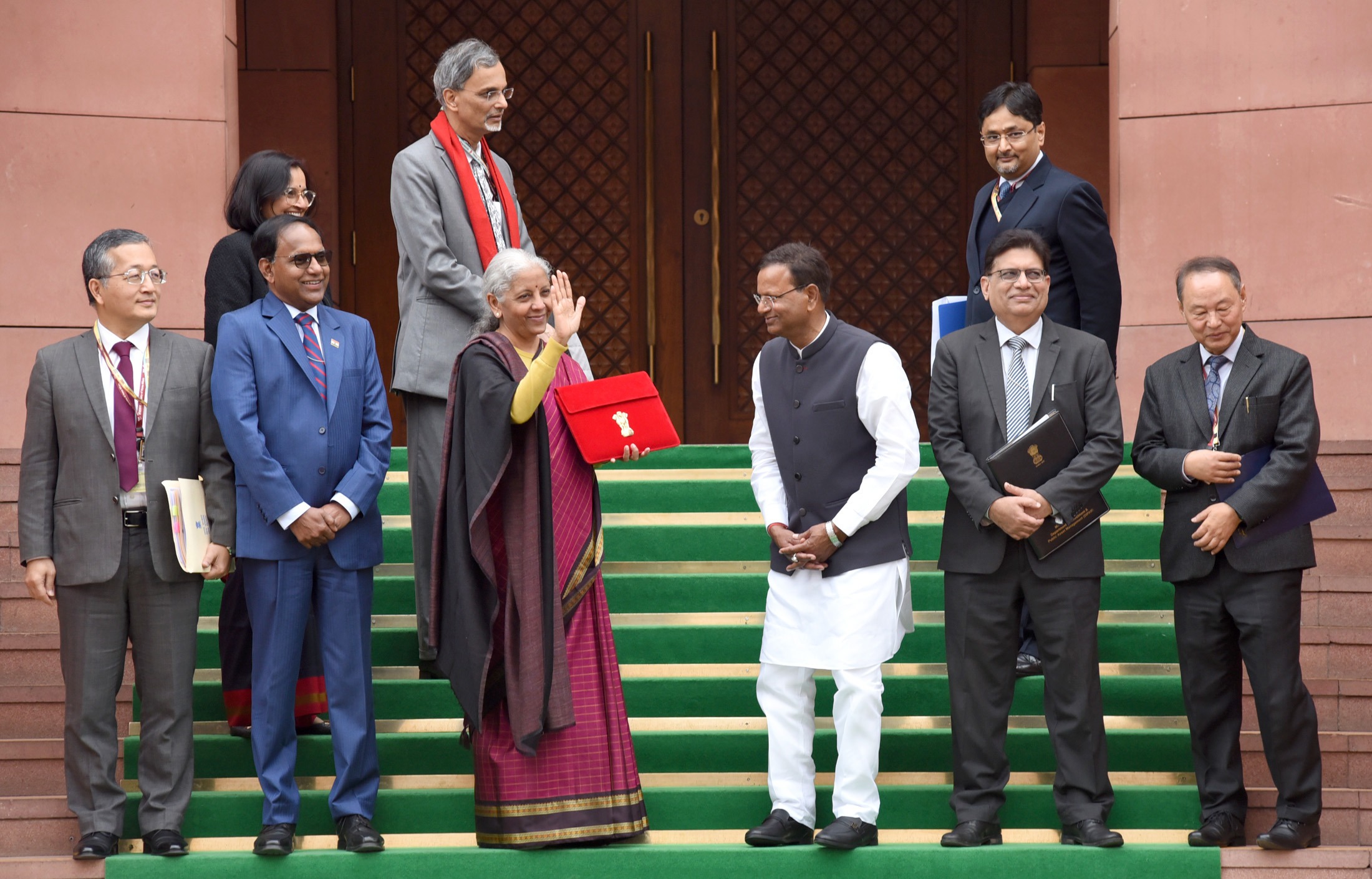
The Union Minister for Finance and Corporate Affairs, Smt. Nirmala Sitharaman along with the Ministers of State for Finance, Pankaj Chaudhary as well as her Budget Team/senior officials at Parliament House
NEW DELHI. Finance Minister Nirmala Sitharaman presented the Union Budget 2026-27 in Parliament today. This is the first budget prepared in Kartavya Bhawan. It is driven by ‘Yuva Shakti’ and focuses on the underprivileged. The Minister outlined three core ‘Kartavyas’ (duties) to guide India’s prosperity. These include sustaining economic growth, fulfilling aspirations, and ensuring inclusive development. The budget balances high-growth ambitions with fiscal discipline.
Direct Tax Reforms in Union Budget 2026-27
A major highlight is the New Income Tax Act, 2025. It will come into effect from April 2026. Union Budget 2026-27 promises simplified tax rules and redesigned forms. The government aims to reduce the multiplicity of legal proceedings. Penalty and prosecution frameworks will be rationalised for easier compliance. Furthermore, the threshold for IT service “safe harbour” has been raised to ₹2,000 crore.
Foreign cloud service providers will receive a tax holiday until 2047. This move aims to attract global data centre investments to India. Additionally, the Securities Transaction Tax (STT) on futures will rise to 0.05 per cent. For individual taxpayers, the overseas tour package TCS stands reduced to 2 per cent. These reforms reflect a shift towards a more transparent and automated tax system.
Infrastructure and Sectoral Growth
The government has enhanced public capex to ₹12.2 lakh crore for FY 2026-27. This is a significant increase from the previous year. The Budget proposes seven new high-speed rail corridors. These “growth connectors” include routes like Mumbai-Pune and Delhi-Varanasi. Moreover, the government will operationalise twenty new National Waterways the next five years. These projects will strengthen India’s logistics and industrial backbone.
For the healthcare sector, the “Biopharma SHAKTI” scheme has an outlay of ₹10,000 crore to boost domestic biologics production. A dedicated ₹10,000 crore SME Growth Fund has also been proposed. This fund will help MSMEs become “future champions” in the global market. To support girl students, every district will get a new hoste . These measures aim to build capacity and promote gender equity in higher education.
Customs Duties and Ease of Doing Business
The Finance Minister proposed significant changes to indirect taxes. Basic customs duty on 17 essential drugs stands exempted. The Budget 2026-27 also reduces the tariff on personal imports from 20 per cent to 10 per cent. Duties on capital goods for Lithium-Ion cell manufacturing have been extended. These steps support the “Make in India” initiative and lower the cost of living.
Customs processes will now feature minimal human intervention. A single digital window for cargo clearance will be ready by the year-end. This is part of a broader effort to improve the Ease of Doing Business. The budget also targets a fiscal deficit of 4.3 per cent of GDP. This path of fiscal consolidation ensures long-term economic stability. India remains committed to becoming a resilient global sourcing hub.
Union Budget 2026-27 provides a roadmap for a ‘Viksit Bharat’. It empowers the youth while protecting the vulnerable. By integrating AI tools like Bharat-VISTAAR in agriculture, the budget embraces technology. The focus remains on sustainable growth and fulfilling the aspirations of 140 crore Indians.
About the Author
