

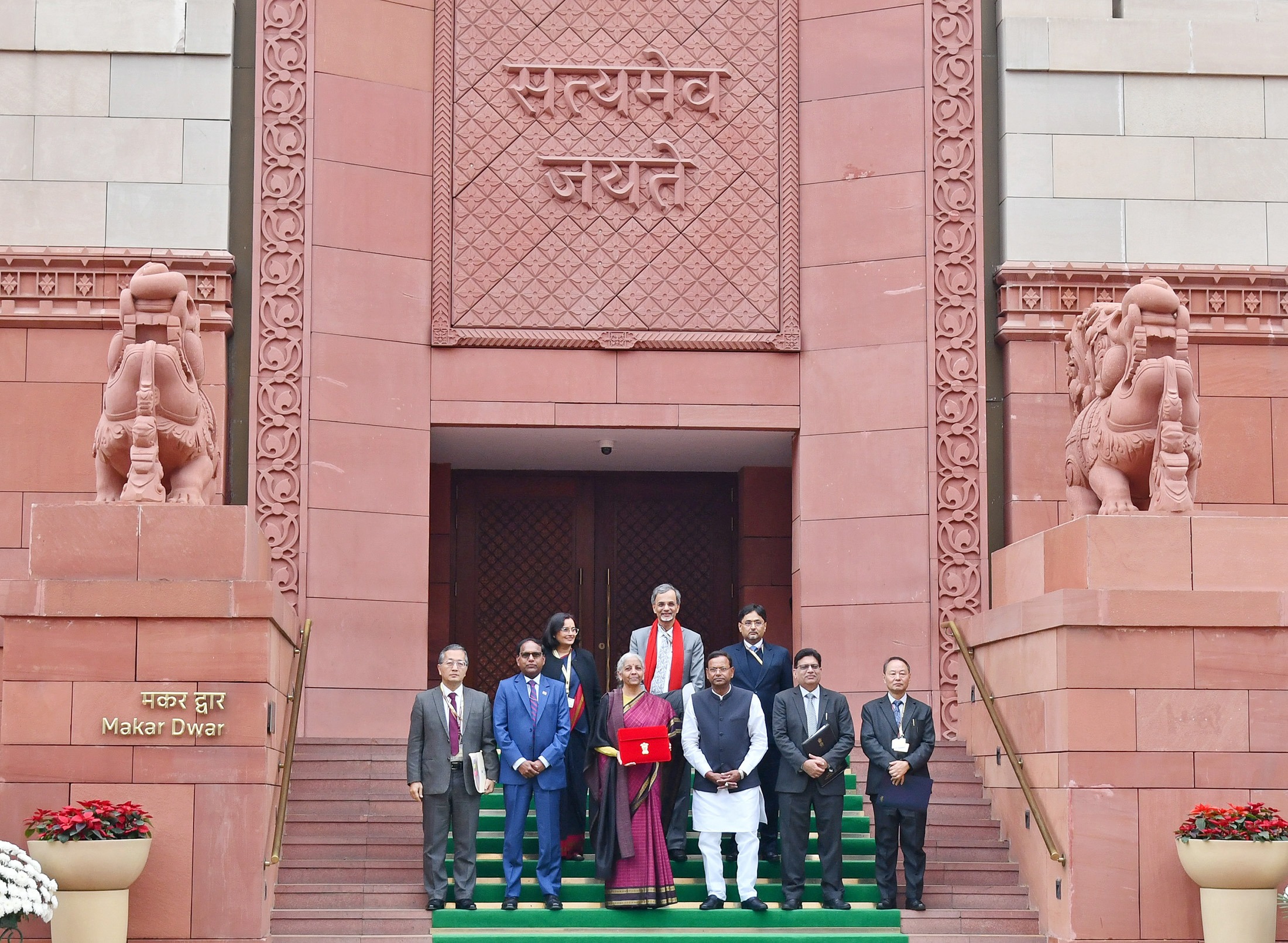
The Union Minister for Finance and Corporate Affairs, Smt. Nirmala Sitharaman along with the Ministers of State for Finance, Pankaj Chaudhary as well as her Budget Team/senior officials at Parliament House
NEW DELHI. The Union Budget 2026-27 estimates present a robust roadmap for fiscal consolidation and high-impact infrastructure spending. The total expenditure for the financial year is projected at ₹53.5 lakh crore, while non-debt receipts are estimated at ₹36.5 lakh crore. The Centre’s net tax receipts are expected to reach ₹28.7 lakh crore. A key highlight is the fiscal deficit target, set at 4.3 per cent of GDP, down from the 4.4 per cent recorded in the revised estimates for 2025-26.
Industrial Growth via Union Budget 2026-27 Estimates
The first ‘Kartavya’ (duty) of the budget focuses on accelerating economic growth through six major interventions. Under the Budget 2026-27 estimates, the manufacturing sector receives a massive boost. The “Biopharma SHAKTI” scheme has been launched with an outlay of ₹10,000 crore over five years. This initiative aims to establish India as a global hub for biologics and biosimilars. Additionally, the India Semiconductor Mission (ISM) 2.0 will be introduced to fortify local supply chains and design full-stack Indian IP.
Furthermore, the Electronics Components Manufacturing Scheme has seen its outlay increased to ₹40,000 crore. To support mineral-rich states like Odisha and Tamil Nadu, dedicated “Rare Earth Corridors” will be established. These corridors will promote domestic mining and processing. The Union Budget 2026-27 estimates also include ₹10,000 crore for a new Container Manufacturing scheme. This will help create a globally competitive ecosystem for logistics.
Infrastructure and Energy Security Projects
Public capital expenditure is set to rise to ₹12.2 lakh crore in the coming fiscal year. The Budget 2026-27 estimates propose several “growth connectors,” including seven high-speed rail corridors. These will link major hubs like Mumbai-Pune and Delhi-Varanasi. To enhance cargo movement, 20 new National Waterways will be operationalised. The government also plans to set up an Infrastructure Risk Guarantee Fund to boost private developer confidence.
In the energy sector, an outlay of ₹20,000 crore has been announced for Carbon Capture Utilization and Storage (CCUS) technologies. This is a vital step toward long-term energy security and Net Zero goals. Furthermore, each City Economic Region (CER) will receive an allocation of ₹5,000 crore over five years. These funds will be awarded through a challenge mode to encourage urban reforms and result-oriented financing.
Social Welfare and Education Initiatives
The second and third ‘Kartavyas’ focus on fulfilling aspirations and inclusive development. The Budget estimates include the establishment of five Regional Medical Hubs to promote medical tourism. The government also aims to add 100,000 Allied Health Professionals over the next five years. To support women in STEM, a girls’ hostel will be established in every district across the country.
Additionally, the Bharat-VISTAAR multilingual AI tool will be launched to support farmers with customised advisory services. The Budget 2026-27 estimates also prioritise mental health with the setting up of NIMHANS-2 in North India. For the North-Eastern region, a new scheme for the development of Buddhist Circuits will be launched. These targeted efforts ensure that the benefits of growth reach every community and region in India.
Union Budget 2026-27 estimates reflect a balanced approach to nation-building. By combining aggressive infrastructure spending with fiscal prudence, the government aims to sustain India’s position as a global economic leader.
About the Author
