

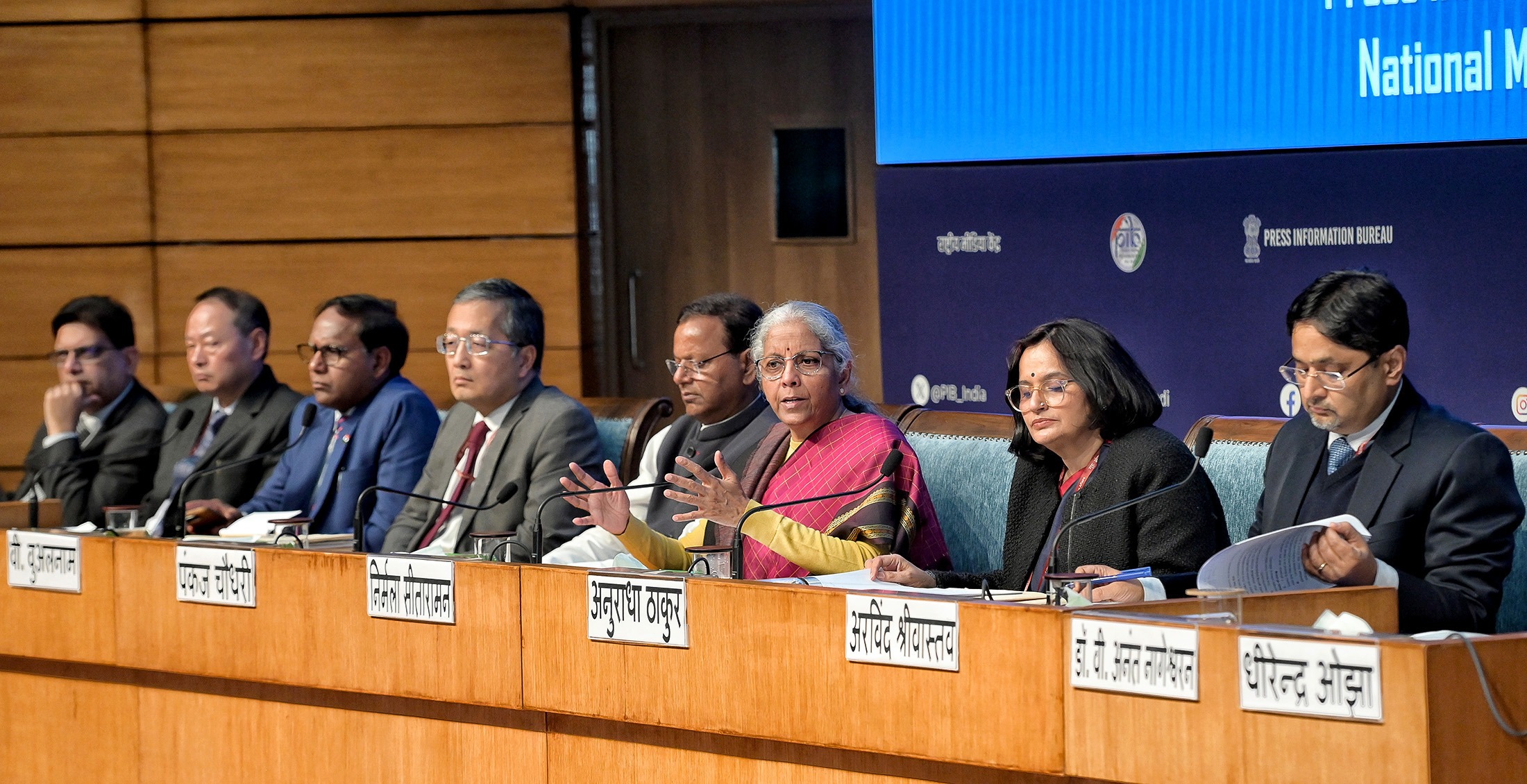
The Union Minister for Finance and Corporate Affairs, Smt. Nirmala Sitharaman, addressing a post-Budget press conference at the National Media Centre, in New Delhi
NEW DELHI. Finance Minister Nirmala Sitharaman has provided a comprehensive Budget 2026-27 manufacturing boost. This initiative focuses on scaling up production across seven strategic and frontier sectors. A central pillar of this plan is “Biopharma SHAKTI,” which has an outlay of ₹10,000 crore over five years. The scheme aims to establish India as a global hub for biologics. It includes upgrading seven NIPERs and creating 1,000 accredited clinical trial sites. These measures will ensure India meets global standards for drug approval and production.
Budget 2026-27 Manufacturing Boost Spurs High-Tech Growth
The electronics and semiconductor sectors are major beneficiaries of this vision. The Union Budget introduces India Semiconductor Mission (ISM) 2.0 which will focus on producing equipment, materials, and full-stack Indian IP. Furthermore, the outlay for the Electronics Components Manufacturing Scheme stands nearly doubled to ₹40,000 crore. To secure essential raw materials, the government will establish dedicated “Rare Earth Corridors” in states like Odisha and Kerala. Significantly, these corridors will promote mining and research for permanent magnets and critical minerals.
Additionally, the government intends to strengthen capital goods capability. The budget proposes the creation of Hi-Tech Tool Rooms at two locations to manufacture high-precision components. The Budget also announced a new scheme for Container Manufacturing with a ₹10,000 crore allocation. It will help India build a globally competitive logistics ecosystem. For the chemicals sector, the government will support three dedicated Chemical Parks through a cluster-based “plug-and-play” model. These efforts aim to reduce import dependency and enhance domestic productivity.
Revitalising Textiles and Sports Manufacturing
The labour-intensive textile sector will see an integrated programme with five sub-parts. This includes the National Fibre Scheme for self-reliance in natural and man-made fibres. The Union Budget 2026-27 manufacturing boost also proposes Mega Textile Parks to be set up in challenge mode. Furthermore, the “Mahatma Gandhi Gram Swaraj” initiative will strengthen khadi and handloom through global branding. To promote health and innovation, the FM also proposed a dedicated initiative for sports goods. This will focus on research in material sciences and advanced equipment design.
Customs Reforms for Energy and Aviation
The Finance Minister also proposed significant changes to the customs tariff structure. These changes aim to support domestic manufacturing and ensure energy security. Pertinently, Basic customs duty (BCD) exemptions for Lithium-Ion cell manufacturing have been extended to include energy storage systems. For the solar sector, BCD on sodium antimonate for solar glass is now exempted. The nuclear energy sector also received a boost, with exemptions for goods required for nuclear power projects extended until 2035.
In the aviation sector, BCD on components for civilian and training aircraft stands exempted. This also applies to raw materials used for maintenance, repair, and overhaul (MRO) in the defence sector. To support local trade, units in Special Economic Zones (SEZs) can now sell to the Domestic Tariff Area at concessional rates. These reforms, combined with the Budget 2026-27 manufacturing boost, seek to make India a competitive global manufacturing destination.
About the Author
