

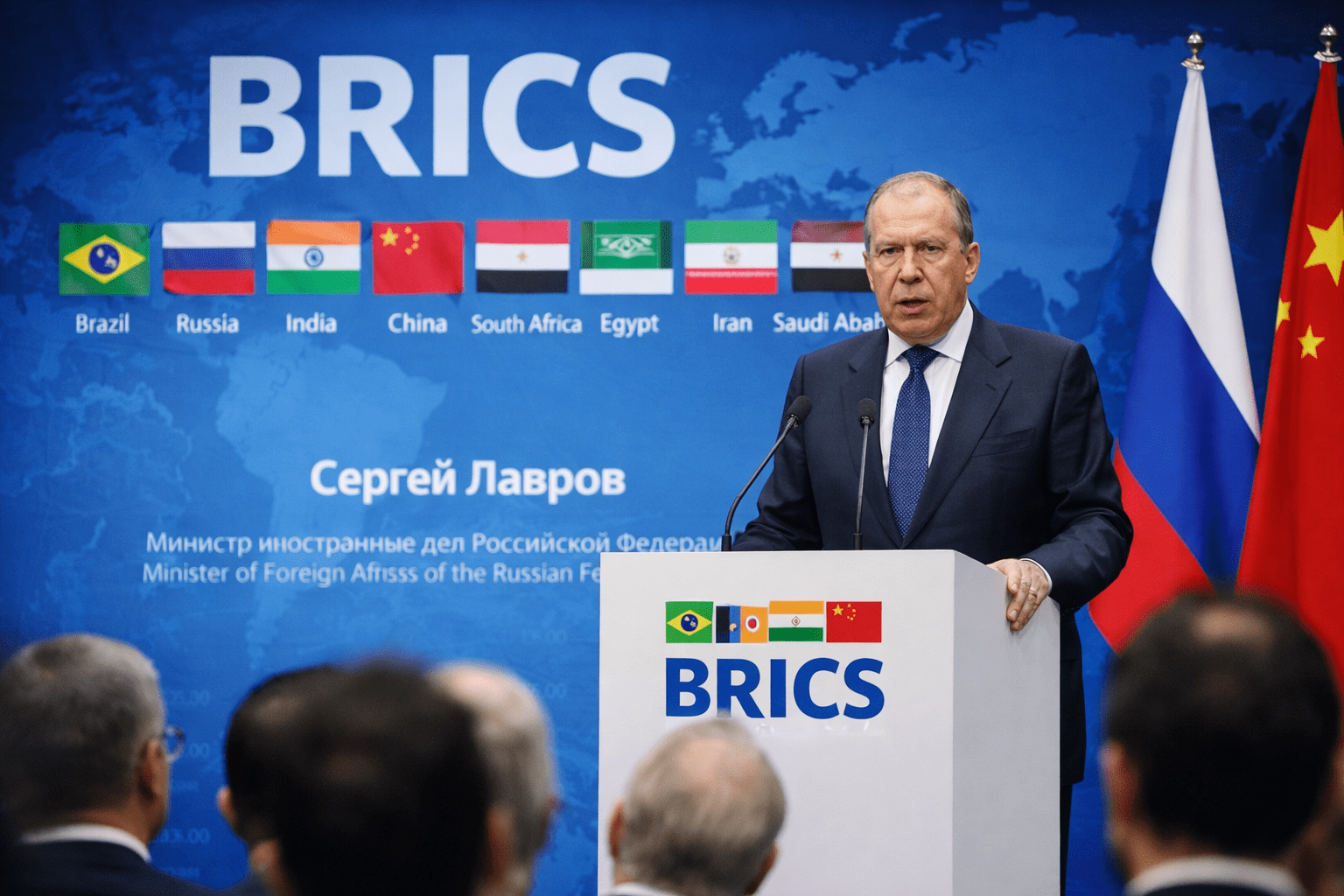
 MOSCOW. Russian Foreign Minister Sergey Lavrov today outlined the evolving global role of the BRICS bloc as it prepares for India’s 2026 BRICS Chairmanship. Notably, he emphasized that the group has become a primary pillar of a more equitable and multipolar international system. Speaking at a diplomatic forum, Lavrov explained that the expansion of the alliance reflects the growing influence of the Global South. Furthermore, he noted that the group now represents a significant portion of global economic output and population. Consequently, the member states remain committed to reforming international institutions to better reflect modern realities.
Strategic Priorities for India’s 2026 BRICS Chairmanship
Moreover, the Russian Foreign Minister identified several key focus areas for the upcoming year. Specifically, he highlighted the importance of enhancing financial sovereignty through the use of local currencies in trade. Because of the increasing use of unilateral sanctions, the bloc is developing an independent payment system to ensure economic stability. Similarly, India’s 2026 BRICS Chairmanship will likely prioritize digital cooperation and the protection of technological sovereignty. Therefore, the member nations will work together to build secure digital infrastructures that are not dependent on Western platforms.
In addition, Lavrov discussed the potential for further institutional growth. To support this, the bloc is refining the criteria for new “partner countries” to join its ranks. Since many nations in Africa, Asia, and Latin America have expressed interest, the group must manage this expansion carefully to maintain its efficiency. Furthermore, the India’s 2026 BRICS Chairmanship will facilitate deeper cooperation in energy security and agricultural trade. Thus, these strategic efforts aim to create a self-sustaining economic ecosystem among the member states.
Diplomatic Collaboration and Multilateral Reform Goals
Beyond economics, the foreign minister underscored a shared commitment to a just global security architecture. Specifically, the two nations agreed to coordinate their positions on major international issues at the United Nations. Furthermore, India and Russia continue to advocate for the reform of the United Nations Security Council to include more voices from developing regions. Meanwhile, both leaders expressed concern over the politicisation of international trade and climate finance. Consequently, they reaffirmed the importance of adhering to international law and mutual respect.
On the other hand, the bloc addressed the challenges of food and energy security. Specifically, they agreed to enhance logistics and supply chain resilience between member states. Since maritime safety is vital for global trade, the India’s 2026 BRICS Chairmanship will also include discussions on securing vital sea lanes. Furthermore, the leaders committed to a regular dialogue on counter-terrorism and intelligence sharing. Additionally, the group will provide specialised support for developing nations to achieve their sustainable development goals without external interference.
Cultural Exchange and Shared Prosperity Projections
Finally, the dialogue focused on the deep-rooted cultural and educational ties within the alliance. For instance, the member states are planning to expand the BRICS Network University to foster academic collaboration. Moreover, the leaders discussed ways to simplify travel for scientists and cultural experts. Regarding trade, the India’s 2026 BRICS Chairmanship results suggest a renewed focus on direct investment in high-tech industries. Consequently, this move will reduce the technological gap between developed and developing nations.
In summary, the transition towards India’s 2026 BRICS Chairmanship signifies a period of consolidation and strategic growth. With a focus on future-ready sectors like digital finance and sustainable energy, the bloc is poised for a new era of global influence. Therefore, the partnership will continue to serve as a stabilizing force in a rapidly changing world order.
BRICS Strategic Outlook
|
Area |
Key Priority |
|---|---|
|
Chairmanship |
India to lead the bloc in 2026. |
|
Finance |
Development of local currency payment systems. |
|
Diplomacy |
Focus on multipolarity and Global South representation. |
|
Tech |
Joint initiatives for AI and digital sovereignty. |
About the Author
