

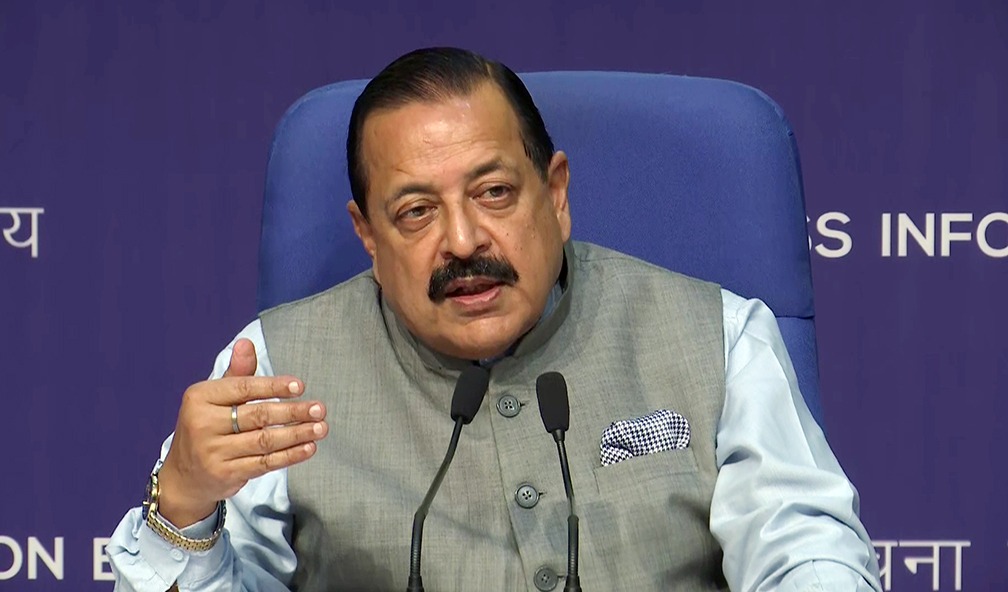
File pic
NEW DELHI. India’s space sector is positioned for an unprecedented phase of commercial expansion over the coming decade. Union Minister Jitendra Singh announced that India’s space economy is expected to expand to about 45 billion dollars over the next seven to eight years. The domestic space industry is currently valued close to 9 billion dollars. Speaking during a media interaction, the Minister reflected on the extensive socio-economic achievements of the Modi administration over the last 12 years. Singh attributed this rapid industrial scaling to pivotal policy reforms that opened the sector to private participation. These strategic policy updates have successfully attracted substantial commercial investments into the domestic aerospace landscape.
Exponential Growth in the Space Startup Ecosystem
The relaxation of entry barriers has triggered an extraordinary wave of local technological entrepreneurship across the country. Singh stated that the national space startup ecosystem has grown to around 400 operational entities today. This massive network contrasts sharply with the single-digit number of startups registered just a few years ago. The Minister emphasized that these new enterprises drive innovation in satellite manufacturing, launch vehicles, and geospatial analytics. This expansion further strengthens the long-term projections driving India’s space economy forward. The government remains committed to supporting these young tech firms through structured incubation programmes and infrastructure access.
Changing Mindsets and Democratisation of Opportunity
The Minister identified a profound shift in the national collective mindset as a core hallmark of recent governance. This transformation manifests visibly in changing demographics across elite national institutions, including the civil services. Singh noted that a growing number of civil services toppers now emerge from small towns and non-metropolitan backgrounds. This geographic diversification reflects the true democratisation of opportunity across the country. The state achieved this equity by leveraging transparent digital technologies and ensuring fair market competition. These foundational societal shifts help cultivate a highly aspirational workforce ready to support India’s space economy.
Inspiring Future Generations Through Space Exploration
The country’s recent cosmic milestones have permanently altered public engagement with advanced core sciences. Singh noted that the successful landing near the Moon’s south pole has dramatically strengthened public interest in scientific disciplines. This historical lunar triumph has turned complex space research into a mainstream career aspiration for young students. Educational institutions report a notable surge in enrollments across aerospace engineering and astrophysics streams nationwide. Nurturing this domestic pool of talent ensures a sustainable pipeline of expertise to manage advanced satellite networks. Consequently, this deep-rooted public interest provides a massive intellectual anchor for the growth of India’s space economy.
India’s Space Sector Progress & Growth Outlook
| Operational Parameter | Current Status / Metric | Future Projections (7-8 Years) |
| Sector Valuation | Close to 9 Billion Dollars. | India’s space economy at 45 Billion Dollars. |
| Startup Ecosystem | Around 400 Active Startups. | Expected to double with deep-tech funding. |
| Primary Catalyst | Sector liberalisation and private entry. | Commercial launch services and data analytics. |
| Key Scientific Achievement | Successful Moon South Pole Landing. | Planned interplanetary and crewed missions. |
| Socio-Economic Trend | Toppers emerging from non-metro areas. | Nationwide democratisation via digital access. |
| Governance Hallmark | Transparency and fair competition. | Streamlined single-window clearings for aerospace. |
About the Author
