

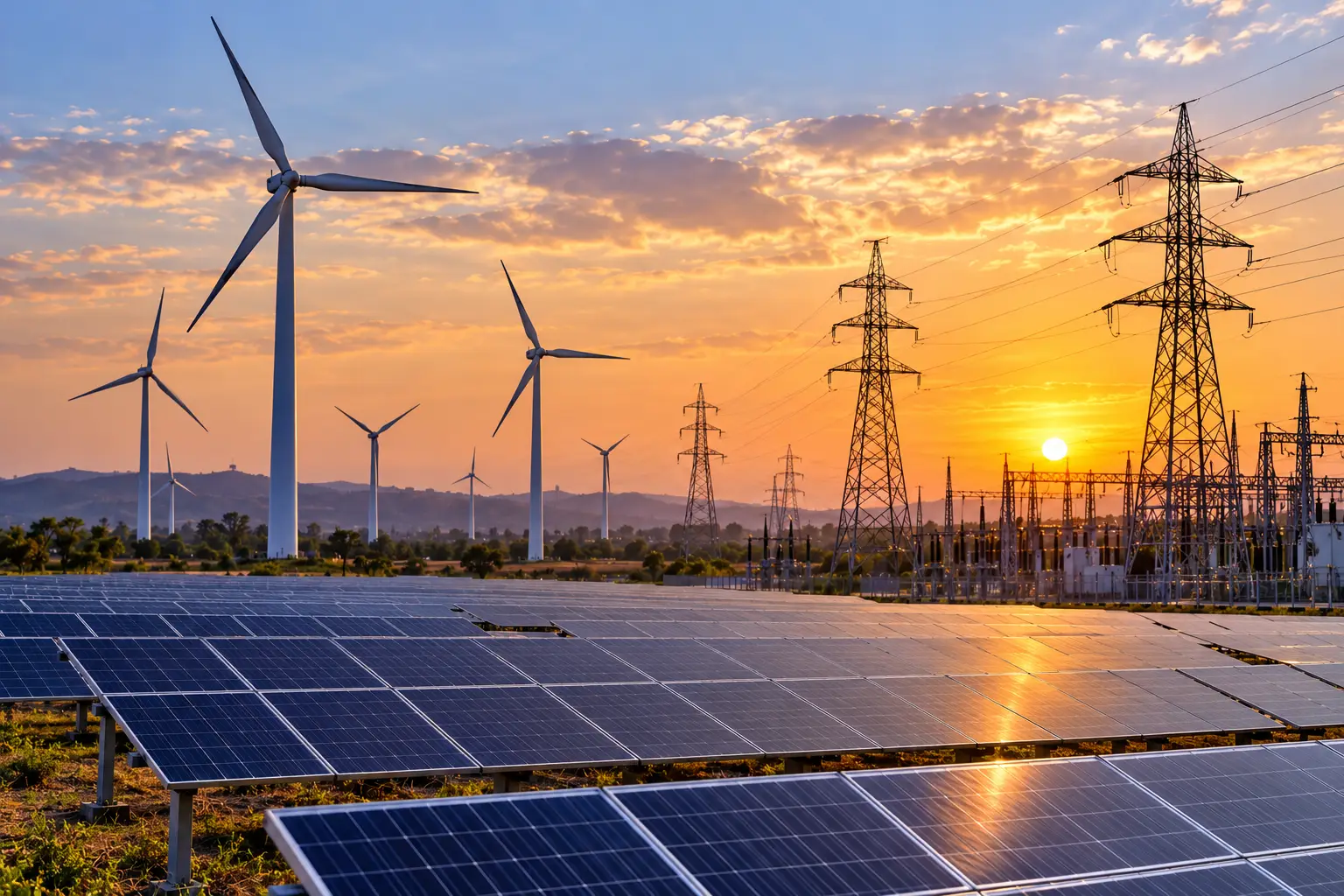
India curtailed 378.52 million units (MUs) of variable renewable energy in September 2026. Grid integration challenges continued to limit the use of available solar and wind power, according to JMK Research. The curtailed electricity accounted for 1.28% of total renewable energy generation.
The curtailment affected 118.6 GW of renewable energy capacity during the month. Solar accounted for 96.9 GW, while wind represented 21.7 GW. These figures refer to the capacity affected by curtailment, not the volume of electricity lost.
Solar power contributed around 314 MUs of curtailed electricity, representing approximately 83% of the total. Wind curtailment stood at 64.98 MUs. Wind’s share of total curtailment rose from 4.7% in September 2025 to 17% in September 2026. Its curtailed energy volume nearly tripled over the year.
Overall renewable energy curtailment fell 43.31% from August and remained 24% below September 2025 levels. The share of renewable generation curtailed also declined from 1.89% in August to 1.28% in September. JMK Research cautioned that this improvement reflected seasonal relief rather than a lasting solution to grid integration challenges.
The pressure on India’s power system had increased earlier in the year. Renewable energy curtailment between May and August 2026 reached nearly four times the level recorded during the same period in 2025. Curtailment peaked at 1,166.52 MUs in July. Monthly levels had remained below 50 MUs between December and February.
India added around 44.6 GW of solar capacity in FY2026. This expansion has increased the need for stronger transmission infrastructure and greater flexibility in grid operations. Solar and wind generation can be high when electricity demand is relatively moderate. Without adequate transmission, storage and balancing capacity, some available power cannot be used.
JMK Research identified demand-generation mismatches, transmission constraints, inadequate storage and limited grid flexibility as key reasons for curtailment. Seasonal variations can also create an overlap between high renewable output and lower demand.
Grid-India data shows that power system balancing accounted for a major share of September’s curtailed electricity. Real-time system constraints led to the curtailment of 146.73 MUs, or 39% of the total. Emergency Tertiary Reserve Ancillary Services Down, known as TRAS Down, accounted for 231.79 MUs, representing 61%.
TRAS Down requires generators to reduce output to help balance electricity supply and demand. Solar power accounted for approximately 82% of the energy curtailed through this mechanism. The figures indicate that balancing requirements played a larger role than transmission congestion alone during September.
The impact was concentrated in Gujarat and Rajasthan. Together, the two states accounted for nearly 79% of India’s renewable energy curtailment during the month.
Gujarat recorded 187.76 MUs, representing 49.6% of the national total. Rajasthan accounted for 110 MUs, or 29.1%. Gujarat contributed approximately two-thirds of India’s wind curtailment, at 43.75 MUs. Rajasthan’s reported curtailment came entirely from solar power.
Karnataka recorded 21.07 MUs of curtailment, with solar accounting for the larger share. Tamil Nadu reported 12.93 MUs, with wind contributing more significantly. The concentration in Gujarat and
Rajasthan points to the need for targeted solutions alongside wider improvements in grid flexibility.
Battery energy storage systems could help absorb surplus renewable electricity. Batteries can store power when solar and wind output is high and demand is low. The stored energy can then be supplied during evening peaks or other periods of stronger demand.
September’s curtailed electricity averaged approximately 12.6 GWh per day. JMK Research estimated that this volume was equivalent in scale to around 3 GW of four-hour battery storage capacity. This is an illustrative comparison rather than a direct estimate of the storage required. Actual requirements would depend on when and where surplus power occurs and how long it lasts.
Gujarat and Rajasthan could be priority locations for storage deployment because of their high curtailment levels. Battery systems located alongside renewable energy projects could absorb recurring surpluses and respond to instructions from grid operators.
Storage alone, however, cannot resolve every constraint. Transmission upgrades, flexible thermal generation and better renewable energy forecasting would also be necessary. Demand shifting and electricity markets that reward flexibility could further improve the use of available clean power.
India’s expanding renewable energy capacity makes grid readiness increasingly important. Adding solar and wind installations does not automatically translate into an equivalent increase in usable electricity. The power system must also transport, balance and store energy when generation exceeds immediate demand.
Reducing renewable energy curtailment will therefore require coordinated investment in generation, transmission and storage. The effectiveness of these measures will determine how much of India’s growing clean electricity supply can reach consumers and contribute to the country’s energy transition.
About the Author
