

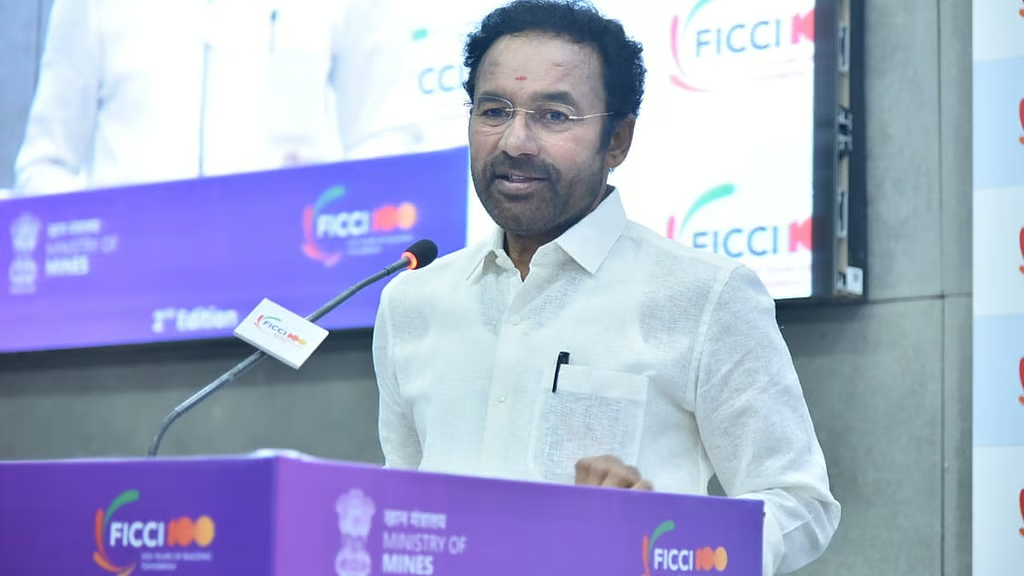
Union Minister G Kishan Reddy addressing the FICCI summit in New Delhi
NEW DELHI. The Union Minister for Mines, G Kishan Reddy, has announced that the government has identified four states to host specialised industrial facilities for value addition. Notably, the initiative for critical mineral processing aims to establish units in Andhra Pradesh, Odisha, Maharashtra, and Gujarat. Minister Reddy made the statement while addressing the Federation of Indian Chambers of Commerce and Industry (FICCI) summit on the country’s critical minerals landscape. During the event, he explained that these states were selected due to their strategic locations and existing industrial infrastructure. Furthermore, he noted that the Ministry of Mines (MoM) is prioritising these regions to create a robust domestic supply chain. Consequently, this development underscores the government’s commitment to mineral security.
Strategic Roadmap and Critical Mineral Processing
Moreover, the Minister highlighted that the primary objective is to reduce the nation’s reliance on imported refined minerals. Specifically, the identified facilities for critical mineral processing in the four states will focus on high-priority elements like Lithium, Cobalt, and Rare Earth Elements (REE). Because these minerals are essential for high-tech manufacturing, Reddy asserted that domestic refining is a prerequisite for the “Atmanirbhar Bharat” vision. Similarly, the Geological Survey of India (GSI) has been tasked with accelerating exploration to provide the necessary raw materials for these upcoming units. Therefore, these strategic interventions ensure that India can mitigate global supply chain disruptions.
In addition, the FICCI summit served as a platform to discuss the technological requirements for complex refining. To support this, the expansion of critical mineral processing capabilities will involve collaboration between the public sector and private industry players. Since the nation aims to be a global leader in the green energy transition, the Minister noted that processed minerals are vital for the production of electric vehicle batteries. Furthermore, the authorities committed to providing a transparent regulatory framework to encourage ease of doing business in the mining sector. Thus, these efforts reflect a coordinated approach to building a “Viksit Bharat” through mineral sovereignty.
Economic Impact on GDP and Industry
Beyond industrial gains, the Minister addressed the role of the mining sector in driving national economic output. Specifically, the roadmap for critical mineral processing involves leveraging the logistical strengths of coastal states like Gujarat and Andhra Pradesh. Furthermore, Reddy stated that the value addition occurring within these states will contribute significantly to the national Gross Domestic Product (GDP). Meanwhile, industry experts at the FICCI summit expressed that the availability of locally refined minerals would lower the input costs for the domestic semiconductor industry. Consequently, the government has encouraged a transparent dialogue with international partners to secure the latest refining technologies.
On the other hand, the success of this transition depends on the speed of implementation at the state level. Specifically, the establishment of critical mineral processing units is expected to create thousands of specialised employment opportunities in Odisha and Maharashtra. Since India contributes a significant portion of the world’s technical talent, the trajectory of its mineral policy is being watched closely by global investors. Furthermore, the GSI continues to identify new mineral blocks to ensure a steady pipeline for the auction process. Additionally, the Ministry of Finance will monitor the fiscal impact of these developments on the overall GDP and the trade balance.
Future Projections and Mineral Security
Finally, the Minister stated that the current decade will define India’s position in the global critical mineral value chain. For instance, the transition toward indigenous refining is expected to play a critical role in achieving net-zero targets by 2070. Moreover, he expressed confidence that the focus on critical mineral processing will act as a catalyst for the “Make in India” initiative in the aerospace and electronics sectors. Regarding long-term goals, he believes that the synergy between the MoM and industry bodies like FICCI will foster a more technologically advanced nation. Consequently, this move will likely redefine the global mineral narrative for years to come.
Minister G Kishan Reddy’s address at the FICCI summit provides a clear direction for the country’s mineral future. With a focus on domestic refining, strategic state partnerships, and value addition, the nation is set to lead the global mineral narrative. Therefore, these strategic initiatives will continue to drive the social and economic evolution of the mining sector.
FICCI Summit Mineral Insights
| Parameter | Detail / Attribution |
|---|---|
| Leading Authority | G Kishan Reddy, Union Minister for Mines. |
| Event Context | FICCI Summit on India’s Critical Minerals Landscape. |
| Identified States | Andhra Pradesh, Odisha, Maharashtra, and Gujarat. |
| Main Objective | Enhancing critical mineral processing and value addition. |
| Key Agencies | Ministry of Mines (MoM) and GSI. |
| Economic Target | Boosting GDP and reducing import dependency. |
About the Author
