
India’s electronics manufacturing sector has recorded significant expansion over the past 11 years. The growth has strengthened India’s position in the global electronics value chain.
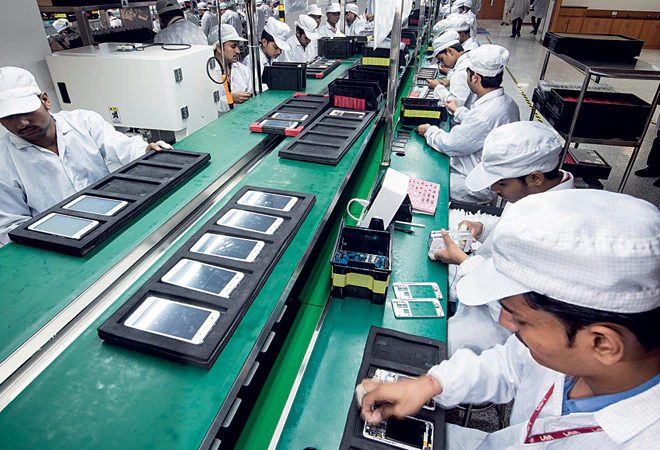
India has now emerged as the world’s second-largest mobile phone manufacturer.
The sector has witnessed sharp increases in production and exports.
Union Minister of State for Electronics and Information Technology Jitin Prasada shared these details.
He provided the information in a written reply in the Rajya Sabha.
The minister said policy-led initiatives have driven the sector’s growth.
Make in India and Atmanirbhar Bharat programmes have played a central role.
Government data shows strong growth in overall electronics production.
Production value rose nearly six times over the past decade.
It increased from about ₹1.9 lakh crore in 2014–15.
Production reached nearly ₹11.3 lakh crore in 2024–25.
Electronics exports also recorded substantial growth during the period.
Export value rose more than eight times.
Exports increased from around ₹0.38 lakh crore in 2014–15.
They reached nearly ₹3.3 lakh crore in 2024–25.
Mobile phone manufacturing has seen the most notable expansion.
Mobile phone production rose sharply during the 11-year period.
Production increased from about ₹0.18 lakh crore in 2014–15.
It reached approximately ₹5.5 lakh crore in 2024–25.
This marked a 28-fold increase in mobile phone production.
Mobile phone exports grew even faster during the same period.
Exports expanded from around ₹0.01 lakh crore in 2014–15.
They climbed to nearly ₹2 lakh crore in 2024–25.
This represented a 127-fold increase in mobile phone exports.
India has now become a net exporter of mobile phones.
This marks a reversal from India’s importer status in 2014.
The minister attributed much of this growth to the PLI scheme.
The Production Linked Incentive scheme for Large Scale Electronics Manufacturing launched in 2020.
The scheme aimed to boost domestic mobile phone production.
Under the scheme, mobile phone output more than doubled.
Production rose from ₹2.14 lakh crore in FY 2019–20.
It increased to ₹5.5 lakh crore in FY 2024–25.
Mobile phone exports rose nearly eight times during this period.
As of December 2025, the scheme attracted significant investment.
Investments under the scheme reached ₹15,172 crore.
The scheme also generated 1,71,448 additional jobs.
The government expanded support through PLI 2.0 for IT hardware.
The scheme launched in 2023 covers laptops and servers.
It also includes tablets and related hardware products.
Till December 2025, the scheme delivered notable outcomes.
Cumulative production reached ₹16,531 crore.
Investments amounted to ₹856.64 crore.
The scheme generated 4,776 direct jobs.
Year-wise data showed steady growth under PLI schemes.
Cumulative production rose from ₹4.95 lakh crore in FY 2023–24.
It increased to ₹10.39 lakh crore by December 2025.
The government has also implemented complementary initiatives.
These include the SPECS and EMC programmes.
The Semicon India Programme supports semiconductor manufacturing.
Additional support includes public procurement preferences.
Tariff rationalisation and customs duty exemptions have aided manufacturers.
The government allows 100 percent FDI in electronics manufacturing.
The minister said these measures strengthened India’s manufacturing ecosystem.
They helped establish India as a trusted global electronics hub.
India’s role in international electronics supply chains continues to expand.
About the Author