

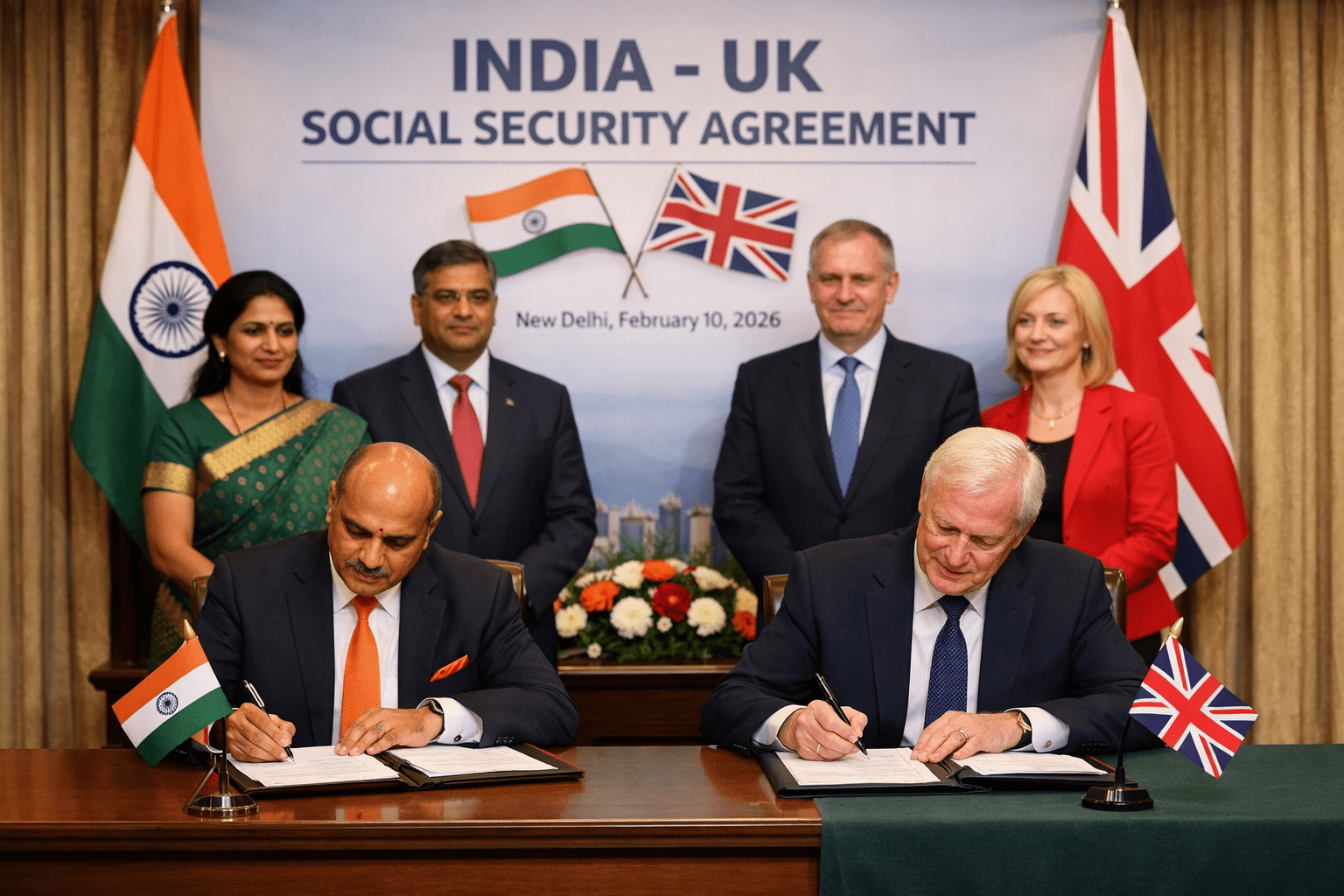
Officials signing the India-UK social security agreement in New Delhi
NEW DELHI. India and the United Kingdom have officially signed a Memorandum of Understanding (MoU) to protect employees on short-term assignments. Notably, the India-UK social security agreement aims to streamline the payment of social security contributions for cross-border workers. During the signing ceremony, officials explained that this pact addresses long-standing concerns regarding double taxation of social security. Furthermore, the agreement ensures that professionals do not lose their benefits while moving between the two nations. Consequently, this development marks a significant step forward in strengthening the bilateral economic partnership.
India-UK Social Security Agreement: Operational Benefits
Moreover, the new framework provides much-needed clarity for companies operating in both jurisdictions. Specifically, the India-UK social security agreement allows employees on short-term assignments to remain covered by their home country’s social security system. Because of this provision, workers will no longer have to pay mandatory contributions in the host country for limited durations. Similarly, this measure reduces the financial burden on Indian professionals working in the United Kingdom. Therefore, the agreement significantly improves the cost-efficiency of international projects.
In addition, the pact simplifies the administrative process for human resource departments. To support this, both governments will implement a digital certification system to verify the status of assigned employees. Since the mobility of high-skilled labour is vital for the technology sector, the India-UK agreement will likely boost productivity in the Information Technology (IT) industry. Furthermore, the leaders committed to a regular review of the operational guidelines to ensure smooth implementation. Thus, these efforts reflect a modern approach to managing global workforce mobility.
Enhancing Ease of Doing Business and Labour Mobility
Beyond individual benefits, the agreement underscores a shared commitment to improving the ease of doing business. Specifically, the two nations agreed to remove bureaucratic hurdles that previously hampered short-term talent transfers. Furthermore, India continues to seek similar arrangements with other major trading partners to support its global workforce. Meanwhile, both governments expressed optimism that the India-UK social security agreement will encourage more British firms to invest in India. Consequently, they reaffirmed the importance of creating a stable and predictable regulatory environment.
On the other hand, the pact addresses the repatriation of social security benefits. Specifically, it ensures that contributions made during longer assignments are protected and transferable. Since the “Viksit Bharat” vision relies on international collaboration, the government is prioritising labour welfare in all free trade negotiations. Furthermore, the agreement aligns with the broader goal of making Indian professionals the preferred choice globally. Additionally, the Ministry of External Affairs will provide specialised assistance to help citizens understand their rights under this new framework.
Strategic Economic Integration and Shared Prosperity
Finally, the dialogue focused on the long-term impact of this pact on bilateral trade volumes. For instance, the reduction in overhead costs for service providers will make Indian exports more competitive in the British market. Moreover, the leaders discussed ways to expand the scope of the agreement to include more categories of workers in the future. Regarding investment, the agreement signal a high level of trust between the two administrative systems. Consequently, this move will likely foster deeper integration between the financial hubs of London and Mumbai.
In summary, the implementation of the India-UK social security agreement provides a robust safety net for the modern workforce. With a focus on removing double contributions and protecting benefits, the two nations are fostering a more dynamic economic environment. Therefore, this partnership will continue to serve as a cornerstone for future bilateral trade agreements.
Agreement’s Key Facts
| Feature | Details |
|---|---|
| Scope | Short-term overseas assignments (typically up to 5 years). |
| Primary Goal | Elimination of double social security contributions. |
| Industry Impact | Significant benefits for IT and professional services. |
| Mechanism | Certificate of Coverage (CoC) issued by the home country. |
About the Author
