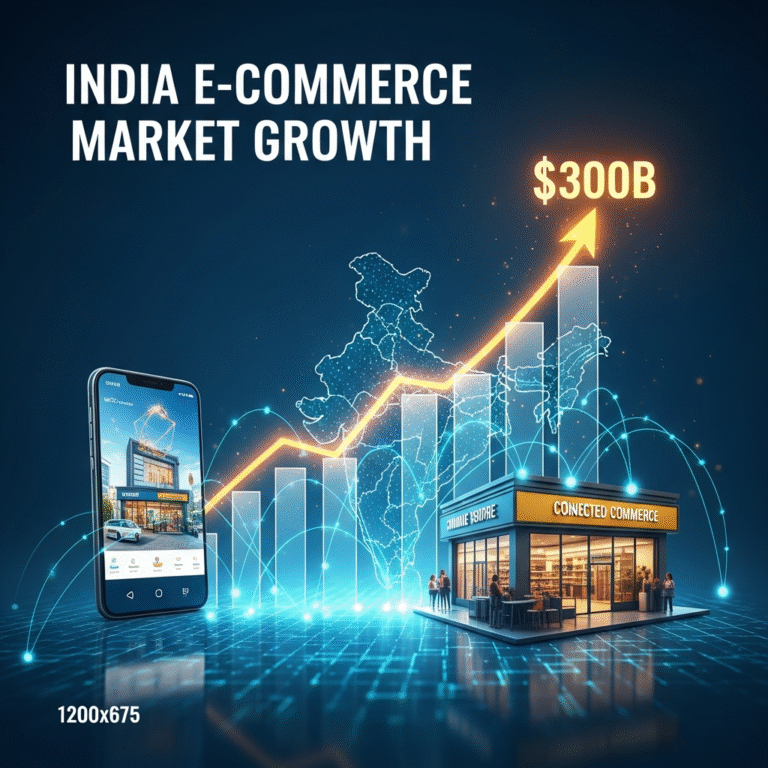

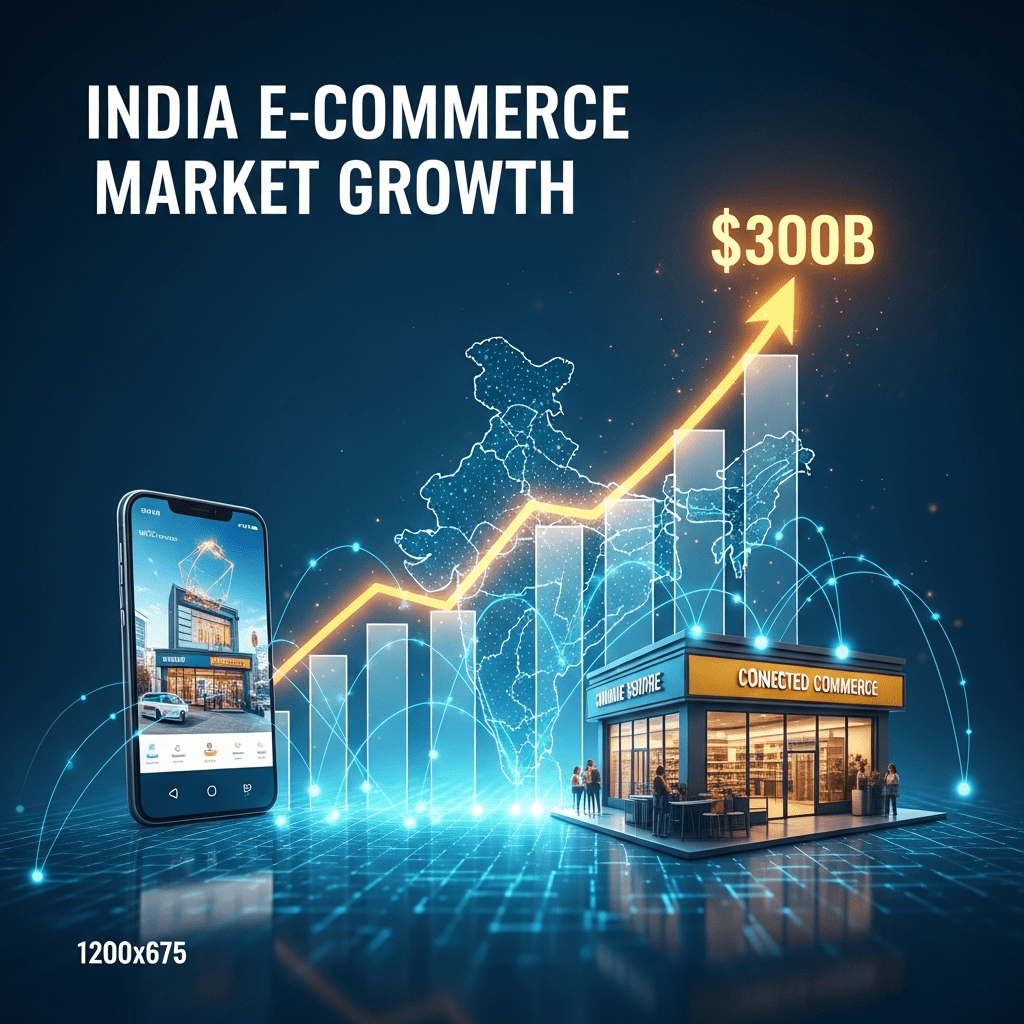
NEW DELHI. The domestic digital economy is entering a transformative phase of structural expansion and omnichannel integration. According to a new report by the Boston Consulting Group (BCG), India’s e-commerce market growth will nearly double to 300 billion United States Dollars (USD) by 2030. The report, titled “$300 Billion Connected Commerce,” suggests the market currently stands between 120 and 140 billion dollars. Despite this rapid rise, online spending still only accounts for 7 to 8 per cent of total consumer expenditure. Furthermore, analysts note that offline retail remains resilient, growing at an annual rate of 13 to 14 per cent over the last four years. Consequently, this development underscores the massive headroom available for future digital penetration.
Driving Factors for India’s E-commerce Market Growth
Digital adoption and rising smartphone usage fuel India’s e-commerce market growth across both urban and rural zones. The sector comprises e-retail, valued at 75 to 85 billion dollars, and e-services, valued at 45 to 55 billion dollars. Specifically, the report predicts that e-services will see a forward Compound Annual Growth Rate (CAGR) of 20 to 22 per cent. In comparison, e-retail expects a growth rate of 16 to 18 per cent. Because consumers now move seamlessly between screens and stores, brands must adopt “connected commerce” strategies. Similarly, approximately 45 per cent of mobile phones and 23 per cent of personal electronics are already purchased online. Therefore, these trends ensure a robust trajectory for the entire digital ecosystem.
Experts attribute India’s e-commerce market growth to the rise of multi-channel shopping behaviours among modern consumers. Parul Bajaj, the India Leader for Marketing, Sales and Pricing Practice at BCG, observed that retail in the country is becoming structurally multi-channel. She stated that five out of ten offline shoppers now use online platforms to research and gather information before buying. Since shoppers prioritize convenience and trust, brands that treat online and offline as separate strategies risk falling behind. Furthermore, the report highlights that categories like beauty, personal care, and apparel are emerging as dominant growth drivers. Thus, the competitive advantage now lies in orchestrating connected consumer journeys across all formats.
Diverse Demographics and Small Business Impact
Smaller cities and middle-income segments will significantly drive India’s e-commerce market growth in the coming decade. The report estimates that the total number of online shoppers will increase from 300 million to 440 million by 2030. Notably, around 30 per cent of current online shoppers originate from rural India, while nearly 45 per cent are women. Kanika Sanghi, a Partner and Director at BCG, indicated that the demographic mix of online shoppers is becoming more democratic. She suggested that platforms must design simpler and safer experiences to build trust among these diverse groups. Consequently, these shifts are forcing brands to rethink their language and logistics strategies.
Technological advancements like Artificial Intelligence (AI) improve personalization and support India’s e-commerce market growth through higher efficiency. Specifically, emerging formats such as quick commerce and social commerce are gaining significant momentum in Tier 2 and Tier 3 cities. Quick commerce has seen a growth rate of over 100 per cent, while social commerce is growing at 40 to 45 per cent. Furthermore, the time required for brands to reach 100 crore rupees in annual revenue has fallen from 11 years to just seven years. Additionally, the Ministry of Finance and the Ministry of Electronics and Information Technology (MeitY) will monitor how this digital scale-up impacts the national Gross Domestic Product (GDP).
Future Outlook for Connected Commerce
Finally, the report highlights how Micro, Small, and Medium Enterprises (MSMEs) benefit from India’s e-commerce market growth through lower entry barriers. Nearly 90 per cent of small online sellers report significant sales growth and expanded employment opportunities. For instance, artisans and farmers are now reaching national markets at a much lower cost than traditional methods. Moreover, the synergy between digital skill development and last-mile infrastructure will be vital for sustaining this momentum. Regarding long-term goals, the foundation of connected commerce serves as a bridge to a more modern and integrated national economy. Consequently, this move will likely foster a more prosperous and technologically advanced retail landscape for years to come.
India E-commerce Projections 2030
| Parameter | Statistic / Attribution |
|---|---|
| Market Forecast | $280–300 Billion USD by 2030. |
| Current Market Size | $120–140 Billion USD (2025-26). |
| Shopper Base | 440 million shoppers by 2030. |
| Growth Drivers | E-services (20-22% CAGR) and E-retail (16-18% CAGR). |
| Connected Commerce | 50% of offline buyers research online first. |
| Diverse Base | 30% Rural shoppers; 45% Women shoppers. |
| Leading Agency | Boston Consulting Group (BCG). |
About the Author