

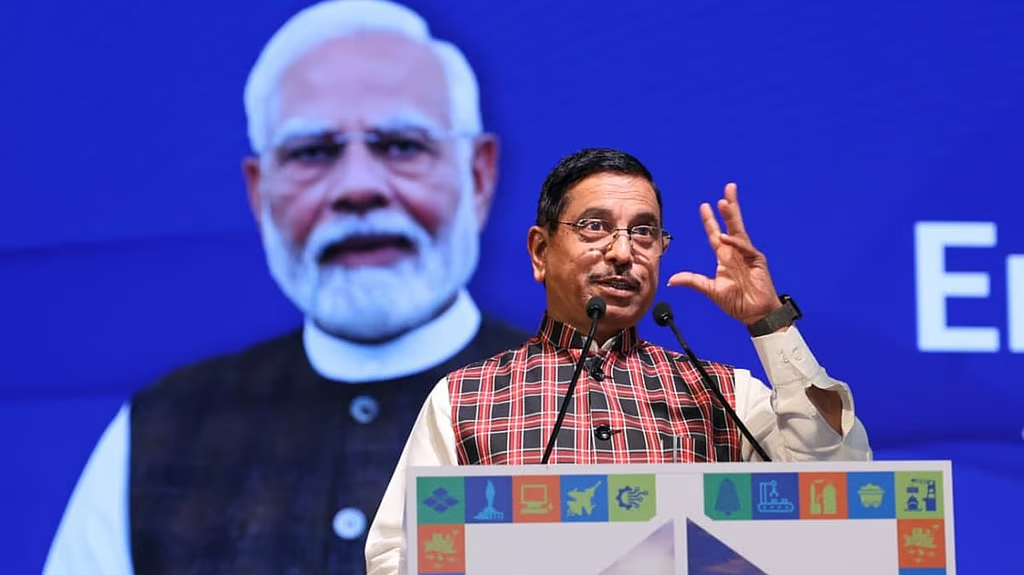
Union Minister for New and Renewable Energy (MNRE), Pralhad Joshi
NEW DELHI. The Union Minister for New and Renewable Energy (MNRE), Pralhad Joshi, has announced that India has achieved a historic milestone in the clean energy sector. Notably, the nation has established a new green hydrogen price record of Rs 2.79 per kilogram during the latest auction conducted by the Solar Energy Corporation of India (SECI). During a press briefing in the capital, the Minister explained that this competitive pricing makes Indian production significantly cheaper than current benchmarks in the Middle East, Australia, and the United States. Furthermore, he noted that this achievement reflects the high level of investor confidence in India’s renewable ecosystem. Consequently, this development underscores the nation’s potential to become a leading global exporter of clean fuels. [Alt: A futuristic green hydrogen production facility with storage tanks]
Strategic Gains and the Green Hydrogen Price Record
Moreover, the Minister highlighted that these low costs were made possible through the Strategic Interventions for Green Hydrogen Transition (SIGHT) scheme. Specifically, the green hydrogen price record was reached through a transparent bidding process for a total capacity of 4,50,000 tonnes per annum. Because of the robust policy framework under the National Green Hydrogen Mission (NGHM), developers are now able to leverage significant economies of scale. Similarly, the administration continues to invest in world-class green energy corridors to facilitate the evacuation of power to production hubs. Therefore, these interventions ensure that the domestic industry can transition away from fossil fuels more rapidly.
In addition, the cooperation between the public and private sectors remains a primary driver for the NGHM goals. To support this, the government has encouraged public sector undertakings to integrate the green hydrogen price record insights into their long-term procurement strategies. Since the nation possesses an abundance of solar and wind resources, the Minister noted that the cost of renewable energy input has fallen drastically in the previous fiscal year. Furthermore, the authorities committed to providing specialised infrastructure support for port-based green ammonia plants. Thus, these efforts reflect a strategic approach to building a “Viksit Bharat” through energy sovereignty.
Economic Impact of the Green Hydrogen Price Record
Beyond environmental benefits, the Minister underscored the role of low-cost energy in driving industrial growth. Specifically, the green hydrogen price record will directly benefit the steel, refinery, and fertiliser sectors, which are traditional heavy consumers of grey hydrogen. Furthermore, the Minister stated that this achievement would significantly reduce the nation’s import bill for natural gas and crude oil. Meanwhile, industry experts expressed that the focus on domestic manufacturing of electrolysers will further push costs down. Consequently, the government has encouraged a transparent dialogue with international trade partners to establish green fuel standards.
On the other hand, the success of this transition depends on maintaining a steady supply of low-cost finance. Specifically, the green hydrogen price record is expected to attract billions of dollars in foreign direct investment into the renewable energy space. Since India contributes a significant portion of the world’s incremental energy demand, the trajectory of its decarbonisation is being watched closely by global climate agencies. Furthermore, the MNRE continues to refine the regulatory landscape to ensure that the Gross Domestic Product (GDP) benefits from this green transition. Additionally, the Ministry of Finance will monitor the fiscal incentives provided to the sector to ensure sustainable growth and a healthy GDP.
Future Projections and Global Energy Leadership
The Minister stated that the current decade will define India’s role as a green energy superpower. For instance, the transition toward a hydrogen-based economy is expected to play a critical role in reaching the net-zero target by 2070. Moreover, he expressed confidence that the green hydrogen price record will act as a catalyst for other nations to accelerate their own energy shifts. Regarding long-term goals, he believes that the synergy between the SIGHT scheme and the NGHM will foster a more technologically advanced and economically stable nation. Consequently, this move will likely redefine the global energy narrative for years to come.
In summary, Minister Pralhad Joshi’s announcement provides a clear roadmap for a sustainable and competitive energy future. With a focus on price efficiency, policy stability, and industrial integration, the country is set to lead the global green hydrogen narrative. Therefore, these strategic initiatives will continue to drive the social and economic evolution of the digital and green era.
Green Hydrogen Benchmark 2026
| Parameter | Detail / Attribution |
|---|---|
| New Price Record | Rs 2.79 per kilogram. |
| Leading Authority | Pralhad Joshi, Minister for MNRE. |
| Tendering Agency | Solar Energy Corporation of India (SECI). |
| Core Framework | National Green Hydrogen Mission (NGHM). |
| Financial Scheme | Strategic Interventions for Green Hydrogen Transition (SIGHT). |
| Capacity Tendered | 4,50,000 tonnes per annum. |
About the Author
