

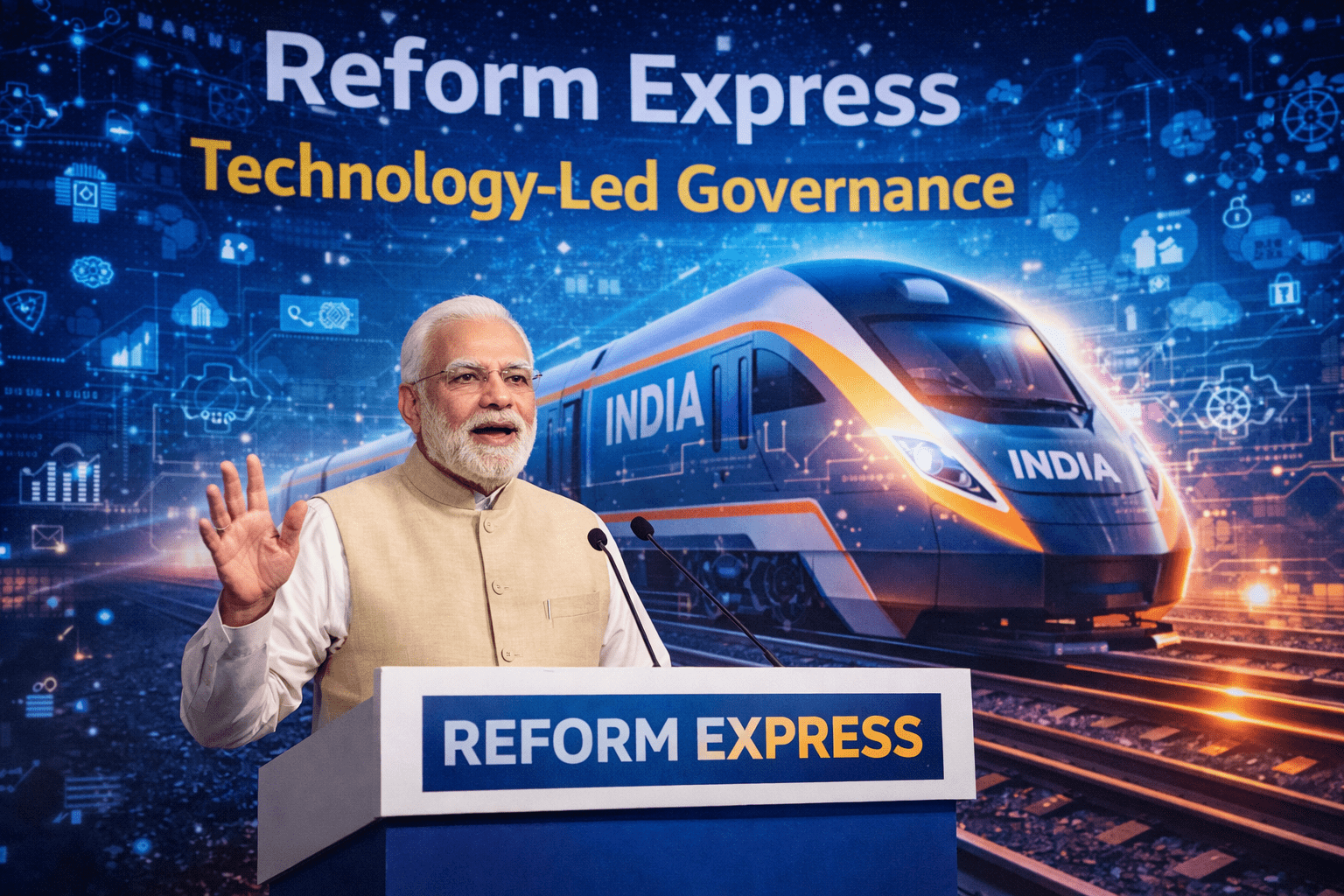
Prime Minister Narendra Modi said India is riding on a Reform Express.
He said the government is simplifying processes across sectors.
Improved Ease of Doing Business remains a core priority.
Technology-led governance continues to expand nationwide.
He addressed a Post Budget Webinar through video conferencing.
The webinar focused on Technology, Reforms and Finance for Viksit Bharat.
He emphasised that reforms must deliver measurable outcomes.
Announcements alone cannot define success, he said.
Delivery excellence must drive implementation across ministries.
Ground-level impact should determine reform effectiveness.
Transparency and accountability must guide governance systems.
Extensive use of artificial intelligence will improve monitoring.
Blockchain technology can enhance process integrity.
Data analytics will strengthen policy evaluation frameworks.
Over the past decade, the government prioritised infrastructure development.
Strategic investments focused on highways and railways.
Ports and digital networks also received sustained attention.
Power systems expanded to support industrial growth.
These assets will generate productivity for decades, he said.
Public capital expenditure continues to rise steadily.
Eleven years ago, allocation stood at ₹2 lakh crore.
The latest Union Budget raised capex beyond ₹12 lakh crore.
He said infrastructure forms the backbone of economic expansion.
Long-term asset creation drives sustainable growth.
Productivity improvements depend on modern logistics networks.
Budget discussions often focus on stock market movements, he noted.
Some debates centre mainly on income tax changes.
However, a national Budget represents a policy roadmap.
It does not serve as a short-term trading document.
Evaluation must rely on substantive economic parameters.
Long-term structural impact should guide assessment.
Implementation quality remains equally important as planning.
The Prime Minister urged participants to move beyond discussions.
The webinar should become a brainstorming platform, he said.
Industry and academia must collaborate closely.
Analysts and policymakers should coordinate implementation efforts.
Collective thinking improves scheme execution.
Better coordination ensures accurate results.
Shared responsibility strengthens delivery systems.
He said India stands at a transformative stage.
Reforms must align with long-term development goals.
Technology integration will accelerate governance efficiency.
Sustained execution will define India’s growth trajectory.
About the Author
