

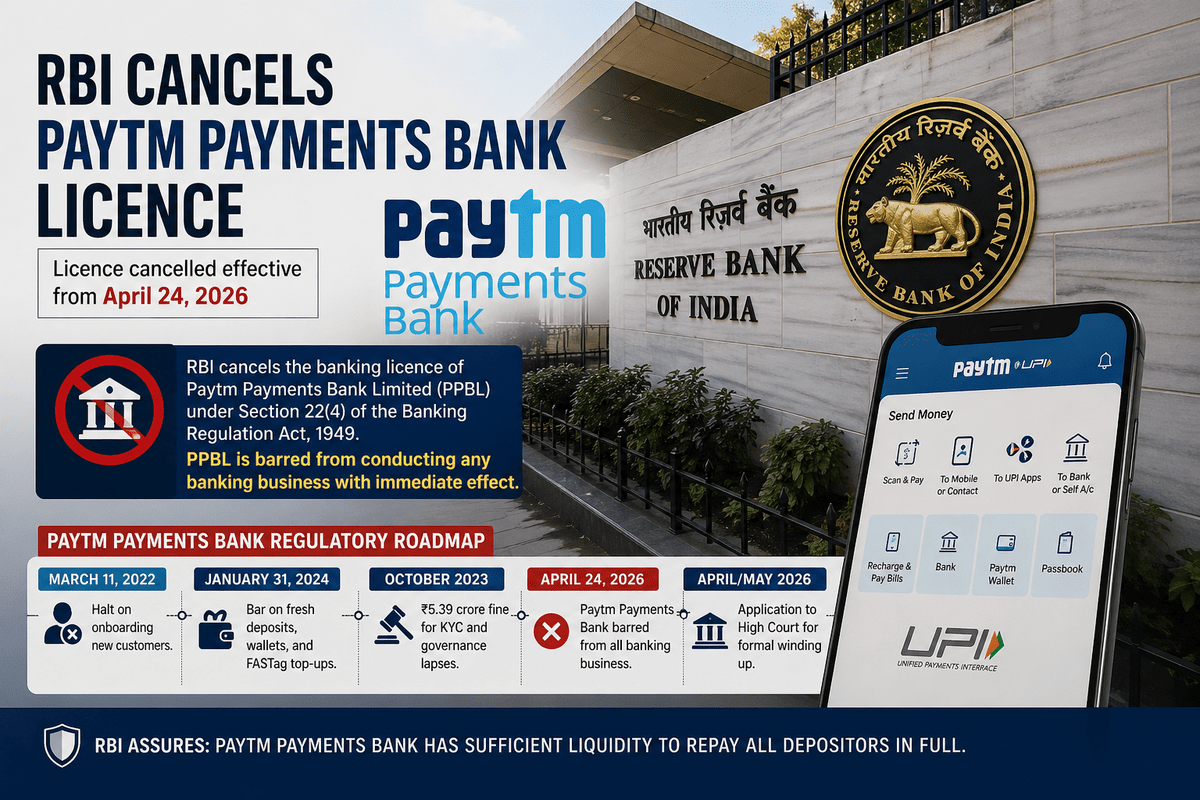
NEW DELHI. The Reserve Bank of India (RBI) officially cancelled the banking licence of Paytm Payments Bank Limited (PPBL) effective from the close of business on April 24, 2026. This final order, issued under Section 22(4) of the Banking Regulation Act, 1949, prohibits the entity from conducting any further “banking” business. The central bank confirmed it will now approach the High Court to initiate formal winding-up proceedings for the institution. This decisive action follows years of escalating restrictions and persistent material supervisory concerns. The regulator concluded that allowing the bank to continue would serve no useful public purpose. Despite the cancellation, the RBI assured the public that the bank holds sufficient liquidity to repay all depositors in full. This move marks the end of one of India’s most prominent experiments in the payments bank space.
Legal Grounds and Management Lapses
The central bank outlined multiple statutory violations as the primary reasons for the Paytm Payments Bank licence revocation. According to the official order, the affairs of the bank were conducted in a manner detrimental to the interests of its depositors. Specifically, the RBI flagged serious concerns regarding the general character of the bank’s management. The regulator stated that the management’s conduct was prejudicial to public interest and violated Section 22(3) of the Banking Regulation Act. This assessment follows a long history of non-compliance, including major lapses in customer due diligence and Know-Your-Customer (KYC) norms. Previous audits revealed critical irregularities, such as linking a single PAN to thousands of accounts and exceeding transaction limits. These systemic failures led to an irreparable loss of regulatory confidence in the bank’s governance framework.
Timeline of Regulatory Escalation
The cancellation is the culmination of a multi-year enforcement process that began as early as 2018. In March 2022, the RBI directed Paytm Payments Bank to stop onboarding new customers due to persistent compliance gaps. This was followed by a more severe intervention in January 2024, which barred the bank from accepting fresh deposits or top-ups. These restrictions effectively froze the bank’s growth and limited its operations to processing withdrawals of existing balances. In October 2023, the regulator also imposed a penalty of ₹5.39 crore for failing to maintain a “Chinese wall” with its parent company, One97 Communications. The inability of the bank to rectify these identified deficiencies led to the ultimate decision to revoke its operational authority. This phased approach provided the ecosystem time to migrate critical services to other partner banks.
Impact on Users and the Fintech Ecosystem
While the banking licence is cancelled, the broader Paytm app and its UPI services remain operational through third-party bank partnerships. Millions of users have already transitioned their merchant settlements and mandates to lenders like Axis Bank and Yes Bank. However, the Paytm Payments Bank closure signals a significant shift in the Indian fintech landscape. Analysts believe this action underscores the RBI’s “compliance-first” stance, warning that innovation cannot come at the cost of regulatory discipline. Market competitors like PhonePe and Google Pay have reportedly seen a surge in user acquisition following the bank’s troubles. The incident serves as a critical case study for other digital-first financial entities regarding the importance of robust risk management. Investors continue to monitor the impact on One97 Communications’ stock as the winding-up process begins.
Security of Deposits and Winding-Up Process
The High Court will now appoint a liquidator to oversee the final distribution of assets and settlement of liabilities. The RBI reiterated that Paytm Payments Bank maintains enough liquidity to honour all its deposit obligations during this transition. Existing customers who still hold balances in their accounts can continue to withdraw their funds without immediate disruption. However, no new credits, including salary transfers or direct benefit transfers, can be processed through the bank’s accounts. The winding-up process will determine the final timeline for the total cessation of all remaining administrative functions. This orderly exit is designed to prevent panic and ensure that the interests of small depositors are protected throughout. The closure of the bank completes a major restructuring of the digital payments infrastructure in the country.
Paytm Payments Bank Regulatory Roadmap
| Event | Date | Regulatory Action |
| Initial Curb | March 11, 2022 | Halt on onboarding new customers. |
| Deposit Ban | January 31, 2024 | Bar on fresh deposits, wallets, and FASTag top-ups. |
| Penalty Issued | October 2023 | ₹5.39 crore fine for KYC and governance lapses. |
| Licence Cancelled | April 24, 2026 | Paytm Payments Bank barred from all banking business. |
| Next Step | April/May 2026 | Application to High Court for formal winding up. |
| Liquidity Status | Current | Sufficient funds to repay all depositors. |
About the Author
