

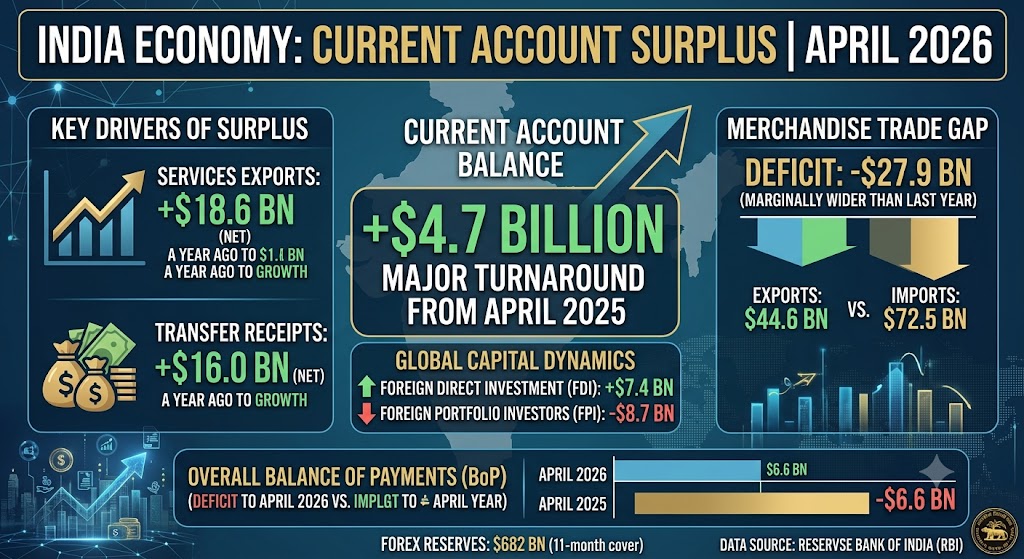
New Delhi: In a major win for the Indian economy, the nation recorded a significant current account surplus of USD 4.7 billion in April 2026. Data released by the Reserve Bank of India (RBI) reveals a sharp economic turnaround, reversing a hefty deficit of USD 4.8 billion logged in April 2025.
The primary catalysts driving this growth were robust services exports and a massive spike in net transfer receipts, which comfortably offset a widening merchandise trade gap.
Services and Remittances Cushion Trade Deficit
While India’s merchandise trade deficit faced minor headwinds, the structural strengths of the broader Indian economy—specifically its technology, services, and massive global diaspora—saved the day.
1. Services Sector and Remittances Surge
-
Net Services Receipts: Climbed to USD 18.6 billion in April 2026, up from USD 15.9 billion a year ago. Total services exports reached USD 37.0 billion.
-
Net Transfer Receipts: Reached USD 16.0 billion, marking a massive leap from the USD 9.4 billion recorded in April 2025.
2. Merchandise Trade Deficit Widens
-
Total Exports: Rose to USD 44.6 billion, compared to USD 38.7 billion last year.
-
Total Imports: Escalated to USD 72.5 billion from USD 65.8 billion.
-
Trade Gap: Stood at USD 27.9 billion, slightly higher than last year’s USD 27.1 billion.
Forex Cushion: RBI Governor Shaktikanta Das highlighted that India’s foreign exchange reserves remain robust at USD 682 billion, offering a secure 11-month import cover for the country.
Capital Outflows Trigger Overall BoP Deficit
Despite the excellent news on the current account front, global capital volatility impacted the overall Balance of Payments (BoP). India saw a net capital account outflow of USD 11.3 billion in April 2026, a steep contrast to the USD 5.3 billion inflow seen in April 2025.
Economic Balance Sheet: April 2026 vs. April 2025
| Indicator | April 2025 | April 2026 |
| Current Account | -$4.8 Billion (Deficit) | +$4.7 Billion (Surplus) |
| Net Foreign Direct Investment (FDI) | +$1.6 Billion | +$7.4 Billion |
| Foreign Portfolio Investors (FPI) | Net Inflow | -$8.7 Billion (Outflow) |
| Overall Balance of Payments (BoP) | +$0.5 Billion (Surplus) | -$6.6 Billion (Deficit) |
Aggressive selling by foreign portfolio investors (FPIs) resulted in an overall BoP deficit of USD 6.6 billion for the month. This follows a strong Q4 FY26 (January–March 2026), where India posted a current account surplus of USD 7.1 billion (0.7% of GDP).
To keep investors better informed, the RBI announced a new transparency standard: going forward, monthly BoP data will be officially released on or before the 15th day of the second subsequent month.
What This Means for the Future of Indian Economy
Short-Term Benefits
A current account surplus reduces pressure on India’s foreign exchange reserves and actively strengthens the Indian Rupee (INR) against global currency volatility. It proves that India’s service-led invisible earnings are successfully buffering manufacturing vulnerabilities.
Medium-Term Outlook
While a consistent current account surplus improves economic stability metrics, economists caution that prolonged surpluses can sometimes reflect sluggish domestic demand or slower import-heavy industrial investments.
For now, the April data demonstrates excellent resilience. Moving forward, the health of the Indian economy will depend heavily on whether steady FDI inflows and services exports can continue to outpace unpredictable global capital flight.
About the Author
