

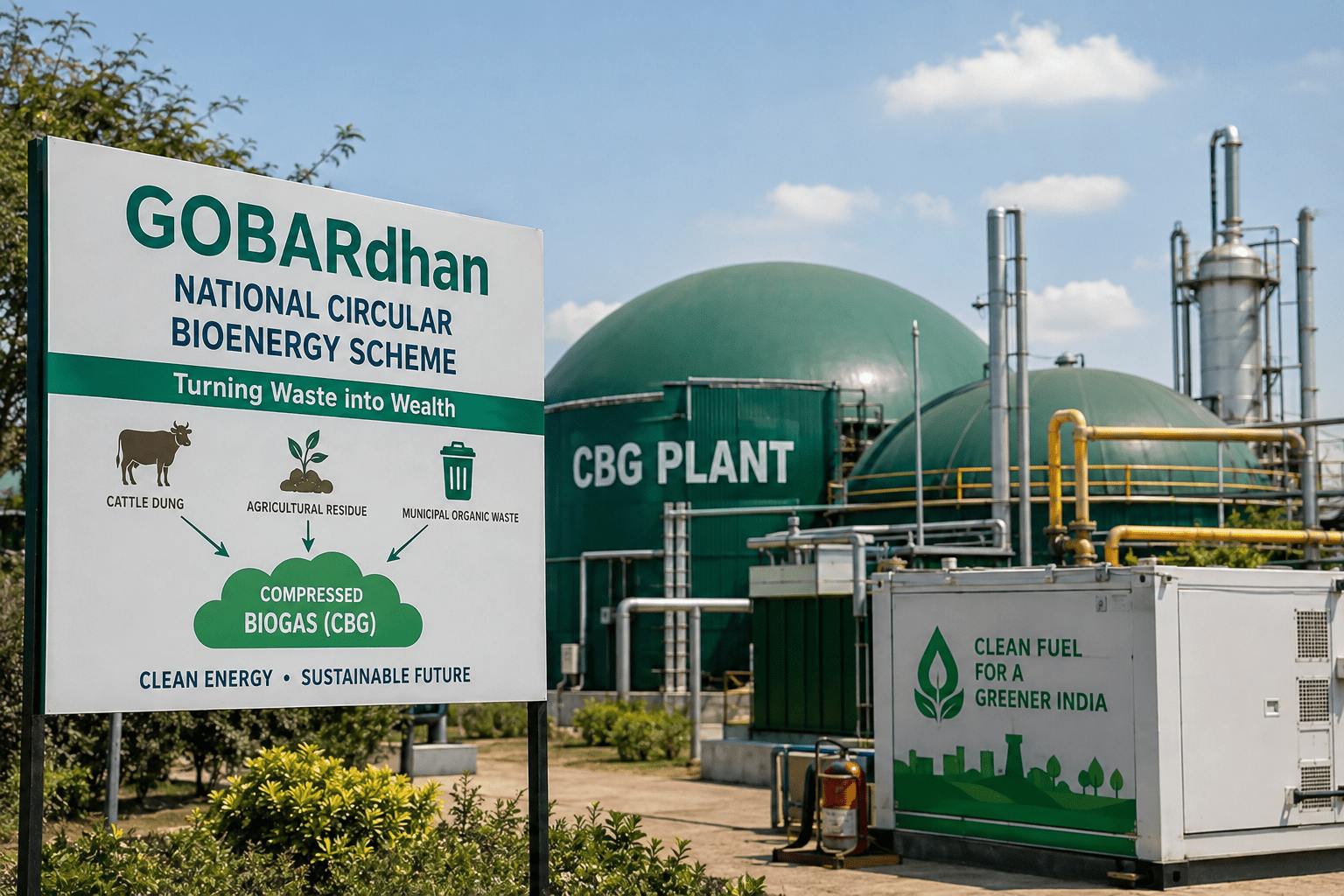
The Union Cabinet has approved a ₹23,731 crore programme to expand India’s compressed biogas production. The GOBARdhan scheme will run for 10 years from FY2026-27 to FY2035-36.
The government expects the programme to raise domestic CBG output nearly ten-fold during the period. The Ministry of Petroleum and Natural Gas will administer the scheme.
Information and Broadcasting Minister Ashwini Vaishnaw announced the Cabinet decision after the meeting. He linked the programme with India’s broader energy security goals.
GOBARdhan Scheme targets higher CBG Production
The programme aims to increase CBG output to about 5 million metric standard cubic metres per day. Current production stands at around 0.4 MMSCMD.
The government expects the new framework to create a stronger market for CBG producers. It will also provide greater certainty for companies planning new projects and capacity expansions.
The GOBARdhan scheme will work through six key components. These include assured CBG offtake, stable pricing, capital assistance, pipeline infrastructure, credit guarantee support and a CBG Ecosystem Challenge Fund.
City gas distribution companies will procure CBG under defined blending obligations. The requirement will stand at 3 per cent in FY2026-27 and rise to 4 per cent in FY2027-28.
The obligation will reach 5 per cent from FY2028-29 onwards for CNG used in transport and PNG used by households.
Government Fixes CBG Price and Offers Capital Support
The government has set an administered CBG price of ₹2,110 per MMBTU. The price translates to about ₹15 per kg of CBG, according to the government.
Eligible greenfield projects can receive capital assistance of up to ₹2 crore per tonne per day of installed capacity. Brownfield expansion projects can also access the support.
The GOBARdhan scheme will also provide credit guarantee support for MSME-based projects. The government expects the mechanism to guarantee about 85 per cent of loans extended to eligible MSMEs.
CBG can integrate with the existing gas ecosystem because it has chemical properties equivalent to natural gas. This feature can help producers supply the fuel through established gas networks.
Focus on Energy Security and Lower Import Dependence
India imports about half of the natural gas it consumes. The government sees higher domestic CBG production as one way to reduce this dependence.
The programme will also support India’s response to global energy disruptions. Geopolitical conflicts can affect LNG supplies and increase pressure on energy markets.
The government expects the initiative to reduce fossil fuel imports by about 10 million tonnes. It also estimates that the programme could prevent around 40 million tonnes of carbon dioxide emissions.
The government expects the initiative to add around ₹75,000 crore to GDP. It could also create about 1.5 lakh direct and indirect jobs.
Agricultural and Municipal Waste to Drive Feedstock Supply
The programme will not depend only on cattle dung. Producers can use agricultural residue, press mud and municipal organic waste as feedstock.
This approach can expand the supply base for CBG plants. It can also create additional value from waste generated by farms, sugar mills and urban areas.
The government also expects the programme to generate around 250 million tonnes of organic manure. This could support agricultural activity while strengthening the circular bioeconomy.
Single Framework for CBG Ecosystem
India has already supported CBG development through several programmes. These include the SATAT scheme, Market Development Assistance scheme, Biomass Aggregation Machinery scheme and Central Financial Assistance under the National Bioenergy Programme.
These initiatives have helped commission more than 200 CBG plants.
The GOBARdhan scheme will bring the wider CBG value chain under a single national framework. The government said the ecosystem previously involved four different ministries.
The move to bring the sector under the Ministry of Petroleum and Natural Gas aims to improve coordination and speed up implementation.
The Cabinet decision marks a major policy push for India’s bioenergy sector. The government now plans to expand production, build demand and support investment while using agricultural and organic waste as valuable energy resources.
About the Author
