

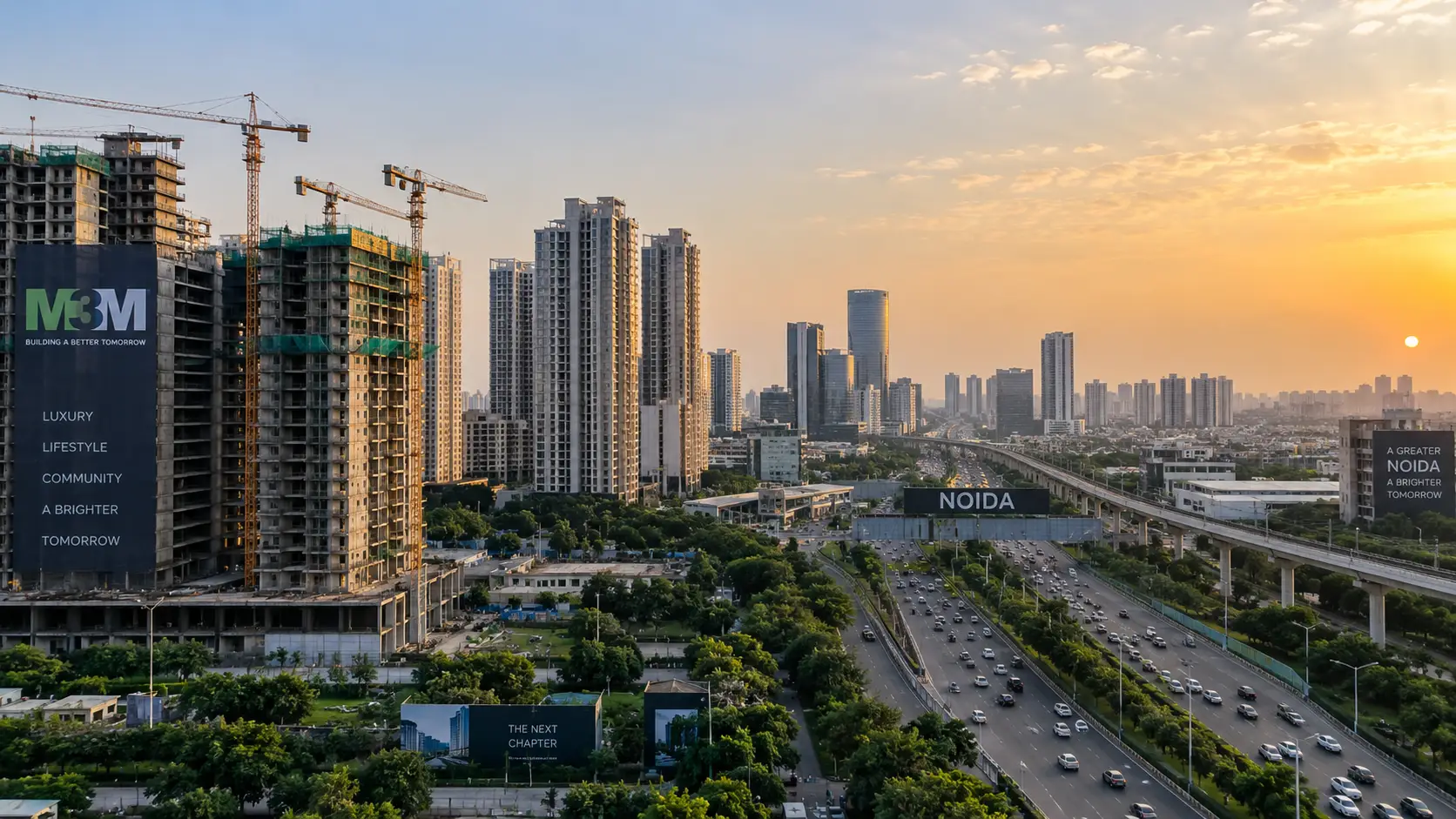
M3M’s ₹1,839-crore Noida land acquisition, sharp rise in property prices and growing institutional funding show how the economics of development are changing
Delhi-NCR’s real estate market is entering a phase where the availability of well-located land is becoming increasingly important to the economics of development. The change is visible in the prices being paid for strategically located land parcels, the sharp rise in residential values over the past decade and the growing flow of institutional capital into premium housing projects.
The latest signal came from Noida, where M3M India emerged as the highest bidder for a 12.5-acre mixed-use parcel in Sector 108 for ₹1,839 crore. The bid was more than twice the reserve price of ₹835 crore, with DLF also participating in the bidding.
The transaction is significant because it shows the value developers are placing on strategically located land in established NCR markets. At such acquisition costs, the development strategy has to be built around the potential of the location, the product mix and the pricing that the market can realistically absorb.
The Noida transaction also needs to be seen against the broader change in NCR housing. According to an ASSOCHAM-Knight Frank Research report, residential prices across NCR increased 193% between 2015 and 2025, while new residential launches declined by 20% during the same period. Residential sales volumes increased only 7% over the decade.
The numbers point to an important shift. Prices have risen much faster than transaction volumes, while the flow of new supply has become more measured. This suggests that the NCR market is not simply experiencing another conventional property-price cycle. It is becoming increasingly influenced by land availability and the cost of creating new supply.
The M3M transaction is therefore less about the ₹1,839-crore headline and more about what the bid says about the future potential being assigned to Noida.
When a developer is willing to pay more than twice the reserve price for a parcel, the calculation is necessarily long term. The developer has to work backwards from the land cost and assess the development mix, achievable pricing, construction expenses, financing costs, taxes, absorption and the time required to monetise the project.
At these land values, an ordinary product proposition leaves little room for error. The project has to offer something that allows it to command a premium.
A similar trend can be seen in Gurugram, although through a different route. Kotak Realty Fund has committed about ₹800 crore in the first phase of its partnership with Smartworld Developers for Smartworld Sky Arc and Trump Residences in Sector 69, Gurugram. The two projects together have a gross development value of more than ₹8,200 crore.
The significance of institutional funding goes beyond the availability of capital. Institutional investors typically assess the developer, location, product, execution capability and the potential market before committing funds. This makes institutional participation an indicator of how professionally the economics of a project are being evaluated.
It also means that capital is becoming more selective. Not every expensive land parcel will necessarily produce a successful premium development.
The changing economics of NCR real estate are also being reflected in buyer preferences. The market has seen increasing demand for larger homes, branded developments along with better amenities and lifestyle-oriented projects, particularly in established premium corridors.
However, premiumisation should not be interpreted as a uniform increase in property values across the entire NCR. Since the region is becoming increasingly fragmented into micro-markets, each with its own economic drivers.
A location with strong connectivity, employment opportunities, social infrastructure and established residential demand can command a very different valuation from a location where these factors are still developing.
This is why the next phase of NCR real estate will depend heavily on infrastructure.
Expressways, metro connectivity, airports and emerging commercial centres are expanding the economic catchment of several locations. Infrastructure does not merely reduce travel time. It changes the geography of demand.
Once connectivity improves, a location can draw residents, employees, businesses and consumers from a much larger catchment. This creates opportunities not only for residential development but also for offices, retail, hospitality and other services.
This is gradually changing the way large developments are being planned. Residential projects can no longer be viewed entirely in isolation from the commercial and social infrastructure around them.
The next phase of NCR real estate is likely to be increasingly about urban ecosystems rather than individual projects. People want convenient access to workplaces, schools, healthcare, retail, dining and leisure, while developers are looking for locations where these different sources of demand canreinforce one another.
The land-constrained nature of the market could also influence the supply profile in the coming years. Developers paying substantially more for prime parcels will have to be more disciplined about product planning, pricing and inventory.
This could further widen the gap between different segments of the NCR market.
Expensive land naturally encourages developers to look towards higher-value products, but premiumisation cannot replace the need for housing across different price points. The challenge will be to match the product to the economics of each micro-market rather than follow a single strategy across the region.
The combination of M3M’s Noida land acquisition, institutional funding in Gurugram and the sharp increase in NCR property prices points towards a market where three factors are increasingly connected: scarce land, premium demand and selective capital.That is perhaps the more important story emerging from NCR real estate today. The market is not simply becoming more expensive. It is becoming more selective.
Landowners are assigning higher values to strategically located parcels. Developers are taking larger bets on locations where they see long-term potential. Institutional investors are looking for projects with stronger fundamentals. And buyers are increasingly willing to pay for location, space, amenities and the overall quality of the development.
The next phase of NCR real estate, therefore, may be defined less by how many projects are launched and more by where they are located, what they offer and whether the surrounding urban ecosystem can support the prices being asked.
About the Author
