

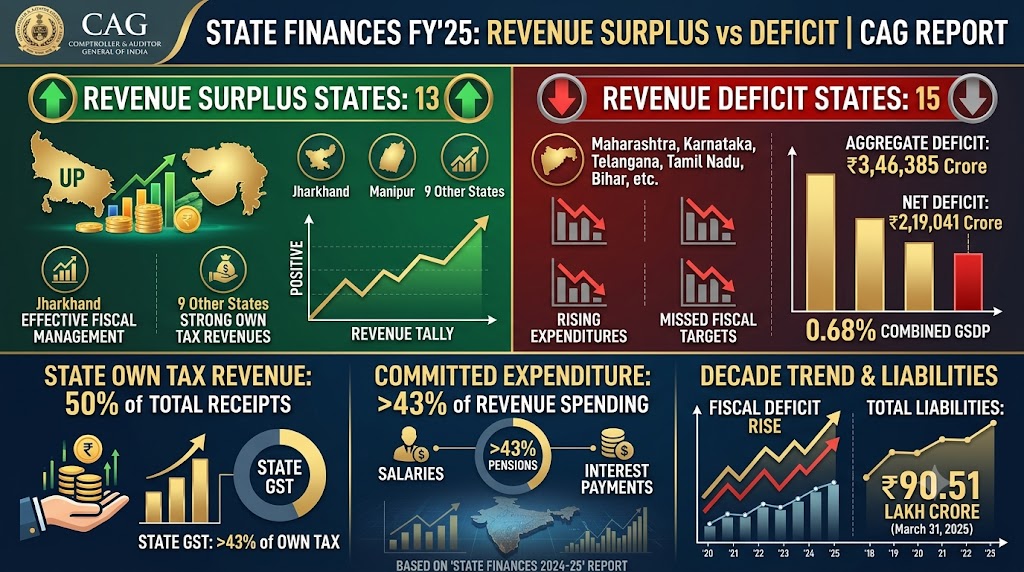
New Delhi: A highly anticipated report on state finances for the financial year 2024-25 has revealed a stark fiscal divergence across India. Released by Comptroller and Auditor General (CAG) K Sanjay Murthy, the publication highlights that 13 states—including Uttar Pradesh, Gujarat, Jharkhand, and Manipur—successfully recorded a revenue surplus. But the remaining 15 states slipped into a revenue deficit.
The comprehensive review is entitled ‘State Finances 2024-25’. It details how states performed against their own fiscal targets . The report outlines the growing pressures on local balance sheets.
The Fiscal Tally: Winners and Losers in FY25
Out of the 28 states audited, initial fiscal targets varied widely. While 18 states actively aimed for a revenue surplus. But only 9 managed to hit the mark.
The Surplus States (13 Total)
-
Target Achievers: 9 states that set a surplus target successfully achieved it.
-
Zero-Deficit Turnarounds: Four states—Goa, Jharkhand, Tripura, and Uttar Pradesh—targeted a zero-revenue deficit. But they outperformed expectations to land in a revenue surplus.
The Deficit States (15 Total)
-
Missed Surplus Targets: Assam, Bihar, Chhattisgarh, Haryana, Himachal Pradesh, Karnataka, Maharashtra, Mizoram, and Telangana missed their positive targets to finish in a deficit.
-
Missed Zero-Deficit Targets: Punjab, Rajasthan, and Tamil Nadu targeted a net-zero balance but ended the fiscal year in a revenue deficit.
-
Special Assistance: To manage their shortfalls, four deficit states—Himachal Pradesh, Mizoram, Punjab, and West Bengal—relied on Finance Commission revenue deficit grants.
Deficit Metrics and GSDP Impact
The scale of the deficit remains a point of observation for policymakers analysing state finances.
-
Aggregate Deficit: The total shortfall of the 15 revenue-deficit states stood at ₹3,46,385 crore (equivalent to 1.5% of their combined Gross State Domestic Product).
-
Net Deficit: After offsetting the gains from the 13 surplus states, India’s net state revenue deficit settled at ₹2,19,041 crore (0.68% of the combined GSDP of all 28 states).
-
Fiscal Deficit Target: The Fifteenth Finance Commission set an indicative fiscal deficit target of 3% of GSDP. The CAG noted that 18 states breached this target.
Own Taxes and Committed Expenses Drive the Budget
The publication sheds light on how states are generating income and where the money is being spent.
1. The Power of State GST
The total revenue receipts across all 28 states touched ₹40.52 lakh crore in FY25. Crucially, states’ own tax revenues accounted for 50% of this entire collection, with State GST (SGST) making up more than 43% of the states’ independent tax pool.
2. The Burden of “Committed Expenditure”
On the expenditure side, total state budgetary spending hit ₹51.20 lakh crore (15.78% of combined GSDP). However, inflexible costs like salaries, pensions, and interest payments continue to hog the budget.
-
Combined Share: These committed expenses ate up over 43% of total revenue spending across India.
-
Inter-State Variance: The reliance on committed spending varied drastically, consuming a massive 74% of the budget in Nagaland compared to just 29% in Maharashtra.
The Decade View: Debts and Post-COVID Pressures
The CAG’s decadal analysis indicates that Indian states, as a collective unit, have remained in both revenue and fiscal deficit from 2015-16 through 2024-25.
Notably, a massive spike in revenue deficits occurred during the COVID-impacted year of 2020-21. Another major surge in fiscal deficits arrived in 2024-25. States experiencing a substantial fiscal deficit expansion compared to the previous year include Andhra Pradesh, Gujarat, Karnataka, Kerala, Madhya Pradesh, Maharashtra, and Odisha.
As of March 31, 2025, the accumulated liabilities across all 28 states reached ₹90.51 lakh crore. Every single state recorded a fiscal deficit. CAG Murthy expressed hope that this data would serve as an “evidence-based resource” to assist governments and citizens in supporting more informed fiscal decisions going forward.
About the Author
