

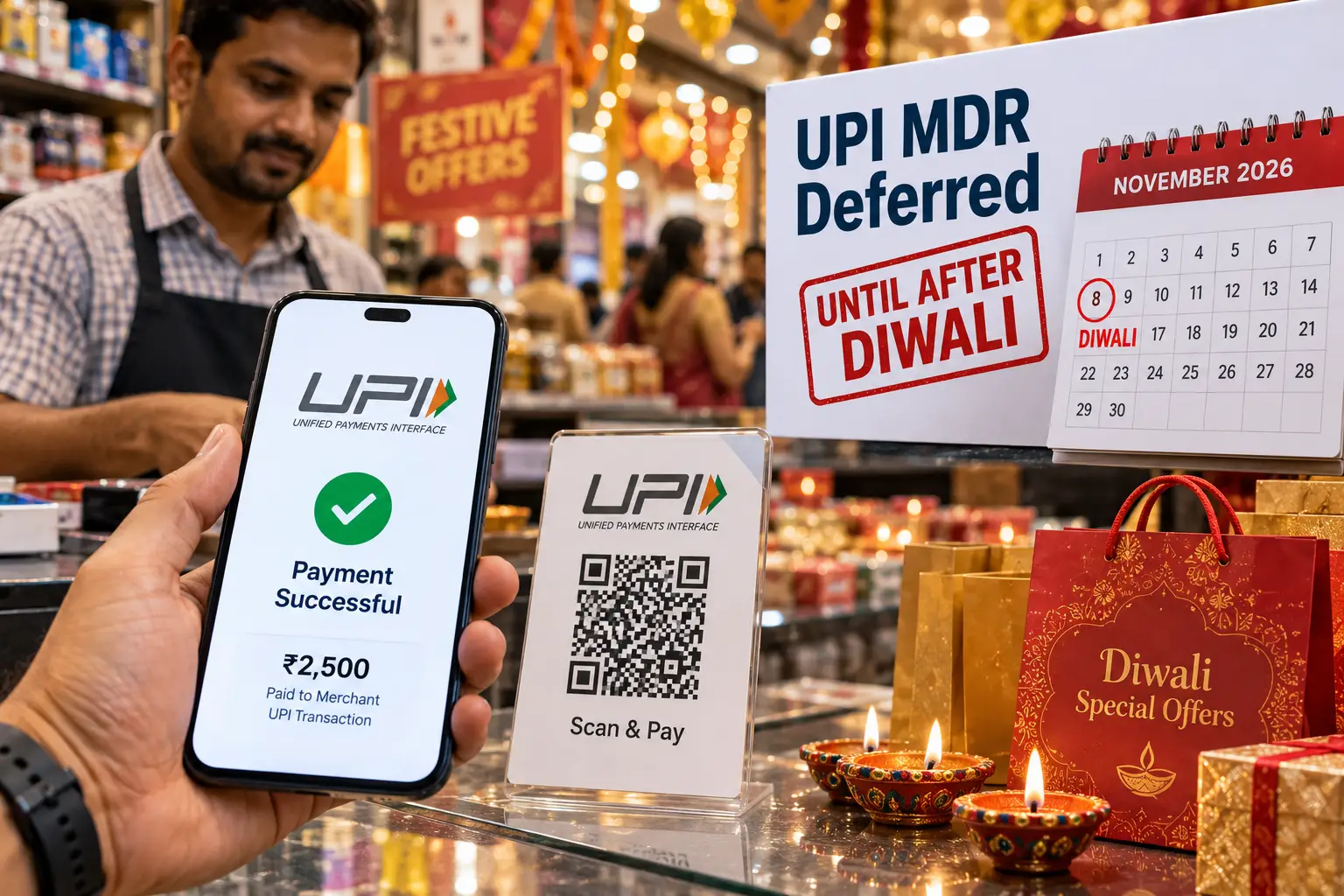
The National Payments Corporation of India (NPCI) has postponed the proposed UPI MDR charges until after Diwali. The decision came just two days before the scheduled implementation date. It follows opposition from traders concerned about additional costs during the festive shopping season.
NPCI announced the decision on Tuesday, citing the festive season. The UPI and Services Steering Committee has decided to implement the charges immediately after Diwali. A fresh implementation date will be announced separately.
The postponement offers temporary relief to merchants. However, it leaves the proposed framework intact and raises questions about the timing of its original announcement. The sequence also highlights the influence that organised stakeholder opposition can have on policy implementation.
The available information does not establish that NPCI or the government acted under direct political pressure. However, trader protests, discussions with the Finance Minister and the subsequent postponement form an important part of the timeline.
The proposed framework was announced on September 15. It sought to impose a merchant discount rate of 0.4% on eligible merchant UPI transactions exceeding Rs 2,000. The maximum charge would be Rs 300 per transaction.
Retailers opposed the proposal, citing the additional burden on businesses. Trade associations had called for a nationwide “No UPI Day” protest on October 2. They later withdrew the protest after a meeting with Union Finance Minister Nirmala Sitharaman on September 30.
The Confederation of All India Traders (CAIT) welcomed the postponement. The sequence of events suggests that merchant concerns may have influenced the timing. However, the available information does not establish that these concerns were the sole reason for the decision.
The timing of the original proposal also deserves attention. Diwali is one of India’s busiest retail periods, with strong demand for electronics, jewellery, apparel and consumer durables. A new payment-processing cost during this period was likely to attract resistance.
The postponement suggests that festive-season considerations gained greater importance as the implementation date approached. It also raises questions about whether the authorities adequately assessed merchant concerns before setting the original deadline.
The controversy has also entered the legal arena. A public interest litigation has challenged the legal basis of the proposed MDR framework. It questions the withdrawal of zero-charge protection for higher-value UPI transactions.
On September 28, the Supreme Court declined to grant an interim stay. It sought responses from the Centre and other authorities. The court has not ruled on the validity of the proposed charges. There is also no established evidence that the legal challenge directly prompted the postponement.
The financial implications for merchants vary with transaction size. Under the proposed rate, a merchant accepting a UPI payment of Rs 10,000 would pay Rs 40. A transaction worth Rs 50,000 would attract a charge of Rs 200.
The government maintains that customers will not be charged directly. It has also stated that approximately 96% of merchant transactions will remain outside the proposed MDR framework.
However, a fee imposed on merchants can still affect business decisions. Businesses operating on thin margins may absorb the expense, reduce discounts or adjust prices. Some may also encourage customers to use alternative payment methods. The actual outcome will depend on competition, enforcement and merchant behaviour.
The government has advised banks to prevent merchants from passing the charge directly to customers. Whether this protection works in practice will depend on how effectively the rules are implemented.
There is also a broader question about funding India’s digital payment infrastructure. Bank-account-based UPI payments have operated under a zero-MDR framework since 2020. Meanwhile, transaction volumes and the costs of maintaining payment systems have increased.
NPCI chief executive Dilip Asbe has estimated the annual cost of operating the UPI ecosystem at around Rs 21,000 crore. Industry estimates suggest that the proposed MDR could generate Rs 13,000 crore to Rs 15,000 crore in its first year.
Banks and payment companies argue that a sustainable revenue stream is necessary to support infrastructure, cybersecurity, fraud prevention and future expansion. This has renewed the debate over whether the government should continue subsidising the ecosystem or require larger merchants to contribute towards its operating costs.
The postponement does not resolve that debate. It delays the proposed charges while leaving the underlying funding question unanswered.
Significantly, NPCI has not announced a reduction in the proposed rates or withdrawn the framework. The charges are expected to take effect after Diwali, which falls on November 8 this year. The precise implementation date remains unannounced.
The decision therefore represents a postponement rather than a confirmed policy rollback. Traders gain temporary relief during the festive period, while banks and payment companies must wait longer for the proposed revenue stream.
For policymakers, the episode highlights the importance of consultation and implementation planning. A payment policy affecting millions of merchants needs clear communication about its costs, coverage and enforcement before implementation.
The central issue is no longer just when the UPI MDR charges will begin. It is whether the authorities can address merchant concerns while developing a sustainable funding model for digital payments.
The available evidence points to merchant opposition and festive-season considerations as important elements in the postponement. It does not establish coercion or an undisclosed political directive. The period before implementation offers NPCI and the government an opportunity to clarify the framework and explain how it will work without weakening confidence in UPI.
About the Author
