

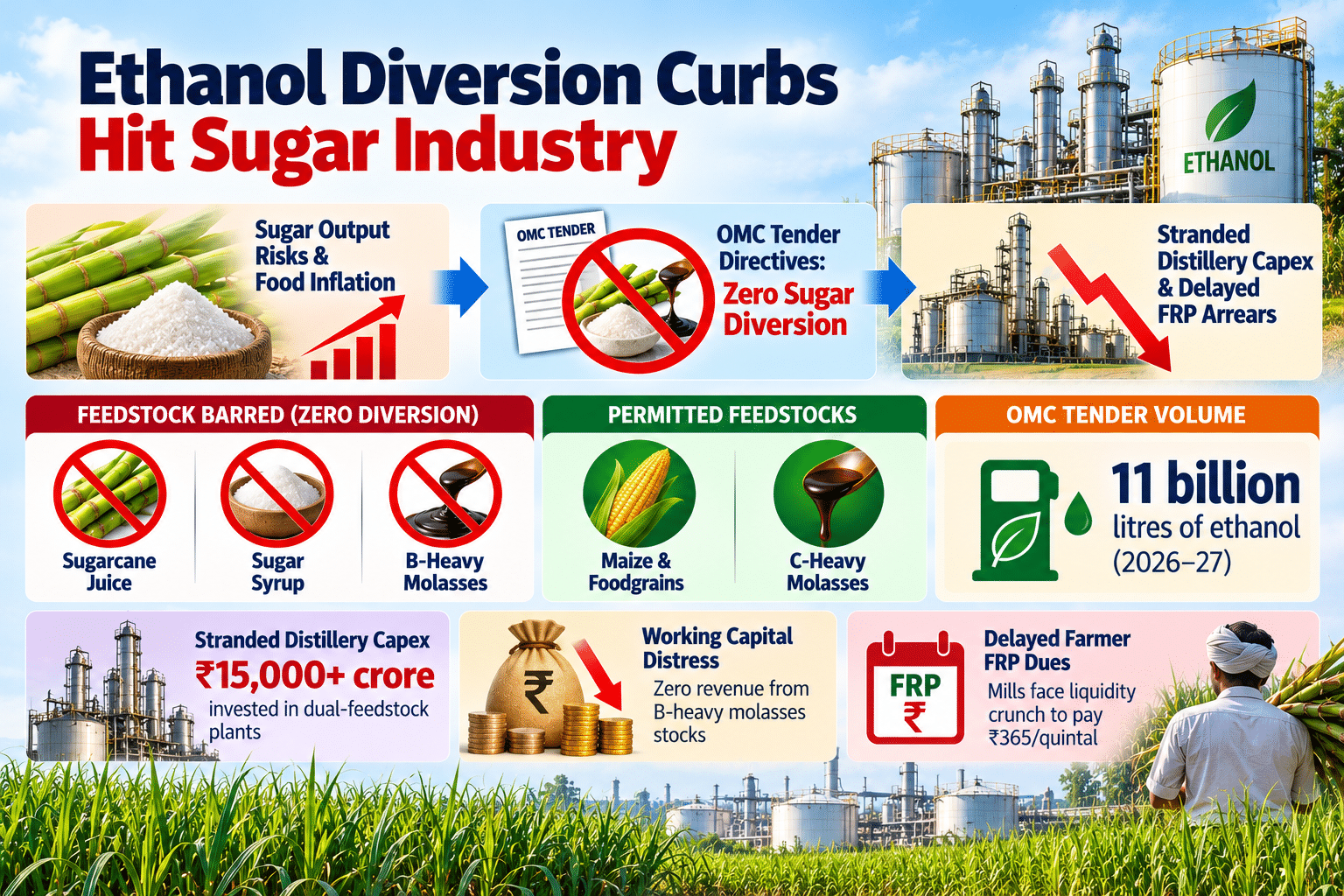
New Delhi: Fresh ethanol diversion curbs enforced by the Central Government have emerged as a major flashpoint in India’s agri-commodity sector after state-run oil marketing companies disallowed the use of sugarcane juice, sugar syrup, and B-heavy molasses for biofuel production during the 2026–27 supply year.
In a tender document issued on behalf of public sector Oil Marketing Companies (OMCs) for 11 billion litres of ethanol, the government effectively set sugar diversion for biofuel blending to zero. Aimed primarily at containing domestic sugar price spikes ahead of the festive season, the decision highlights escalating tensions between food inflation management and national green energy blending targets.
 [Domestic Sugar Output Risks & Food Inflation] ──▶ Triggers ──▶ [OMC Tender Directives: Zero Sugar Diversion]
                                                                                        │
 [Stranded Distillery Capex & Delayed FRP Arrears] ◀──( Sparks Cash-Flow Crisis Across Sugar Mills )┘
Zero-Diversion Policy Targets Food Inflation Ahead of Festive Season
Significantly, the Ministry of Petroleum and Natural Gas, alongside the Ministry of Consumer Affairs, Food and Public Distribution, instructed OMCs to seek offers exclusively from grain-based feedstocks (such as maize and damaged foodgrains) and C-heavy molasses.
Global and domestic sugar prices recently reached multi-month highs amidst erratic rainfall patterns across key producing regions, including Marathwada in Maharashtra and parts of Karnataka. Consequently, policy authorities intervened through strict ethanol diversion curbs to ensure adequate domestic physical availability and maintain retail price stability during peak festive consumption months.
Key Takeaways from the 2026–27 Ethanol Procurement Directives:
Total OMC Tender Volume: Seeking 11 billion litres of ethanol for the 2026–27 supply year.
Excluded Feedstocks: Sugarcane juice, sugar syrup, and B-heavy molasses set to zero.
Permitted Feedstocks: Grain-based sources (maize) and C-heavy molasses.
Primary Policy Objective: Protects domestic food stocks amidst subdued regional cane yields.
Mill Operators Warn of Sunk Capital, Stranded Assets, and Farmers’ Cane Arrears
Crucially, industry bodies—including the Indian Sugar & Bio-energy Manufacturers Association (ISMA)—warned that abrupt regulatory pivots endanger the financial stability of the entire agro-processing ecosystem.
                  [CRITICAL INDUSTRY AND FISCAL IMPACTS]
   ┌────────────────────────────────┼────────────────────────────────┐
   ▼                                ▼                                ▼
[Stranded Distillery Capex]      [Working Capital Distress]       [Delayed Farmer FRP Dues]
₹15,000+ Cr invested in dual-    Zero revenue from B-heavy        Mills face liquidity crunch to
feedstock distillation plants    molasses inventory stocks        pay mandatory ₹365/qtl FRP
Over the past three years, private and cooperative sugar mills invested heavily in expanding dual-feedstock distillation units to support the government’s E20 (20 per cent ethanol blending) roadmap. Mill operators argue that these sudden ethanol diversion curbs starves their plants of operational liquidity. Furthermore, with the Fair and Remunerative Price (FRP) raised to ₹365 per quintal for the 2026–27 sugar season, sugar processors caution that restricted cash flows will delay mandatory payments to sugarcane farmers.
Feedstock & Regulatory Shift Matrix
| Ethanol Feedstock Class | Prior Policy Status | 2026–27 OMC Tender Status | Financial & Operational Impact on Mills |
| Sugarcane Juice / Syrup | Encouraged / High Price Tier | Completely Excluded (0%) | Distillation capacity sits idle; capex unrecovered. |
| B-Heavy Molasses | Primary Blending Driver | Completely Excluded (0%) | Creates working capital lock-up in partially processed stock. |
| C-Heavy Molasses | Low-Yield Residual Tier | Permitted for Bidding | Lowers alcohol yields per tonne; restricts profit margins. |
| Maize & Damaged Foodgrains | Priority Alternative Tier | Primary Target Feedstock | Shifts supply chain dependencies entirely to grain distillers. |
About the Author
