

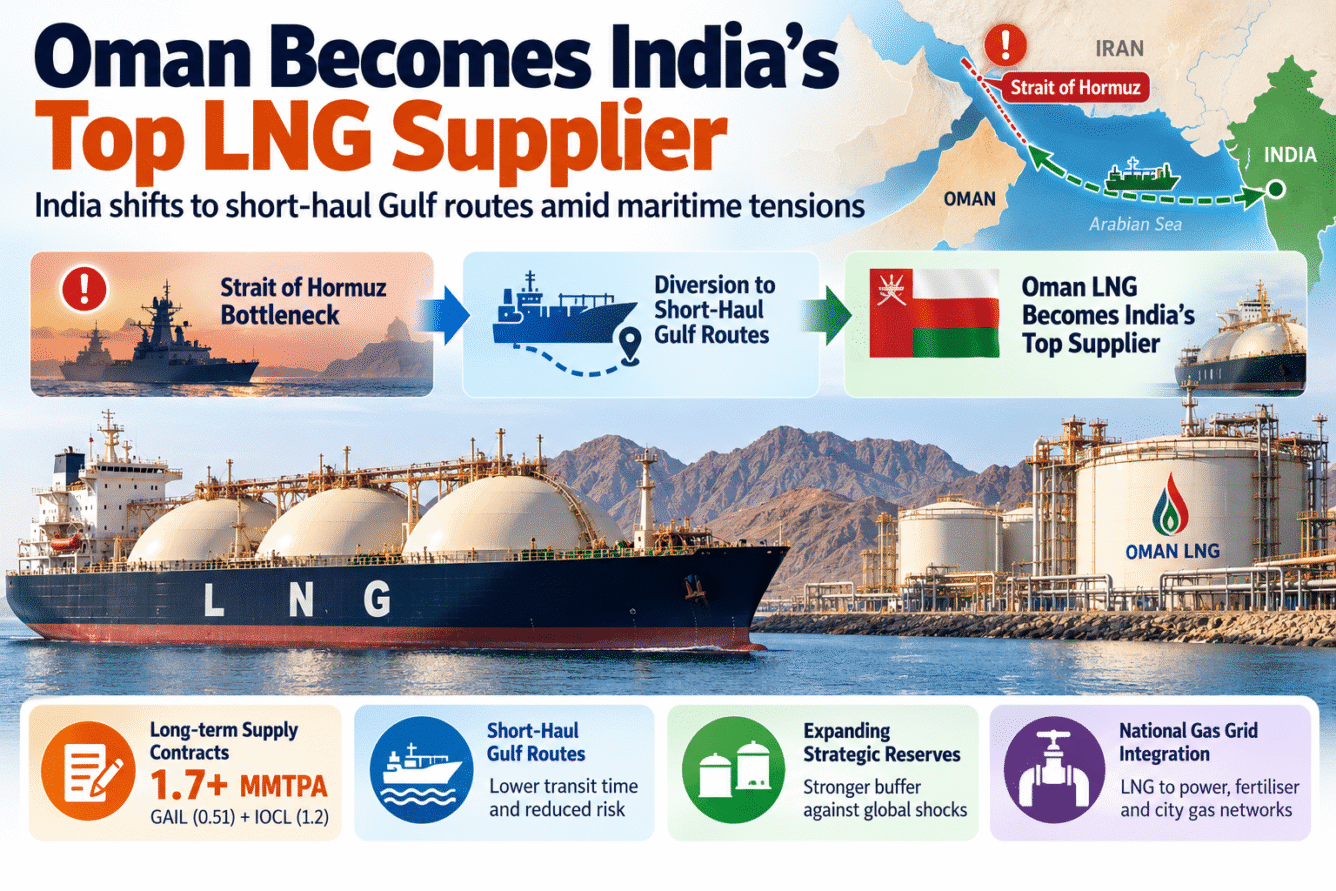
New Delhi: Oman has become India’s top LNG supplier as state-run energy importers and maritime authorities restructure primary supply channels to bypass heightened maritime friction near the Strait of Hormuz.
Amid escalating geopolitical tensions and regional maritime shipping bottlenecks, Indian energy majors shifted procurement volumes towards short-haul Gulf routes. Consequently, Oman surpassed traditional supply partners to become India’s primary source for Liquefied Natural Gas (LNG) shipments.
 [Strait of Hormuz Bottleneck] ──▶ Forces Diversion ──▶ [Short-Haul Direct Gulf Routes]
                                                                  │
 [Oman LNG Supply Contract]    ◀──( Secures Primary Indian Energy Inflows )┘
Restructuring Maritime Routes Outside Vulnerable Chokepoints
Significantly, the strategic shift follows long-term supply contracts executed between Indian state utilities and Omani LNG exporters.
State-owned GAIL (India) Limited previously finalised a long-term contract with Oman LNG to secure 0.51 million metric tonnes per annum (MMTPA). Furthermore, Indian Oil Corporation Limited (IOCL) secured an additional 1.2 MMTPA agreement. These direct, short-haul sea routes allow Indian gas carriers to load cargoes outside the immediate chokepoints of the lower Persian Gulf.
Key Maritime & Energy Supply Highlights:
Primary LNG Supplier: Oman emerges as India’s leading LNG origin point.
Supply Volume Contracts: GAIL and IOCL hold combined commitments exceeding 1.7 MMTPA.
Strategic Freight Advantage: Short-haul Gulf shipping routes reduce vessel transit times.
Buffer Infrastructure: Expanding domestic Strategic Petroleum Reserves (SPR) shields supply chains.
Expanding Strategic Petroleum Reserves and Pipeline Grid Integration
Crucially, the Ministry of Petroleum and Natural Gas is expanding national strategic energy buffers to cushion domestic industries against sudden global supply shocks.
                  [NATIONAL ENERGY SECURITY AND LOGISTICS PILLARS]
   ┌────────────────────────────────┼────────────────────────────────┐
   ▼                                ▼                                ▼
[Short-Haul Maritime Routes]     [Strategic Petroleum Reserves]   [National Gas Grid Integration]
Bypasses Hormuz chokepoints      Expands emergency buffer stocks  Links coastal terminals to inland hubs
Indian maritime authorities have coordinated closely with international shipping registries to protect LPG and LNG tankers. Additionally, expanding the national gas grid infrastructure ensures that imported LNG from Omani terminals feeds directly into power plants, fertiliser manufacturing units, and city gas distribution networks across the country without operational delays.
Oman-India Energy Supply Architecture
| Logistics Parameter | Operational Strategy | Strategic Trade Impact | National Supply Benefit |
| Primary LNG Origin | Oman LNG Terminals | Replaces longer, higher-risk sea transit. | Guarantees uninterrupted industrial gas. |
| Major Importers | GAIL & Indian Oil (IOCL) | Multi-year long-term purchase agreements. | Stabilises long-term import tariffs. |
| Route Protection | Direct Arabian Sea Shipping | Minimises passage through narrow straits. | Reduces maritime insurance premiums. |
| Buffer Strategy | Strategic Gas & Oil Storage | Strengthens emergency reserve capacity. | Shields domestic markets from volatility. |
About the Author
