

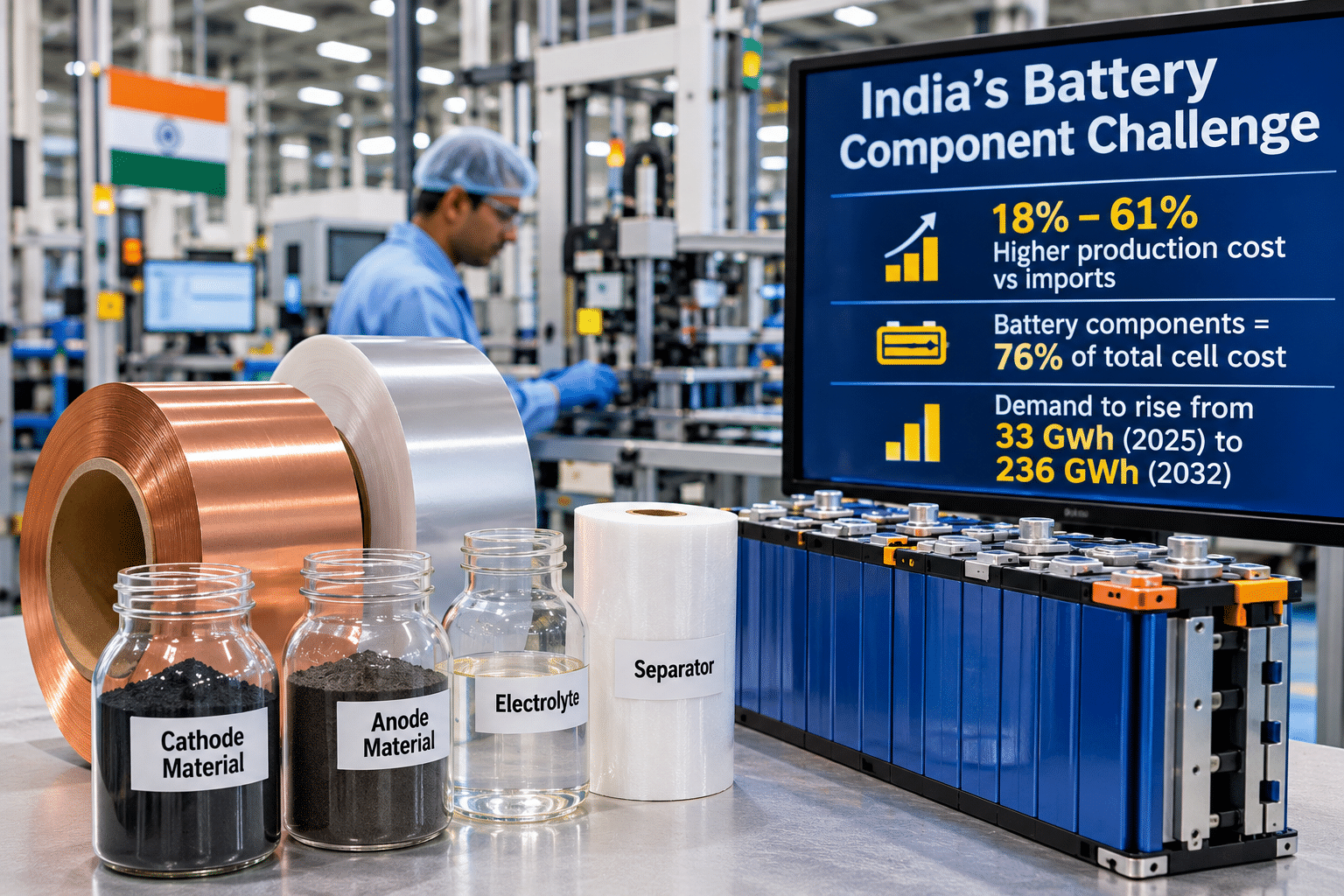
Indian battery component manufacturers are operating at a severe competitive disadvantage. The are facing production costs between 18 per cent and 61 per cent higher than imported alternatives. A landmark report released by the Ministry of Heavy Industries warns that without targeted government incentives, domestic cell plants will remain heavily dependent on overseas supply chains.
The study, titled Accelerating India’s ACC Component Manufacturing Ecosystem, was conducted by the Netzero Energy Transition Alliance (NETRA) alongside ARCI, CSIR-NCL, IIT Madras, and Deloitte. Drawing on primary operational data from over 20 Indian firms, the findings highlight severe cost penalties across critical inputs. These include cathode materials, synthetic graphite anodes, liquid electrolytes, and battery-grade copper foils.
                 INDIAN ACC COMPONENT SUPPLY CHAIN PARADOX

    +-----------------------------------------------------------+
    |               Surging National Battery Demand             |
    |      (33 GWh in 2025 ---> 236 GWh by 2032 ---> ~600 GWh)  |
    +-----------------------------+-----------------------------+
                                  |
                                  v
    +-----------------------------------------------------------+
    |               Upstream Component Cost Penalty             |
    |         (Components Account for ~76% of Total Cell Cost)  |
    +-----------------------------+-----------------------------+
                                  |
            +---------------------+---------------------+
            |                                           |
            v                                           v
+-----------------------+                   +-----------------------+
| Local Production Gap  |                   | Severe Domestic Void  |
| - Cathode/Anode/Fluid |                   | - 0% Capacity in      |
|   Meets <3% of Demand |                     Separators & Copper   |
| - 18% to 61% Cost     |                     Foil                  |
|   Penalty vs Imports  |                   | - 100% Import Reliance|
+-----------------------+                   +-----------------------+
High Cost Penalties and Zero Local Capacity Voids
Because battery components account for approximately 76 per cent of total cell manufacturing costs, localized raw material processing remains vital for national energy security. The report reveals that NMC cathode production in India carries an 18 per cent cost penalty. LFP cathode carries a 47 per cent penalty, and synthetic graphite anode manufacturing costs up to 61 per cent more than landed Chinese imports.
Furthermore, current domestic manufacturing capacity satisfies less than 3 per cent of projected 2032 demand for active cathode materials, anode materials, and electrolytes. More critically, India possesses zero local commercial capacity for battery separators or battery-grade copper foils. It leaves local cell gigafactories completely reliant on foreign suppliers.
+--------------------------------+-------------------------------------------------------+
| Component Material / Metric    | Indian Production Cost Gap vs Landed Imports          |
+--------------------------------+-------------------------------------------------------+
| Target Focus Keyphrase         | India battery component manufacturing cost gap        |
| NMC Cathode Active Material    | 18% Higher Cost (Used in long-range EV packs)         |
| LFP Cathode Active Material    | 47% Higher Cost (Standard chemistry for mass EVs)     |
| Natural & Synthetic Anode      | 51% to 61% Higher Cost (High power borrowing costs)   |
| Liquid Electrolyte Formulations| 37% Higher Cost (Chemical precursor import lag)       |
| Separators & Copper Foils      | 0% Domestic Capacity (100% Import Dependent)          |
+--------------------------------+-------------------------------------------------------+
The Urgent Policy Window and Incentive Framework Options
Industry leaders warn that policy intervention must occur before March 2027 to align domestic material supply with upcoming gigafactory operational deadlines. Cell manufacturers require 18 to 24 months to test and qualify raw material suppliers. So, delays in establishing component incentive schemes will force first-generation cell plants commissioning by 2029 to lock in long-term import contracts.
To bridge the India battery component manufacturing cost gap, the Ministry of Heavy Industries report proposes three distinct policy incentive models:
Hybrid Model: Combines a 25 per cent capital subsidy with sales-linked operating support, covering roughly 30 per cent of the cost gap (yielding 5%–18% effective support).
Operational Model: Provides an operating incentive covering around 60 per cent of the cost gap for five to seven years (yielding 11%–37% effective support).
High Capital Support Model: Offers a 50 per cent capital expenditure subsidy disbursed alongside project spend, mirroring the Semicon India policy framework.
Ultimately, choosing the appropriate policy intervention will determine whether India builds a self-sustaining clean energy value chain. Closing the component cost gap remains essential to converting downstream battery demand into resilient domestic industrial growth.
About The Author
