

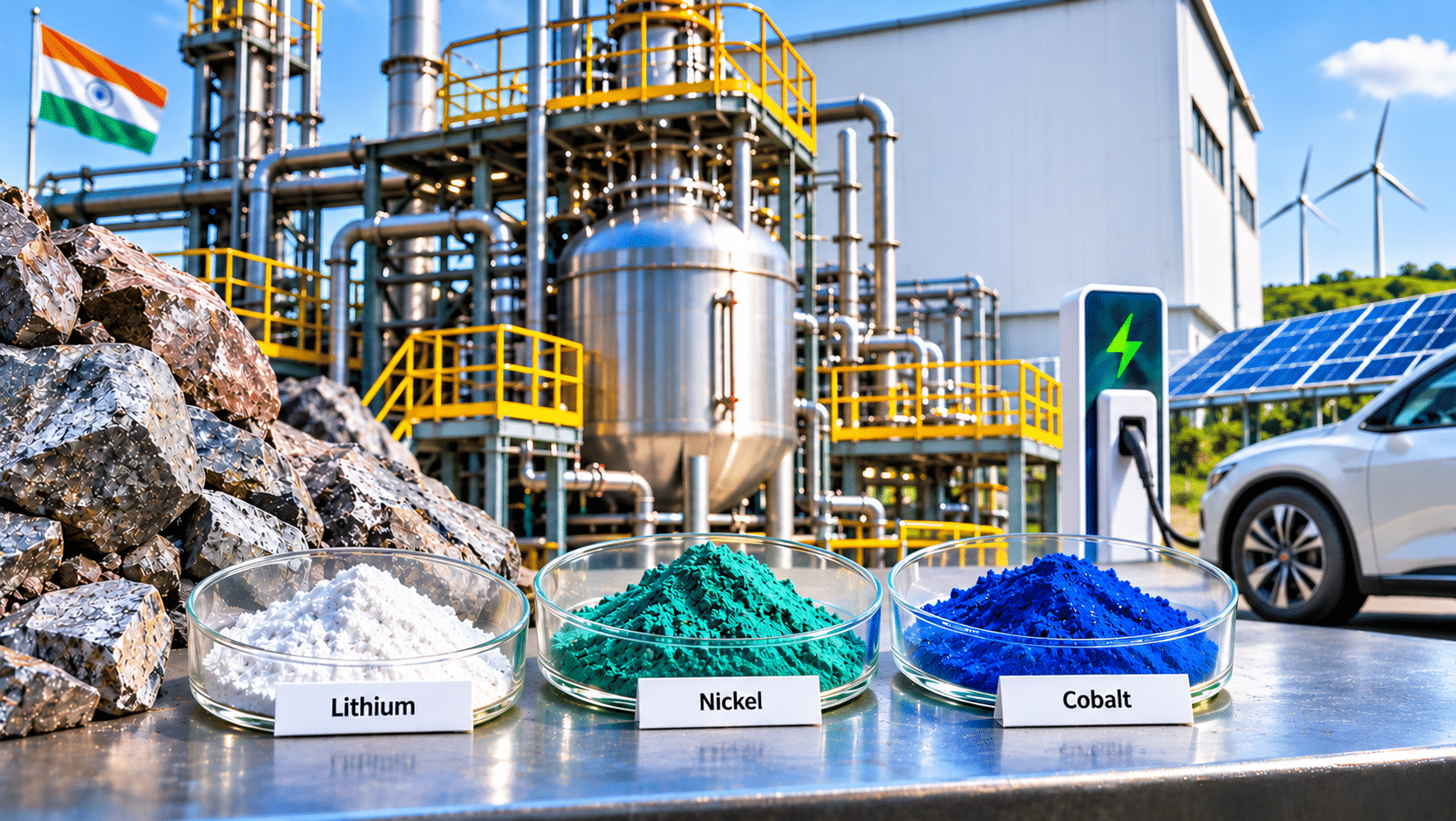
The critical mineral processing scheme represents a fundamental pivot in India’s industrial policy, moving the national focus from raw material extraction to advanced chemical refining. The scheme earmarks an overall financial outlay of ₹2,814 crore over a five-year implementation window (FY 2026–27 to FY 2030–31). The initiative is designed to build domestic facilities capable of converting raw mineral feedstock into battery-grade industrial inputs.
While India has expanded critical mineral block auctions and overseas mining acquisitions, localised refining capacity has remained a major structural vulnerability. By offering targeted capital expenditure subsidies, the policy offsets high upfront equipment costs. It encourages private developers to establish high-purity chemical processing hubs.
            CRITICAL MINERAL PROCESSING SCHEME STRUCTURE

    +-----------------------------------------------------------+
    |           ₹2,814 Crore Total Budgetary Outlay             |
    |      (₹2,800 Cr Direct Subsidies | ₹14 Cr Admin Expenses) |
    +-----------------------------+-----------------------------+
                                  |
                                  v
    +-----------------------------------------------------------+
    |               Targeted Domestic Processing Hubs           |
    +-----------------------------+-----------------------------+
                                  |
            +---------------------+---------------------+
            |                                           |
            v                                           v
+-----------------------+                   +-----------------------+
| Lithium Processing    |                   | Nickel & Cobalt Hubs  |
| - 2 Beneficiaries     |                   | - 2 Beneficiaries     |
| - 30,000 Tonnes Min   |                   | - 50,000 Tonnes Min   |
|   Capacity Each       |                     Capacity Each         |
| - ₹1,000 Cr Outlay    |                   | - ₹1,800 Cr Outlay    |
|   (Cap: ₹500 Cr/Plant)|                   |   (Cap: ₹900 Cr/Plant)|
+-----------------------+                   +-----------------------+
Infrastructure Outlays and Technical Target Capacities
Under the framework of the critical mineral processing scheme, financial assistance takes the form of a 30 per cent capital subsidy on eligible investments. The overall budget allocates ₹2,800 crore for direct capital support and ₹14 crore for administrative and managerial implementation. The scheme explicitly targets two essential energy metals: lithium and nickel.
For lithium, the scheme supports two facilities, requiring a minimum annual processing capacity of 30,000 tonnes per plant. It provides capital assistance capped at ₹500 crore per beneficiary. The lithium component excludes brines, focusing instead on processing ores and concentrates into battery-grade chemicals.
For nickel, the policy funds two plants with a minimum capacity of 50,000 tonnes each, capping assistance at ₹900 crore per beneficiary while requiring the recovery of cobalt as a high-value byproduct. Combined, these four facilities aim to create 60,000 tonnes of annual lithium processing capacity and 100,000 tonnes of nickel processing capacity by 2030, leveraging an estimated ₹10,000 crore in total private sector investment.
+--------------------------------+-------------------------------------------------------+
| Scheme Parameter / Metric      | Structural Specification & Benchmark Target           |
+--------------------------------+-------------------------------------------------------+
| Core Nodal Authority           | Ministry of Mines (Governing Council Oversight)       |
| Total Budgetary Support        | ₹2,814 Crore (FY 2026–27 to FY 2030–31)               |
| Financial Subsidy Mechanism    | 30% Capital Support (3-Tranche Milestone Disbursement)|
| Lithium Output Target          | 60,000 Tonnes Annual Capacity across 2 Plants         |
| Nickel & Cobalt Output Target  | 100,000 Tonnes Annual Capacity across 2 Plants        |
| Expected Private Mobilization  | ~₹10,000 Crore in secondary industrial capital         |
+--------------------------------+-------------------------------------------------------+
Bidding Mechanics and Financial Disbursement Tranches
The critical mineral processing scheme employs a competitive, two-stage bidding mechanism to select project developers. Applicants must first pass a technical evaluation assessing processing technology, feedstock arrangements, and environmental safeguards. Bidders who clear technical vetting then compete in a financial bidding round,. The selection follows a least-cost evaluation model that awards contracts to developers requesting the lowest government capital support.
Disbursement of the awarded capital subsidy is strictly tied to equity and construction milestones to enforce timely execution:
First Tranche (25% Disbursement): Released once the beneficiary incurs 25 per cent of committed CAPEX and injects at least 15 per cent of required equity.
Second Tranche (Cumulative 50% Disbursement): Released upon spending 50 per cent of committed CAPEX and contributing 50 per cent of baseline equity.
Final Tranche (Remaining 50% Disbursement): Released following commercial commissioning of the plant and full 100 per cent equity deployment.
Selected developers are required to commission their facilities within three years of receiving the Letter of Award. Failure to meet the three-year timeline triggers a progressive reduction in remaining subsidy payments, with a strict five-year long-stop deadline for full project completion.
Integration with National Supply Chain Architecture
By establishing high-purity chemical processing inside domestic borders, the framework protects India’s advanced manufacturing ecosystem from international supply disruptions and volatile price swings. Output from these plants will supply battery cell manufacturers, grid-scale storage developers, specialty steel producers, and defense contractors.
This initiative forms a core component of the broader National Critical Mineral Mission. It complements upstream mineral block auctions and downstream recycling schemes for spent lithium-ion batteries.
Ultimately, establishing high-capacity processing hubs ensures that access to raw minerals translates into long-term industrial capability. The scheme bridges the gap between raw feedstock and high-purity industrial inputs. It positions domestic manufacturing to support long-term energy transition and technological resilience.
About The Author
