
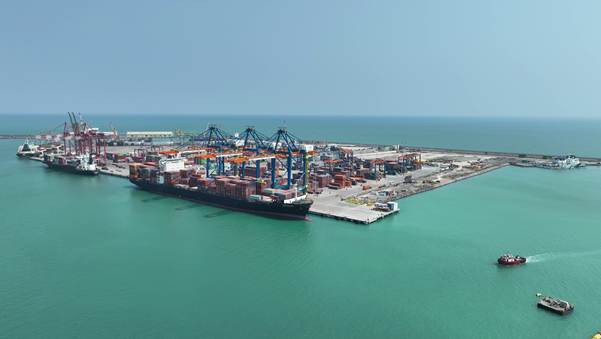
NEW DELHI. The Vallinayagam Olaganathan (VO) Chidambaranar Port Authority (VOCPA) has achieved a historic milestone in Indian maritime history. Digital twin port technology now powers the management of this strategic facility in Tuticorin. Sarbananda Sonowal, Union Minister of the Ministry of Ports, Shipping and Waterways (MoPSW), inaugurated the platform recently. This system creates a real-time virtual replica of the entire port infrastructure and maritime ecosystem. This echnology marks a significant step toward smart and technology-driven maritime management in India. The platform integrates advanced Internet of Things (IoT) sensors and Global Positioning System (GPS) tracking. Consequently, the port achieves higher operational visibility and data-driven decision-making immediately.
Technical Integration and Real-Time Monitoring
The platform mirrors real-time conditions using Light Detection and Ranging (LiDAR) mapping and drone imaging. This technology enables seamless coordination among all operational departments. Operators now visualise berth occupancy and vessel movements on a live digital interface. Furthermore, the system tracks crane utilisation and yard capacity with extreme precision. Digital twin port technology supports predictive maintenance through Artificial Intelligence (AI) based asset monitoring. This proactive approach minimises equipment downtime and improves overall reliability for international shipping lines. CCTV networks and sensors provide a continuous data stream into the virtual model.
Operational Efficiency and Sustainability Goals
The system facilitates berth and traffic optimisation by enabling intelligent scheduling of vessels. The port authority expects a reduction in vessel turnaround time by up to $25\%$. Such efficiency gains from digital twin port technology lower the operational costs for global trade. In addition, the platform tracks energy and emissions to support sustainability management. Scenario simulation capabilities allow operators to conduct “what-if” modeling for peak demand situations. Thus, the port prepares for potential operational disruptions or sudden demand spikes effectively. The project follows a phased implementation plan to ensure total system stability.
Digital Twin Port Technology: National Vision and Global Benchmarking
Prime Minister Narendra Modi envisioned this digital transformation under the Maritime India Vision (MIV) $2030$. Digital twin port technology helps achieve globally benchmarked targets for Ease of Doing Business (EoDB). Chairperson Susanta Kumar Purohit stated that this initiative aligns the port with international smart port standards. However, the full-fledged rollout requires consistent technical support and massive data management. High-tech systems often face challenges during the initial integration with legacy infrastructure. Therefore, the port continues to move forward with a focus on long-term resilience and transparency.
VOC Port Digital Twin Launch (March 2026)
| Parameter | Detail / Attribution |
|---|---|
| Project Name | First Indian Major Port Digital Twin. |
| Leading Authority | Sarbananda Sonowal, Union Minister (MoPSW). |
| Primary Theme | Implementation of digital twin port technology. |
| Efficiency Goal | Reduce vessel turnaround time by up to $25\%$. |
| Technologies | IoT, AI, LiDAR, Drones, and GPS tracking. |
| National Vision | Aligned with MIV $2030$ and Amrit Kaal Vision $2047$. |
About the Author
