

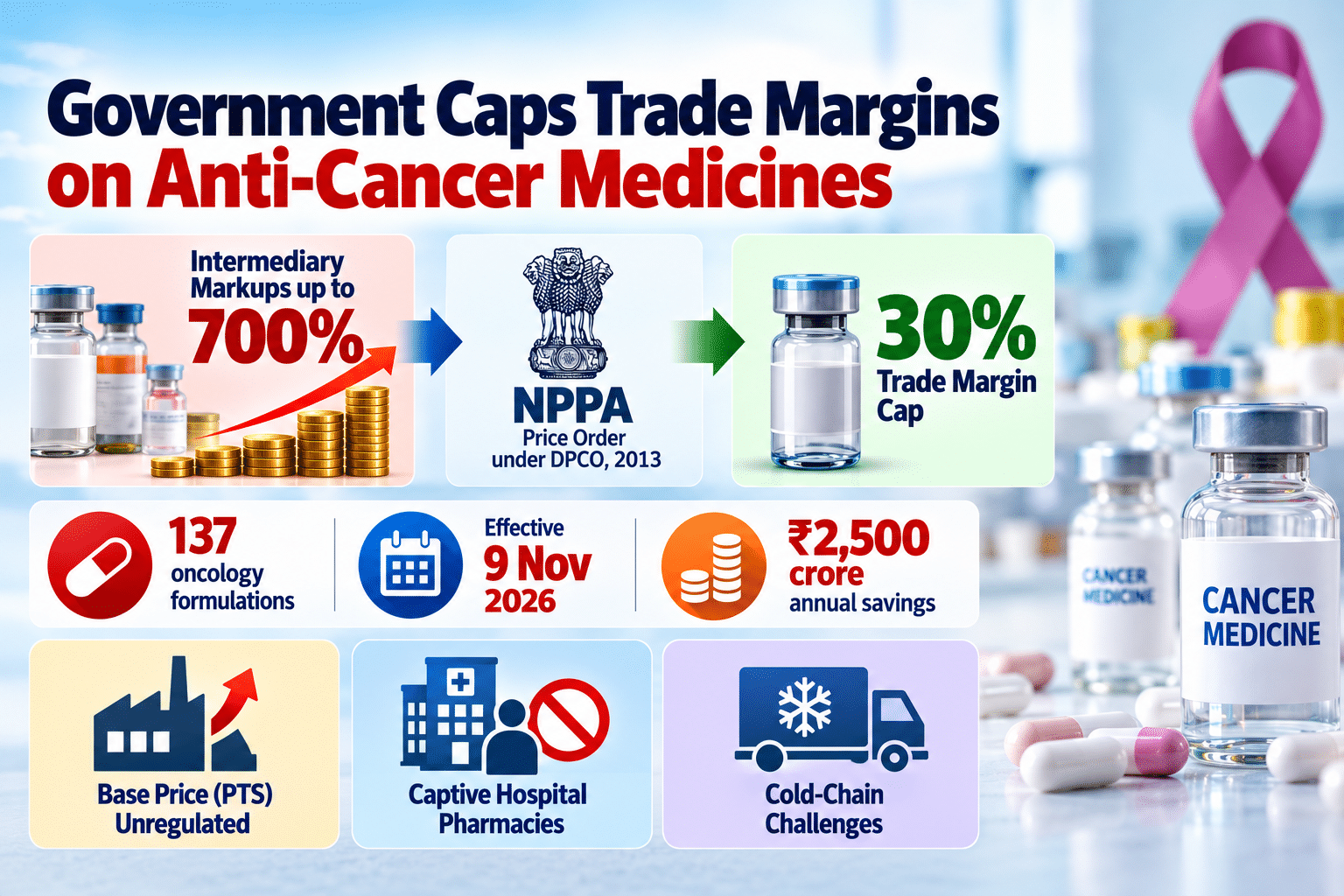
New Delhi: Public health regulators have enforced a major price-intervention framework as the government caps trade margins on anti-cancer medicines.
In a formal notification issued under Paragraph 19 of the Drugs (Prices Control) Order (DPCO), 2013, the National Pharmaceutical Pricing Authority (NPPA) capped trade margins at 30 per cent across 137 non-scheduled oncology formulations. Effective 9 November 2026, the directive aims to eliminate excessive intermediary markups. These margins historically reached up to 700 per cent. The move will deliver estimated annual consumer savings of ₹2,500 crore.
 [Historical Intermediary Markups: 170%–700%] ──▶ Capped by NPPA ──▶ [Mandated 30% Trade Margin Cap]
                                                                                      │
 [Unregulated Manufacturer Base Price (PTS)] ◀──( Leaves Base Price Inflation Unchecked )┘
Trade Margin Cap Restructures Retail Pricing Formulas
Significantly, the NPPA notification covers critical, high-cost therapies, including patented immunotherapies like pembrolizumab, durvalumab, and osimertinib.
Under the Trade Margin Rationalisation (TMR) formula, the trade margin represents the mathematical spread between the Maximum Retail Price (MRP) and the price at which the manufacturer sells the drug to the stockist (Price to Stockist or PTS). By restricting this gap to a maximum allowable markup of 42.86 per cent over the PTS, the regulator expects retail prices for several life-saving formulations to fall by 30 to 70 per cent.
Key Regulatory Parameters (NPPA Anti-Cancer Price Order):
Regulated Formulations: 137 non-scheduled anti-cancer drugs.
Statutory Provision: Invoked Paragraph 19 of DPCO, 2013 in public interest.
Implementation Deadline: Manufacturers must issue revised price lists taking effect 9 November 2026.
Mandated Production: Invoked Paragraph 21(2) of DPCO 2013 to prevent artificial supply shortages.
Why Trade Margin Caps Alone Fall Short
Crucially, health economists, patient rights advocates, and Supreme Court filings highlight significant structural loopholes in the TMR model that prevent true universal affordability.
                  [STRUCTURAL LIMITATIONS OF THE 30% MARGIN CAP]
   ┌────────────────────────────────┼────────────────────────────────┐
   ▼                                ▼                                ▼
[Base Price (PTS) Inflation]     [Captive Hospital Monopolies]    [Cold-Chain & Logistical Overhead]
Manufacturers can raise baseline Institutional dispensaries force Industry notes specialized handling
Price to Stockist to preserve profit  patients to buy at maximum MRP  costs are excluded from margin math
1. Unregulated Baseline Manufacturer Pricing
The 30 per cent cap applies strictly to the gap between the Price to Stockist (PTS) and the MRP. So, it leaves the baseline PTS completely uncontrolled. Drug manufacturers can offset squeezed retail margins by simply inflating their initial wholesale selling price to stockists. Without backward cost audits on actual manufacturing or import expenses, high base prices keep advanced therapies out of reach for lower-income households.
2. Failure to Disband Captive Hospital Pharmacies
Pertinenly, a major driver of inflated cancer treatment bills is the commercial linkage between private tertiary hospitals and in-house dispensaries. Corporate hospitals frequently prohibit patients from buying cheaper, generic oncology medicines from outside retail chemists, compelling them to purchase drugs from in-house pharmacies at the absolute maximum allowed MRP. Health advocates argue that unless the Competition Commission of India (CCI) enforces open procurement, hospital chains will absorb the remaining 30 per cent margin while refusing to pass off-label discounts to patients.
3. Supply Chain Disincentives for Cold-Chain Therapies
Conversely, pharmaceutical industry representatives caution that complex biologicals and immunotherapies require specialised cold-chain storage and handling. A uniform 30 per cent cap across all channel links—distributors, stockists, and retailers—may disincentivise tier-2 and tier-3 distributors from maintaining strict temperature-controlled storage, risking supply chain disruptions outside major metros.
About the Author
