

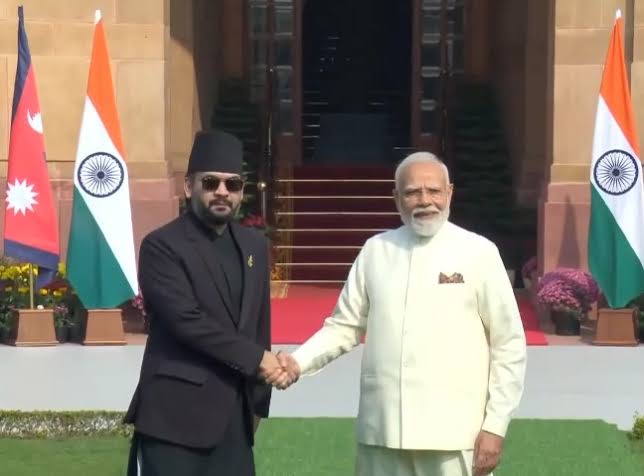
Prime Minister Narendra Modi announced a major economic and development package worth 240 billion Nepalese rupees (approximately $1.62 billion, at 148.62 Nepalese rupees per US dollar) for Nepal on Monday, November 23, 2026, following bilateral talks in New Delhi with Nepalese Prime Minister Balendra “Balen” Shah. The announcement capped Shah’s two-day state visit to India on November 22–23—his first overseas bilateral trip since taking office in March 2026—and comes as Kathmandu rebuilds from severe flooding and glacial flood damage earlier this year.
During the visit, Shah was accorded a ceremonial reception at Rashtrapati Bhavan, met External Affairs Minister S. Jaishankar, paid tribute at Raj Ghat, and called on President Droupadi Murmu before holding comprehensive talks with Modi. A 34-member official delegation—including Nepal’s Finance Minister Swarnim Wagle, Foreign Minister Shishir Khanal, and Chief Adviser Kumar Byanjankar—accompanied Shah alongside a 52-member business delegation for engagements through the Nepal-India Business Forum.
Key Pillars of the Bilateral Agenda and Package
Post-Flood Reconstruction and Strategic Context
The assistance arrives as Nepal confronts steep rebuilding needs after deadly flooding and August glacial flood events that claimed over a thousand lives and damaged thousands of homes and hydroelectric facilities, with Nepali assessments estimating total recovery costs in the multi-billion-dollar range. Ahead of the visit, Kathmandu had sought a package of around $2 billion to advance infrastructure and reconstruction works.
India remains Nepal’s largest trading partner—absorbing roughly 80 per cent of Nepal’s goods exports under duty-free access and providing vital transit and seaport access—as well as accounting for nearly a third of its foreign direct investment. Both sides framed the talks around New Delhi’s Neighbourhood First policy and a forward-looking cooperation vision across physical and digital links, while maintaining bilateral mechanisms for addressing sensitive boundary questions.
Commercial and Institutional Takeaways
For businesses and policymakers across the border, the package signals fresh momentum for cross-border engineering, power transmission, logistics, and reconstruction contracting. Market and policy watchers will look closely at project-level implementation timelines, grant-versus-credit breakdowns, and how commercial ventures leverage improved rail, customs, and energy corridors.
About The Author
