

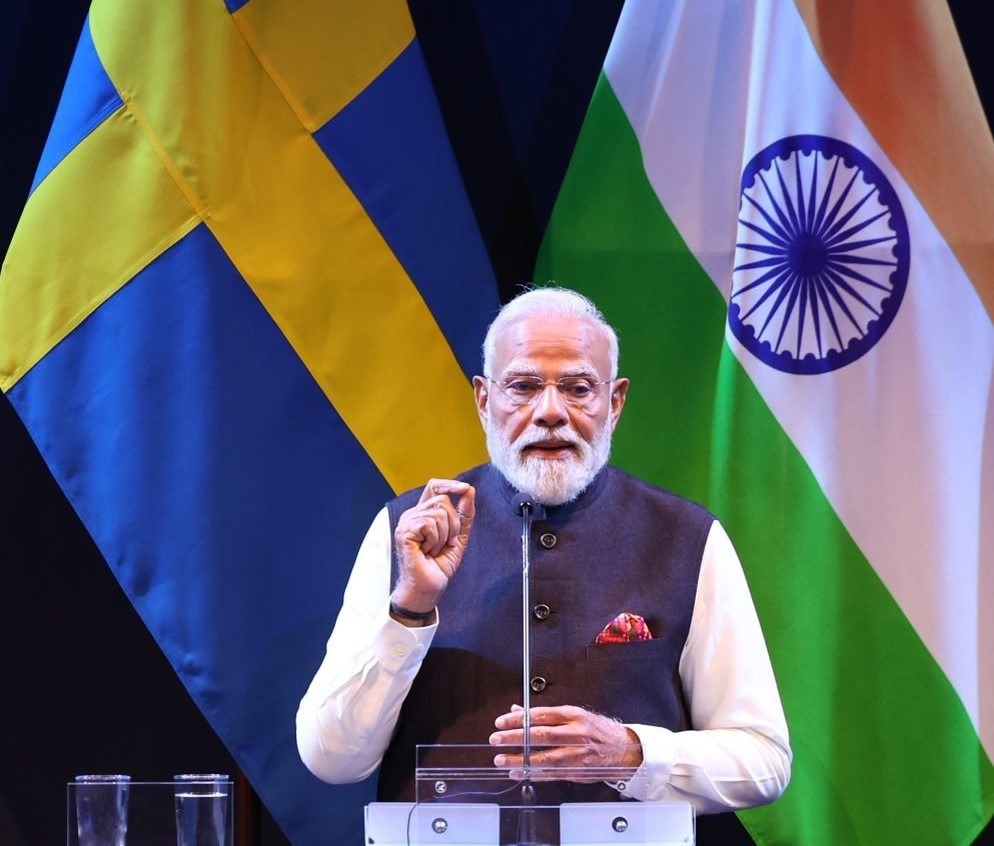
GOTHENBURG. Prime Minister Narendra Modi addressed the European Round Table for Industry (ERT) to strengthen economic ties. He announced that the recently concluded India-EU FTA negotiations will create massive opportunities across several commercial sectors. Speaking at the gathering hosted by Volvo Group, he pitched India as a trusted global economic partner. Swedish Prime Minister Ulf Kristersson and European Commission President Ursula von der Leyen attended the high-level business interaction. Modi highlighted the growing strategic convergence and shared democratic values binding India and Europe together. He described the landmark trade pact as a truly transformative partnership for long-term growth. This agreement marks a turning point for international trade and technology collaboration.
Expanding Investment and Resilient Supply Chains
The Prime Minister emphasised that both regions must cooperate to build highly diversified and resilient supply chains. The India-EU FTA remains a vital tool to cushion businesses against an increasingly uncertain global environment. Modi pointed to India’s rapid economic growth, next-generation reforms, and expanding infrastructure as primary investment drivers. He reiterated the national governance vision of “Design for India, Make in India and Export from India”. European industry leaders received an invitation to deepen their manufacturing engagement with the domestic market. Strategic connectivity initiatives like the India-Middle East-Europe Economic Corridor will further accelerate this business cooperation. These combined frameworks aim to secure critical trade routes and boost corporate confidence.
Technological Collaboration and Future Sectors
Modi identified several cutting-edge industries as key focus areas for enhanced bilateral industrial collaboration. Achieving the full potential of the India-EU FTA requires deep partnerships in artificial intelligence and semiconductors. He urged European firms to invest in Indian telecom infrastructure, digital public networks, and deep-tech manufacturing. The Prime Minister also highlighted massive ongoing transformations in green hydrogen, transport logistics, and nuclear power. To strengthen institutional engagement, he proposed holding an annual India-Europe CEOs Round Table meeting. He also suggested creating a dedicated India Desk at the ERT for continuous industrial dialogue. These platforms will help synchronise policy directions with private sector innovation.
Talent Mobility and Institutional Partnerships
The address heavily underlined the importance of education, skill development partnerships, and cross-border talent mobility. Modi described India’s young and skilled workforce as a primary engine for future global economic growth. The India-EU FTA will facilitate smoother people-to-people ties and robust academic research collaborations. In the healthcare and life sciences sectors, he noted a broad scope for digital health and medical devices. European conglomerates like Philips, Nestle, and Unilever already maintain long-standing relationships with the Indian market. The Prime Minister concluded by stating that the bilateral relationship extends far beyond mere economic figures. Both sides reaffirmed their shared commitment to sustainable growth and resilient global partnerships.
India-EU Business Interaction Highlights
| Parameter | Details / Strategic Outcomes |
| Event Location | Gothenburg, Sweden (Hosted by Volvo Group). |
| Primary Metric | India-EU FTA. |
| Key Attendees | PM Narendra Modi, PM Ulf Kristersson, President Ursula von der Leyen. |
| Core Sectors | AI, Semiconductors, Telecom, Clean Energy, and Healthcare. |
| Connectivity Link | India-Middle East-Europe Economic Corridor (IMEC). |
| Institutional Proposals | Annual CEOs Roundtable & Dedicated India Desk at ERT. |
About the Author
