

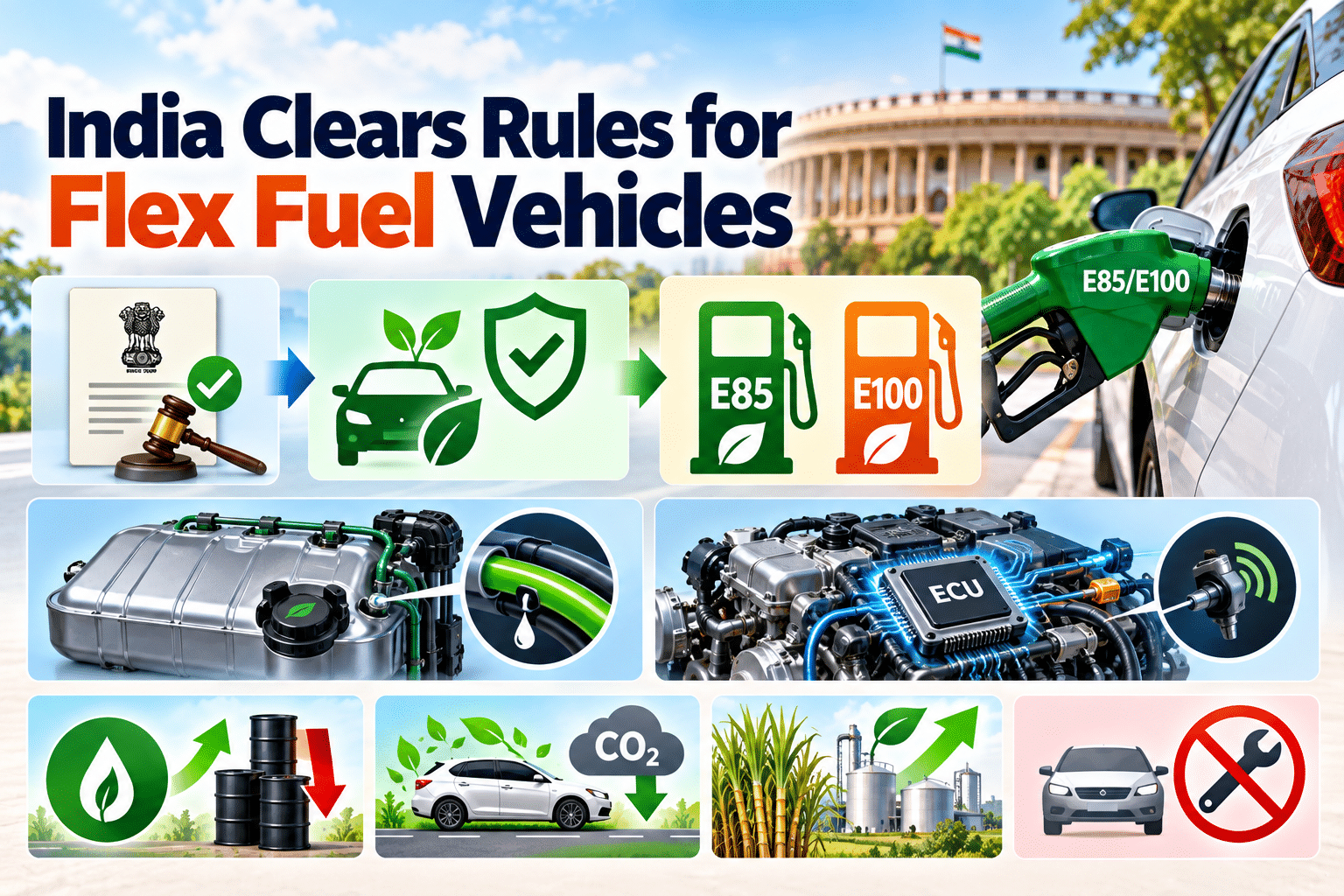
The Ministry of Road Transport and Highways (MoRTH) has notified amendments to the Central Motor Vehicles Rules, 1989. The regulatory updates facilitate the official adoption of flex fuel vehicles capable of operating on high ethanol blends.
Specifically, the notification explicitly incorporates E85 and E100 ethanol fuels into national emission certification provisions. Consequently, vehicles certified under these new rules must satisfy all prescribed safety and environmental standards applicable to their category.
                  FLEX FUEL EMISSION & REGULATORY ROADMAP

    +-----------------------------------------------------------+
    |         MoRTH Central Motor Vehicles Rules Amendment      |
    +-----------------------------+-----------------------------+
                                  |
                                  v
    +-----------------------------------------------------------+
    |             Emission & Safety Certification               |
    |          (Covers E85 & Predominantly E100 Blends)         |
    +-----------------------------+-----------------------------+
                                  |
            +---------------------+---------------------+
            |                                           |
            v                                           v
+-----------------------+                   +-----------------------+
| Dedicated Hardware    |                   | Automatic Engine      |
| & Material Standards  |                   | Control Calibration   |
| - Ethanol Resistance  |                   | - Sensor Fuel Ratio   |
| - Specialized Tanks   |                   |   Adjustments         |
+-----------------------+                   +-----------------------+
Understanding Flex Fuel Technology and Compatibility
Flex fuel technology allows vehicles to run on varying combinations of petrol and ethanol within a single fuel tank. In fuel nomenclature, the letter ‘E’ stands for ethanol, while the numerical value indicates its percentage volume.
Thus, E85 contains up to 85 per cent ethanol by volume, whereas E100 consists predominantly of pure ethanol. Advanced engine control units automatically adjust fuel injection parameters based on real-time fuel composition sensors.
+--------------------------------+-------------------------------------------------------+
| Regulatory Metric              | Operational Guideline & Technical Scope               |
+--------------------------------+-------------------------------------------------------+
| E85 Fuel Composition           | Petrol and ethanol blend containing up to 85% ethanol |
| E100 Fuel Composition          | Predominantly ethanol fuel blend                      |
| System Requirements            | Dedicated ethanol-compatible components & ECU sensors |
| Existing Vehicle Exemption     | No mandatory retrofitting required for legacy fleet   |
+--------------------------------+-------------------------------------------------------+
Curbing Crude Oil Dependence and Emissions
Furthermore, expanding domestic ethanol consumption directly aligns with national energy security objectives. Greater utilization of locally produced ethanol significantly reduces India’s reliance on expensive crude oil imports.
Additionally, deploying ethanol in purpose-built engines lowers tailpipe exhaust pollutants. Therefore, the transition helps curb overall lifecycle greenhouse gas emissions depending on raw feedstock processing efficiency.
Impact on Existing Vehicle Owners
Meanwhile, the Ministry clarified that existing vehicle owners are not required to switch to high ethanol blends or retrofit their engines. Standard vehicles engineered for E10 or E20 blends cannot safely run on E85 or E100 fuels.
Consequently, motorists must check the official fuel compatibility sticker on their vehicles before refuelling. Ultimately, the notification also updates biodiesel provisions and technical corrections, taking immediate effect upon publication in the Official Gazette.
About The Author
