
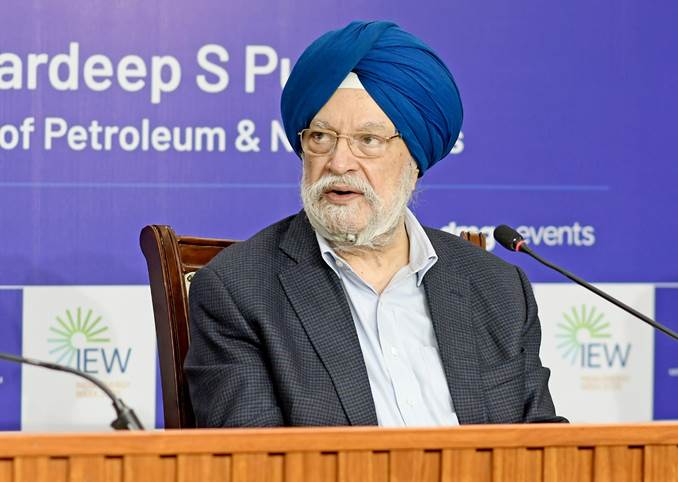
Union Petroleum and Natural Gas Minister Hardeep Singh Puri
New Delhi: Public sector oil marketing companies (OMCs) incurred a massive financial hit of ₹74,781 crore on the below-cost sale of petrol, diesel, and domestic LPG during the period leading up to June 30. The massive under-recoveries were a direct result of international crude oil prices skyrocketing at the peak of the recent West Asia conflict.
Speaking to reporters, Union Petroleum and Natural Gas Minister Hardeep Singh Puri detailed why state-run refiners continue to feel the financial squeeze despite international markets turning bearish over the last few weeks.
The Procurement Lag: Processing High-Cost Crude
Addressing the current financial health of Indian refiners, Minister Puri explained that while global crude benchmark prices have eased significantly. But oil marketing companies are still actively processing raw inventory purchased at the height of the West Asia crisis.
The Refinement Timeline Explained:
-
Advance Procurement: Indian oil companies typically purchase crude oil—the primary feedstock for domestic fuel production—at least two months in advance.
-
Delayed Reflection: Consequently, the crude oil being refined and dispatched to retail pumps at present largely reflects expensive cargoes bought back in April and early May. At that time, geopolitical tensions choked international supply corridors.
Will Petrol and Diesel Prices Be Cut?
When questioned on whether the central government or state refiners would pass on relief to retail consumers via fuel price cuts, the Minister indicated that it is too early to make a definitive move.
Minister Hardeep Singh Puri on Price Revisions: “This would be a legitimate question if oil prices stayed low for the next few weeks.”
Puri strongly implied that an official retail price reduction would warrant serious policy consideration only if international crude benchmarks sustain their subdued levels consistently over the coming weeks.
International crude prices only began their downward trajectory during the latter half of June. This correction followed a successful diplomatic breakthrough and agreement between the United States and Iran, which effectively resolved the blockade, leading to the reopening of the strategic Strait of Hormuz.
Market Share Trends: PSUs Dominate Fuel Retailing
Despite absorbing these significant short-term under-recoveries to insulate Indian consumers from extreme global inflation, state-run refiners have strengthened their market dominance.
According to data highlighted by the Joint Petroleum Secretary, public sector oil marketing companies recorded a solid 4.57% increase in their combined market share for petrol and diesel retailing over the volatile period. This underscores consumer reliance on state-owned retail networks during global energy disruptions.
Financial Impact on OMCs at a Glance
About the Author
