

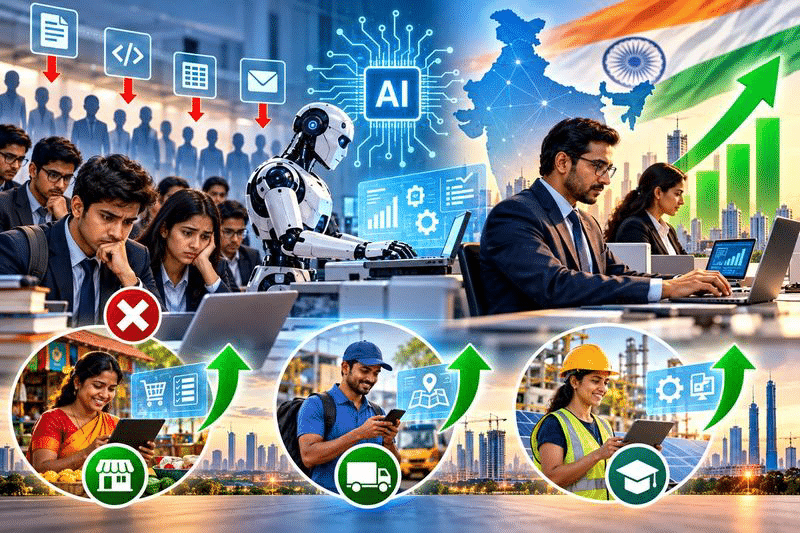
Research published by IIT Madras in collaboration with NITI Aayog warns that rapid artificial intelligence adoption is altering formal labour markets. While AI task automation rarely replaces entire roles instantly, it automates specific entry-level tasks, significantly narrowing junior recruitment pipelines.
Consequently, fresh graduates face fewer opportunities in routine data processing, basic software development, and administrative roles. Meanwhile, highly experienced professionals command substantial wage premiums for managing AI workflows.
                  AI TASK AUTOMATION & LABOUR SHIFTS

    +-----------------------------------------------------------+
    |                 IndiaAI Deployment Push                   |
    |          (Targeting MSME Productivity Expansion)          |
    +-----------------------------+-----------------------------+
                                  |
                                  v
    +-----------------------------------------------------------+
    |              Labor Market Structural Disruption           |
    +-----------------------------+-----------------------------+
                                  |
            +---------------------+---------------------+
            |                                           |
            v                                           v
+-----------------------+                   +-----------------------+
| Entry-Level Freeze    |                   | Policy Mitigation     |
| - Junior Role Pipeline|                   | - Portable Social     |
|   Constrained         |                   |   Safety Nets         |
| - Over 60% Formal Jobs|                   | - Skilling & Reskilling|
|   Exposed by 2030     |                   |   Missions            |
+-----------------------+                   +-----------------------+
Portable Social Safety Nets for Informal and Gig Workforce
NITI Aayog estimates that over 60 per cent of formal sector jobs will experience AI-driven task modifications by 2030. However, the technology also offers productivity gains for India’s 490 million informal and gig workers by enabling low-cost inventory, bookkeeping, and language tools.
+--------------------------------+-------------------------------------------------------+
| Labor Market Parameter         | Projection & Economic Metric                          |
+--------------------------------+-------------------------------------------------------+
| Informal Workforce Scale       | ~490 million workers (90% of total workforce)         |
| Estimated AI Economic Value    | USD 1.7 trillion addition to Indian economy by 2035   |
| Projected AI-Linked Jobs       | Up to 4 million specialised jobs by 2031              |
| Formal Job AI Exposure         | Over 60% of formal roles exposed to task automation   |
+--------------------------------+-------------------------------------------------------+
To manage career transitions due to AI automation, policy advisors recommend establishing portable social protection systems—covering healthcare, pensions, and retraining allowances—that move seamlessly with workers across job shifts.
Takeaways
Ultimately, AI is changing the way people work, and India will need to prepare its workforce for this shift. While automation may make it harder for fresh graduates to find their first jobs, it will also create new opportunities for those who can adapt to changing demands. The key lies in helping people learn new skills, making retraining more accessible and ensuring that workers do not lose basic social security when they change jobs. The challenge is to make AI work for people, rather than leave them struggling to keep up with it.
About The Author
