

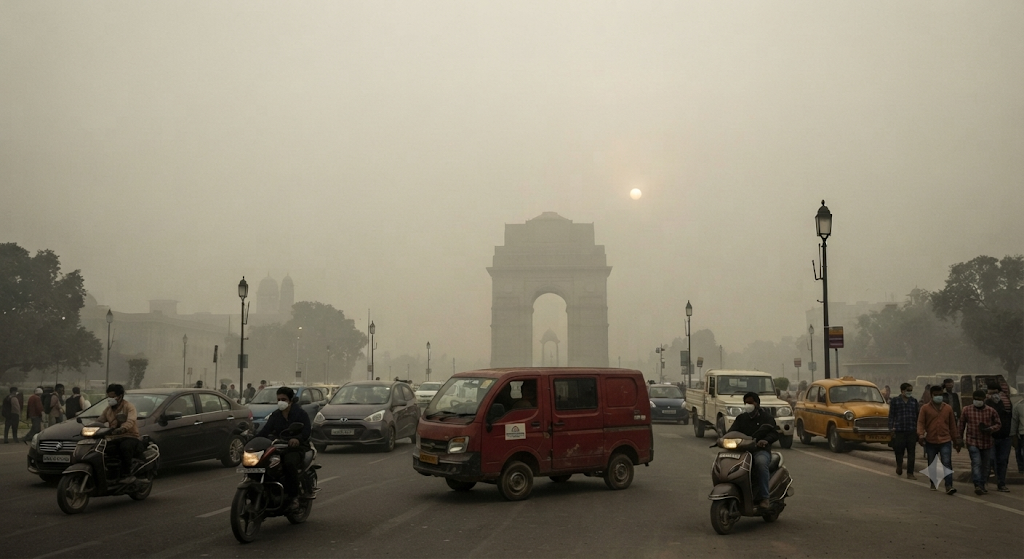
Delhi surpassed Lahore to become the world’s most polluted city on Friday, November 13, as a thick blanket of smog enveloped the national capital. Swiss air monitoring group IQAir recorded Delhi’s Air Quality Index (AQI) at 334, placing the capital in the “hazardous” category. Concurrently, India’s Central Pollution Control Board (CPCB) logged an even higher severe reading of 403 at 9:00 AM, with 33 out of 58 monitoring stations crossing severe thresholds following post-Diwali particulate accumulation.
Monitoring Discrepancies and Index Metrics
The discrepancy between the figures reported by international bodies and domestic regulators stems from distinct measurement scales and calculation methods. While IQAir applies a US EPA-based metric emphasizing fine particulate matter (PM2.5\text{PM}_{2.5} concentrations), the CPCB utilizes India’s National Air Quality Index, which aggregates multiple pollutants including PM10\text{PM}_{10}, NO2\text{NO}_2, CO\text{CO}, and SO2\text{SO}_2. Despite these methodological differences, both frameworks confirmed that air quality had deteriorated into extreme brackets, with certain localized stations recording individual spikes exceeding 450.
Contributing Factors and Meteorological Conditions
The sharp accumulation of pollutants followed festive celebrations, compounding seasonal vulnerabilities across the National Capital Region (NCR). Stagnant meteorological conditions—characterized by low wind speeds, reduced atmospheric dispersion, and dropping nocturnal temperatures—trapped particulate matter close to the surface. Furthermore, stubble-burning emissions transported from regional agricultural belts, combined with vehicular exhaust and local dust, sustained the heavy shroud over a population of roughly 20 million residents.
Public Health Implications and Regulatory Response
Health experts have strongly advised vulnerable demographics, including children, the elderly, and individuals with pre-existing respiratory or cardiovascular conditions, to restrict outdoor exposure. Medical literature, including studies published in The Lancet Planetary Health, links short-term spikes in PM2.5\text{PM}_{2.5} well above World Health Organization (WHO) guidelines to acute respiratory distress and increased mortality risks across major urban Indian centers. In response to the worsening crisis, municipal authorities intensified localized mitigation measures, deploying water sprinklers and anti-smog guns across high-density traffic junctions and commercial corridors to suppress fugitive dust.
About The Author
