
Patients undergoing oncology care across the country will experience major financial relief starting Monday, 9 November 2026. Following decisive regulatory action by the National Pharmaceutical Pricing Authority (NPPA), anti-cancer medicine prices are set to drop sharply across 1,031 formulations. The price reduction follows a mandatory trade margin ceiling capping distributor and retail markups at 30 per cent of the Maximum Retail Price (MRP).
The policy intervention implements recommendations from an expert committee constituted by the Directorate General of Health Services (DGHS). Official data confirms that 76 pharmaceutical manufacturers have already submitted revised price structures covering 1,225 formulations across 121 oncology drugs.
The Backdrop to the Price Cut
The genesis of the forthcoming drop in anti-cancer medicine prices lies in direct judicial intervention from the Supreme Court of India during its hearing of a Public Interest Litigation (PIL) challenging exorbitant pharmaceutical markups. A bench led by Justices Vikram Nath and Sandeep Mehta strongly rebuked excessive hospital and distributor margins. They called markups as high as 700 per cent an act of “extortion” and “dacoity” that profited off vulnerable patients.
Pushing back against the argument that market forces should dictate non-scheduled drug pricing, the Apex Court demanded immediate statutory justification from the Union Government to balance corporate commercial interests with the constitutional Right to Life. Facing intense judicial scrutiny, the government and the NPPA notified a strict Trade Margin Rationalisation (TMR) policy capping margins at a maximum of 30 per cent of the MRP across 137 oncology drugs. This court-led push ultimately forced 76 major drugmakers to slash prices on over 1,000 formulations by up to 96.45 per cent.
            NPPA ANTI-CANCER TRADE MARGIN CAP MECHANICS

    +-----------------------------------------------------------+
    |               DGHS & NPPA Trade Margin Mandate            |
    |       (S.O. 5690(E) Capping Trade Margins at Max 30%)     |
    +-----------------------------+-----------------------------+
                                  |
                                  v
    +-----------------------------------------------------------+
    |               Scale of Price Reductions & Scope           |
    +-----------------------------+-----------------------------+
                                  |
            +---------------------+---------------------+
            |                                           |
            v                                           v
+-----------------------+                   +-----------------------+
| Formulations Impacted |                   | Consumer Cost Impact  |
| - 1,031 Formulations  |                   | - ₹3,502.31 Crore     |
|   Report Marked Cuts  |                     Annual Net Savings    |
| - 600 Brands Cut MRP  |                   | - Highest Single Cut  |
|   by >50%             |                     Reaches 96.45%        |
+-----------------------+                   +-----------------------+
Scale of Price Cuts and Consumer Savings Impact
According to the Ministry of Chemicals and Fertilizers, over 600 commercial brands recorded MRP cuts exceeding 50 per cent. The sharpest single reduction touches 96.45 per cent. Lowering anti-cancer medicine prices may generate ₹3,502.31 crore in direct annual savings for patients and their families.
Furthermore, the TMR framework automatically extends to 10–15 identified anti-cancer molecules currently awaiting commercial launch in India. As these pipeline drugs enter the market, manufacturers must strictly comply with the 30 per cent margin cap.
+------------------------------------+---------------------------------------------------+
| Anti-Cancer Brand & Formulation    | Pre and Post-TMR Maximum Retail Price (MRP) Comparison|
+------------------------------------+---------------------------------------------------+
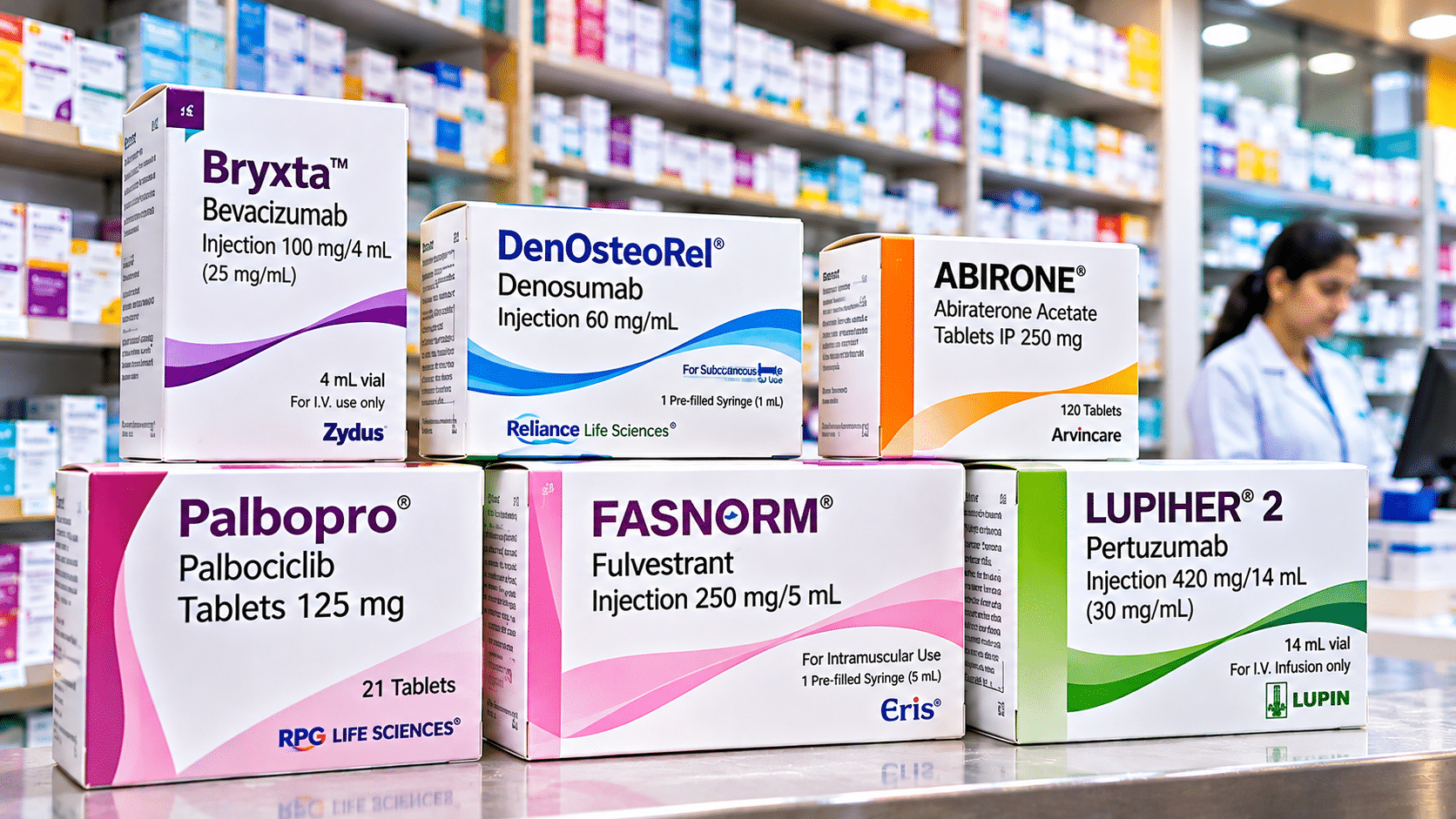
| Bryxta (Bevacizumab 100 MG)        | ₹25,995.00 reduced to ₹3,318.00 (Zydus Life)      |
| DenOsteoRel (Denosumab 60 MG)      | ₹24,955.00 reduced to ₹6,240.00 (Reliance Life)   |
| ABIRONE (Abiraterone 250 MG)       | ₹41,250.00 reduced to ₹3,218.23 (Arvincare)       |
| Palbopro (Palbociclib 125 MG)      | ₹40,421.33 reduced to ₹2,720.00 (RPG Life)        |
| FASNORM (Fulvestrant 250 MG)       | ₹30,421.87 reduced to ₹3,671.73 (Eris Lifesciences)|
| LUPIHER 2 (Pertuzumab 420 MG)      | ₹83,520.00 reduced to ₹37,358.35 (Lupin Limited)  |
+------------------------------------+---------------------------------------------------+
Statutory Compliance and Monitoring Framework
To prevent supply chain bottlenecks, drugmakers retain the right to adjust annual pricing under Paragraph 20(1) of the Drugs (Prices Control) Order, 2013, provided trade margins remain under the 30 per cent ceiling. However, hospitals, pharmacies, and institutional buyers are statutorily required to display updated rate cards prominently on their websites and physical premises.
State Drug Controllers stand empowered to enforce compliance across distribution channels and prosecute violators. Consumers can verify approved rates using the Pharma Sahi Daam mobile app or the official NPPA portal. They can report any instances of overcharging directly to health authorities.
Ultimately, capping trade margins marks a decisive step toward eliminating predatory markups in critical care. Ensuring strict ground-level enforcement will determine how effectively these price cuts translate into accessible healthcare for patients nationwide.
About The Author
