

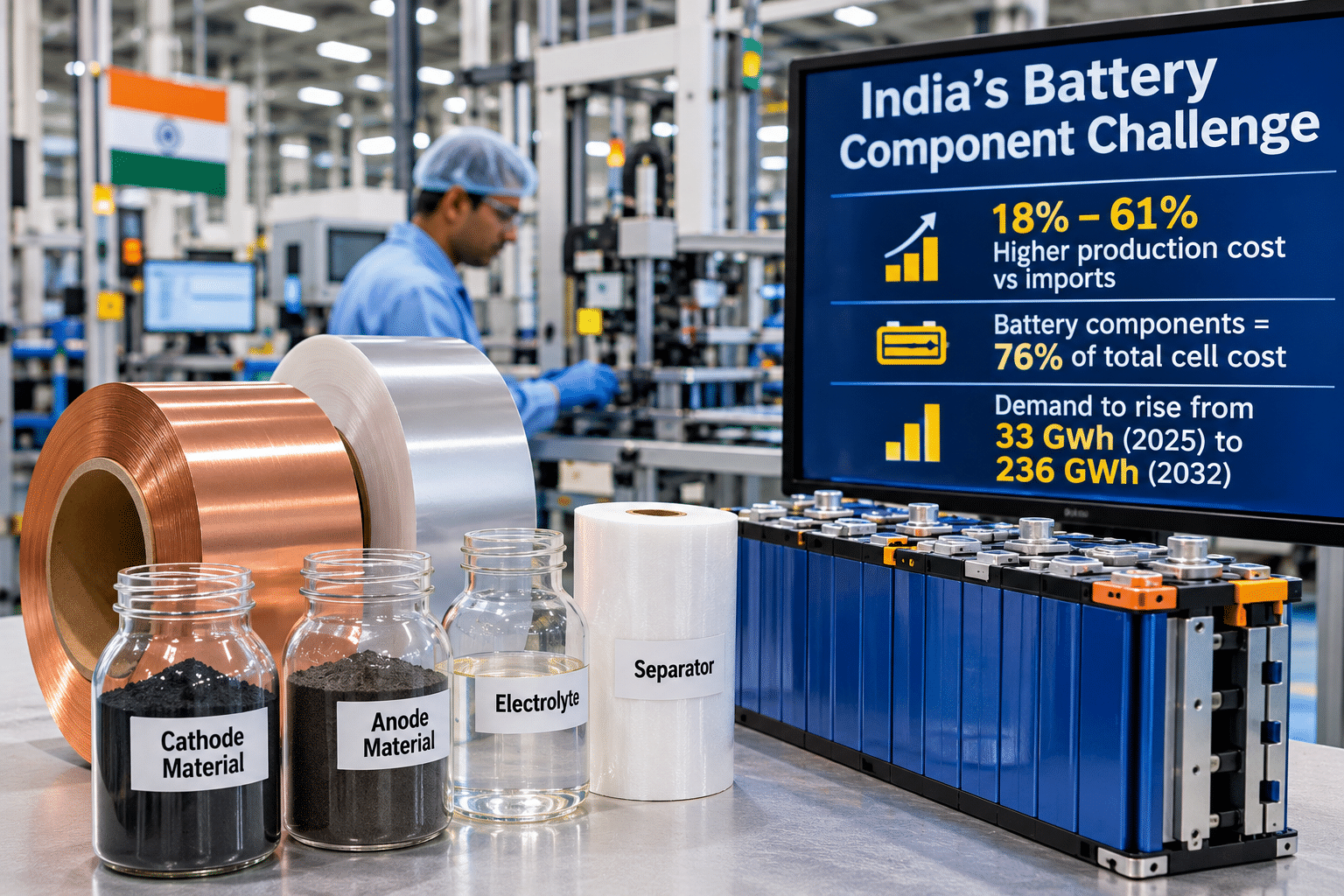
Indian battery component manufacturers face production costs between 18% and 61% higher than imported alternatives, putting domestic suppliers at a significant competitive disadvantage. A report released by the Ministry of Heavy Industries has called for targeted incentives to strengthen local manufacturing and reduce dependence on imports.
The study, titled Accelerating India’s ACC Component Manufacturing Ecosystem, was prepared by the Netzero Energy Transition Alliance (NETRA). It was developed in collaboration with ARCI, CSIR-NCL, IIT Madras and Deloitte. The report draws on cost and industry data from more than 20 Indian companies.
The findings come as the government considers a dedicated incentive scheme for advanced chemistry cell (ACC) battery components. The report identifies cost disadvantages, limited manufacturing capacity and dependence on overseas suppliers as major obstacles to building a competitive domestic industry.
China continues to dominate global battery supply chains. Indian manufacturers of cathode and anode materials, electrolytes, separators and battery-grade copper foil face substantial cost disadvantages against overseas suppliers.
Battery components account for approximately 76% of total cell manufacturing costs. Their domestic production is therefore important for India’s electric mobility and energy storage ambitions. Debi Prasad Dash, Co-Founder and Executive Director of NETRA, said the cost gap varies across components.
“The cost data in this report comes from Indian companies that are building or planning these plants, and it shows that the gap has a different cause in each component,” Dash said.
India’s battery demand is expected to rise sharply over the coming years. The report projects demand to increase more than sevenfold, from approximately 33 GWh in 2025 to 236 GWh by 2032. It could approach 600 GWh by 2037. Domestic manufacturing capacity, however, remains limited. Existing facilities can meet less than 3% of projected 2032 requirements for cathode materials, anode materials and electrolytes.
The report also identifies major gaps in other critical components. It found no known domestic production of battery separators or battery-grade copper foil. These shortages expose India’s battery supply chain to import dependence even as demand for cells and energy storage rises.
NETRA Founder and President Rahul Walawalkar warned that delays in policy intervention could affect the development of a competitive domestic component industry.
“New entrants face high scrap rates for five to six years, and cell makers take 18 to 24 months to qualify a supplier. Decisions taken by March 2027 will decide whether the cell plants coming online by March 2029 can buy qualified materials made in India. We offer this evidence with options, not a single demand,” Walawalkar said.
The study has proposed three incentive models for the government to consider. The options aim to address the cost gap while supporting investment in domestic battery component manufacturing.
The first model combines a 25% capital subsidy with sales-linked operating support. The operating incentive would cover approximately 30% of the cost gap. Depending on the component, this would translate into support equivalent to 5%-18% of component costs.
The second option proposes an operating incentive covering around 60% of the cost gap. This would amount to support equivalent to 11%-37% of component costs. The report suggests providing this assistance for five to seven years.
The third model recommends a higher capital subsidy of 50%. The subsidy would be disbursed alongside investors’ expenditure, broadly following the model used under the Semicon India programme.
The proposals offer different approaches to addressing the cost disadvantage faced by Indian manufacturers. The choice of incentive structure will influence investment decisions, production economics and the ability of domestic suppliers to compete with imports.
The report highlights the importance of timely policy decisions. Battery component manufacturing will require investment, technology development and time for suppliers to meet cell makers’ qualification requirements.
India’s battery demand is expected to expand across electric mobility and energy storage. Building a domestic component ecosystem could reduce import dependence and improve supply chain resilience. However, the scale of the opportunity will depend on whether domestic manufacturers can narrow the cost gap and establish reliable production capacity.
About The Author
