

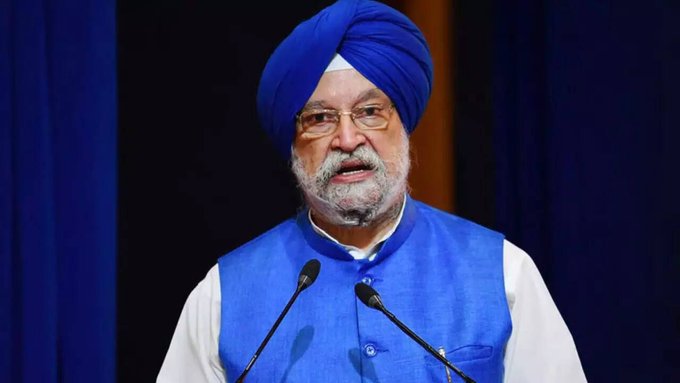
New Delhi: Retail petrol and diesel prices will likely drop if international crude oil markets remain stable. Union Petroleum and Natural Gas Minister Hardeep Singh Puri delivered this optimistic outlook at the Viksit Bharat Conclave 2026.
Furthermore, global oil and gas supplies continue to expand daily. Because of this expansion, the minister expressed confidence that consumers will enjoy highly favourable market conditions.
Managing the Global Energy Crisis
Recently, severe geopolitical conflicts triggered major disruptions across international energy markets. However, India successfully weathered these massive supply shocks.
 [Global Supply Disruption] ──> [Strategic Refineries Pivot] ──> [LPG Boost: 35k to 54k MT/Day]
                                                                        │
 [Strait of Hormuz Blockade] ──> [Naval & Diplomatic Convoys] ──> [Uninterrupted LPG Supply]
According to Mr Puri, the government combined swift policy interventions with robust diplomatic engagement. Consequently, the nation boosted domestic fuel production and safely diversified its import baskets. This resilience clearly demonstrates the immense value of long-term energy sector reforms.
Strategic Refineries Pivot Accelerates Domestic Gas
Specifically, the ministry prioritized protecting ordinary households from running out of cooking gas. Therefore, the government instructed national refineries to maximize liquid petroleum gas output. Refiners shifted their focus away from high-value petrochemicals to guarantee an uninterrupted LPG supply.
India’s Rapid Refining Surge Accomplished in 2026:
Baseline Production: 35,000 Metric Tonnes per day.
Enhanced Production Capacity: 54,000 Metric Tonnes per day.
Total Protected Consumer Base: Over 33 Crore active households.
Thanks to this rapid operational pivot, domestic capacity scaled up within a remarkably short period. As a direct result, more than 33 crore domestic consumers avoided cooking gas shortages entirely.
Maritime Diplomacy Clears the Strait of Hormuz
Simultaneously, escalating regional hostilities severely threatened crucial international shipping lanes. Hostile actions temporarily stranded several Indian energy cargoes near the vital Strait of Hormuz.
Nevertheless, effective diplomacy resolved the maritime crisis safely. The ministry maintained close contact with key regional partners, including Iran, Oman, Qatar, and the UAE. Eventually, this intense naval coordination enabled the secure passage of vital Indian fuel vessels.
Basket Diversification Eliminates Retail Fuel Shortages
In addition to traditional Gulf partnerships, India aggressively diversified its global sourcing networks. For example, energy companies quickly secured fresh cargo shipments from the United States, Algeria, and Argentina.
 Traditional Gulf Suppliers  ───┐
 United States Shipments     ───┼───> [Securing India's Diversified Energy Basket]
 Algeria & Argentina Cargoes ───┘
Meanwhile, logistics teams reorganised transport routes and redirected freight carriers efficiently. Consequently, not a single retail fuel outlet ran dry during the height of the crisis. Timely state intervention successfully prevented public panic and stabilised domestic inventory levels.
Safeguarding Consumers from Global Inflation
Furthermore, Indian pump prices have remained among the lowest globally over the past four years. The central government achieved this stability by implementing three consecutive rounds of excise duty reductions.
Instead of passing high import costs onto citizens, the exchequer absorbed a massive fiscal burden. To secure future growth, India has now expanded its crude oil sourcing from 21 nations to nearly 40. Finally, amended petroleum laws and newly opened exploration zones are attracting historic investments into the upstream sector.
Indian Fuel Management Metrics
| Operational Parameter | Previous Operational Baseline | Current Reformed Benchmarks (2026) | Strategic Shielding Impact |
| Daily Domestic LPG Yield | ~35,000 Metric Tonnes | 54,000 Metric Tonnes | Guaranteed an uninterrupted LPG supply. |
| Crude Sourcing Footprint | 21 Exporting Nations | Nearly 40 Sovereign Partners | Minimises vulnerability to regional shocks. |
| Retail Pump Availability | Vulnerable to panic buying | Zero dry outlets nationwide | Prevented public panic and supply panics. |
| Excise Duty Framework | Standard pricing metrics | Three consecutive tax cuts | Absorbed global inflation at the state level. |
| Upstream Exploration | Restricted territory blocks | Modernized laws; open bidding | Stimulates massive long-term local extraction. |
About the Author
