

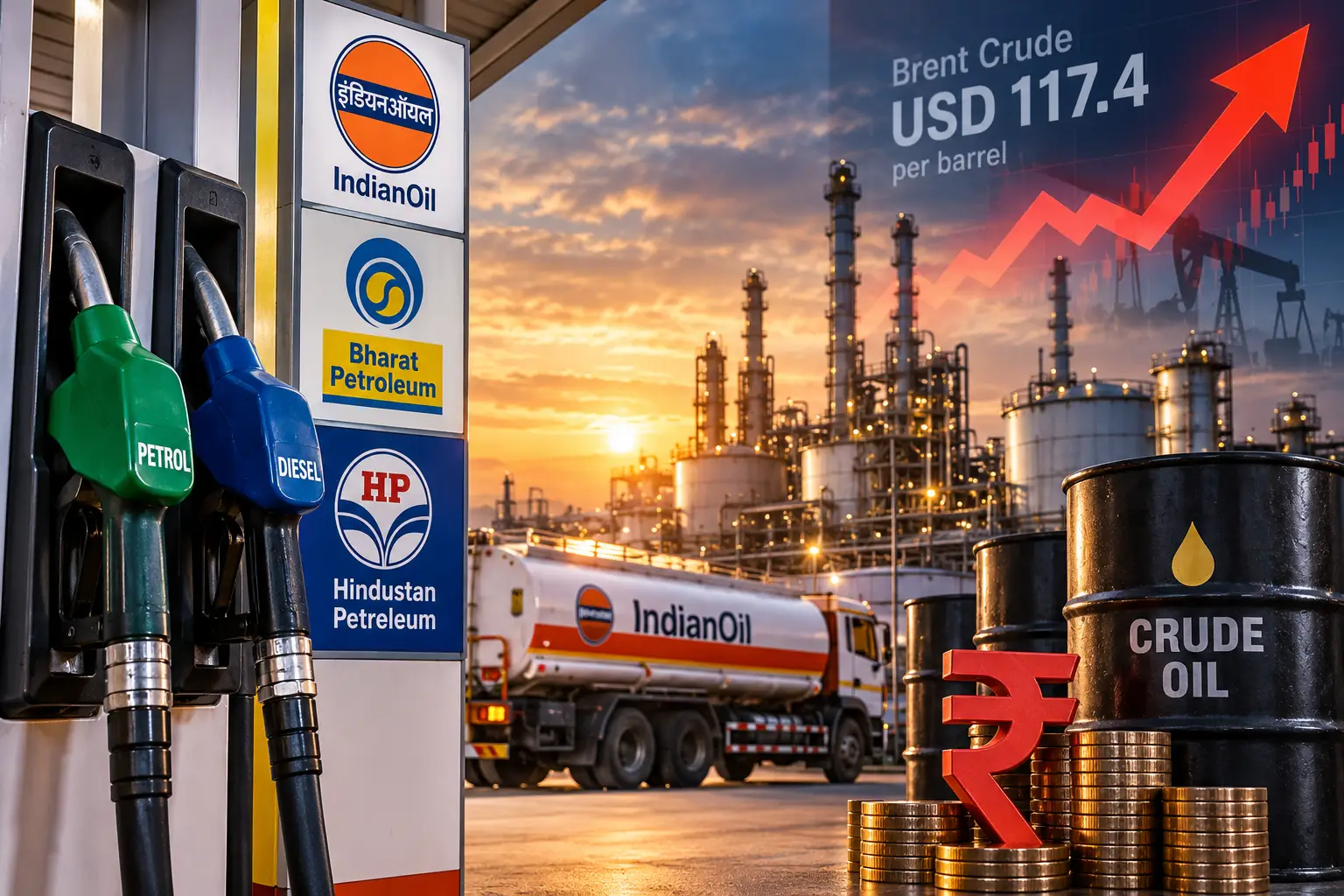
India’s state-run oil marketing companies are facing a sharp squeeze as international crude prices climb while domestic fuel rates remain unchanged.
Rating agency ICRA estimates that Indian Oil Corporation, Bharat Petroleum Corporation and Hindustan Petroleum Corporation are together losing around Rs 530 crore every day.
The companies are currently estimated to face a marketing loss of about Rs 8 per litre on petrol. The estimated loss on diesel is around Rs 9 per litre.
The pressure has intensified after a sharp increase in international crude prices. The Indian basket of crude oil reached USD 117.4 per barrel on September 21, 2026. The basket had averaged around USD 66 per barrel during 2025-26.
The sharp rise has widened the gap between the cost of crude and the prices at which oil companies sell petrol and diesel in the domestic market. With retail fuel prices unchanged, the higher input cost is directly affecting the marketing margins of the state-run companies.
ICRA has linked the rise in crude prices to worsening geopolitical tensions and disruptions along major oil supply routes in West Asia. The rating agency cited the renewed US-Iran conflict, the shutdown of Saudi Arabia’s East-West pipeline and increased Houthi activity in the Red Sea as key factors behind the price surge.
“The escalation of the West Asian conflict and disruptions to key oil supply routes have led to a spike in crude prices,” said Prashant Vasisht, Senior Vice President and Co-Group Head, Corporate Sector Ratings, ICRA.
The impact on the oil companies has been partly offset by stronger refining margins. Singapore gross refining margins have stayed above USD 10 per barrel since the West Asia crisis began, according to ICRA.
Refinery outages, supply disruptions and inventory drawdowns have supported these margins. However, strong refining margins may not fully offset the pressure created by higher crude and petroleum product prices.
The companies could also need additional short-term funding to meet higher working capital requirements. Expensive crude increases the amount of money required to maintain inventories and manage day-to-day operations.
LPG is adding to the pressure on the oil marketers. ICRA estimates that the under-recovery on a domestic LPG cylinder stood at around Rs 300 in September. The figure had been higher at around Rs 500 per cylinder during the first quarter of 2026-27.
The moderation in LPG under-recovery by September has provided some relief. However, the cumulative negative LPG buffer remained significant at Rs 61,940 crore as of June 30.
Higher international LPG prices and supply disruptions in West Asia contributed to the buildup. The situation has therefore created another financial burden for the state-run oil companies alongside the pressure on petrol and diesel marketing margins.
The companies may face higher borrowing requirements if crude prices remain elevated for an extended period. Their financial performance will also depend on product cracks, domestic retail fuel prices and any government support for LPG under-recoveries.
The government could face a greater need to assess support measures if the LPG burden remains high. Any such support would influence the eventual impact of the higher input costs on the companies’ earnings.
Meanwhile, export levies on petroleum products have also remained elevated. The Special Additional Excise Duty stood at Rs 20 per litre on diesel from September 16. The duty on aviation turbine fuel stood at Rs 15 per litre, according to ICRA.
The combination of higher crude prices and unchanged domestic fuel rates has therefore created pressure on both margins and cash flows. The situation could become more challenging if international oil prices remain at elevated levels.
“The elevated crude prices and unchanged domestic fuel prices would put pressure on profitability and cash flows of OMCs,” Vasisht said. He also pointed to the possibility of higher short-term borrowing requirements.
The outlook for the companies will depend heavily on the direction of crude prices over the coming months. A sustained decline in global crude prices could reduce the pressure on fuel marketing margins.
A revision in domestic petrol and diesel prices could also improve the situation for the oil marketers. Government support for LPG under-recoveries could provide another source of relief.
For now, the scale of OMC losses highlights the financial pressure created when international crude costs rise faster than domestic fuel prices. The estimated daily burden also shows how quickly geopolitical developments can affect the finances of state-run oil companies.
The immediate challenge for the companies is to manage higher crude costs while maintaining adequate liquidity and meeting domestic fuel demand. The eventual impact of the current OMC losses on their 2026-27 earnings will depend on crude prices, refining margins, retail fuel prices and government support.
About the Author
