

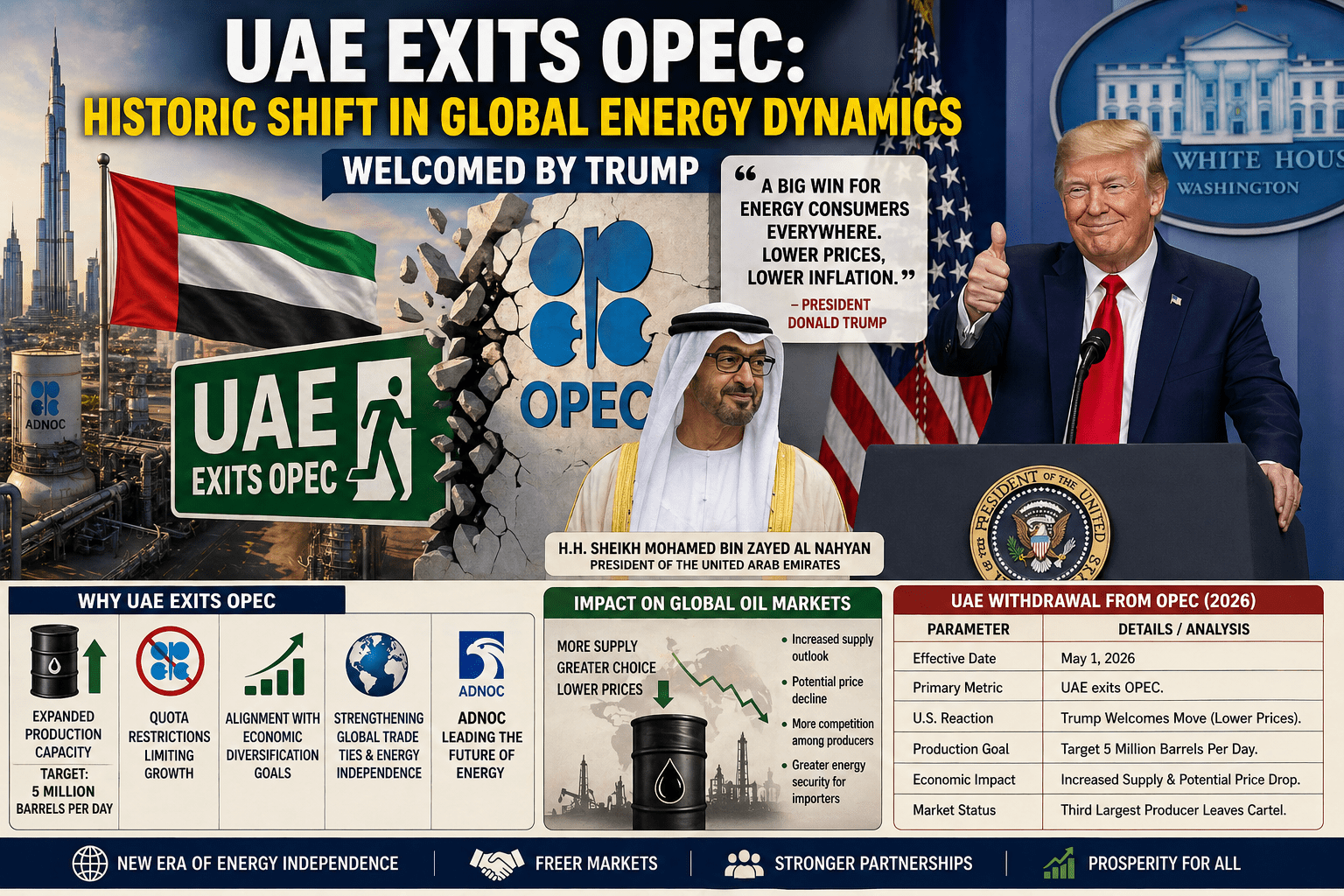
WASHINGTON, DC. The global energy market witnessed a paradigm shift today as the United Arab Emirates (UAE) formally announced its withdrawal from the Organisation of the Petroleum Exporting Countries (OPEC). This decision, effective from May 1, 2026, marks the departure of the cartel’s third-largest producer. U.S. President Donald Trump officially welcomed the development during a press briefing at the White House. He characterized the UAE exits OPEC event as a significant victory for global energy consumers. Trump stated that the move would help reduce fuel prices and drive down overall inflation. The President praised UAE President Sheikh Mohamed bin Zayed Al Nahyan for his strategic leadership in this matter. Analysts believe this exit underscores a growing divide within the OPEC+ alliance regarding production quotas.
Strategic Drivers and Production Capacity
The decision follows years of internal friction between Abu Dhabi and the leadership of the oil cartel. The UAE exits OPEC primarily because it seeks to fully utilise its expanded production capacity. The Abu Dhabi National Oil Company (ADNOC) has invested billions to reach a capacity of 5 million barrels per day. OPEC’s restrictive output limits prevented the UAE from achieving its sovereign revenue targets. By operating independently, the UAE can now align its oil output with its long-term economic diversification goals. This freedom allows the nation to strengthen its direct trade ties with major Asian importers. Experts suggest that the “quota trap” had become a significant hurdle for the UAE’s fiscal planning.
Trump’s Vision for Energy Abundance
President Trump linked the withdrawal to his broader agenda of achieving domestic and global energy abundance. He noted that the UAE exits OPEC at a time when the cartel faces mounting internal structural problems. Trump argued that artificial supply constraints have historically harmed the American economy and global trade. The White House anticipates that increased supply from the UAE will provide a necessary buffer against market volatility. This endorsement signals a strengthening of the bilateral relationship between Washington and Abu Dhabi. The President reiterated his commitment to supporting nations that prioritise free-market principles in the energy sector. Such diplomatic backing ensures that the UAE faces minimal political resistance for its departure from the group.
Impact on Global Oil Markets
The departure of a core member significantly dilutes the monopoly held by the remaining OPEC nations. Following the UAE exits OPEC announcement, Goldman Sachs analysts identified a meaningful upside risk to global supply forecasts. The UAE joins a growing list of nations, including Qatar and Angola, that have left the cartel recently. While the exit may lower prices in the medium term, it introduces fresh competition for market share. Intensified rivalry among major producers could lead to a period of sustained price fluctuations. However, for major oil-importing nations, the prospect of non-cartel supply offers greater energy security. The transition reflects a broader global trend toward decentralised energy management and national interest.
UAE Withdrawal from OPEC
| Parameter | Details / Analysis |
| Effective Date | May 1, 2026. |
| Primary Metric | UAE exits OPEC. |
| U.S. Reaction | Trump Welcomes Move (Lower Prices). |
| Production Goal | Target 5 Million Barrels Per Day. |
| Economic Impact | Increased Supply & Potential Price Drop. |
| Market Status | Third Largest Producer Leaves Cartel. |
About the Author
