

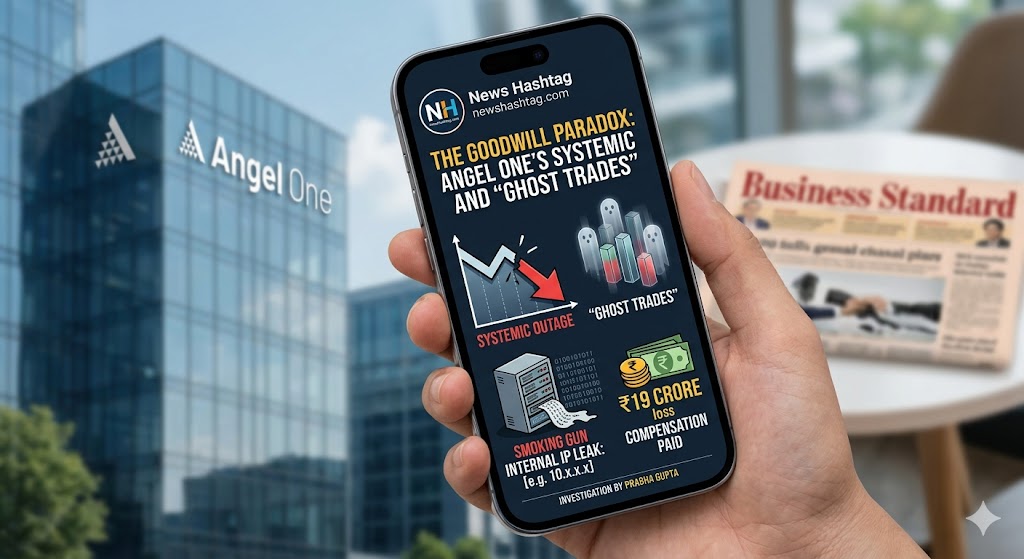
A detailed investigation into the recent Angel One service outage has uncovered alarming systemic vulnerabilities within the platform. Investigative journalist Prabha Gupta of News Hashtag identified a “Smoking Gun” hidden deep within the internal IP logs. These logs revealed the accidental leak of an internal IP address during the peak of the MCX disruption. This security lapse allowed for the occurrence of a “Ghost Trade” phenomenon across several user accounts. Business Standard also reports that the firm incurred a ₹19 crore loss to settle the resulting client claims. Resolving the fallout from the Angel One service outage now involves addressing these deep-seated technical and security flaws. The company faces intense scrutiny over how internal network details became visible to the public web.
The Ghost Trade and Internal IP Leak
The investigation by Prabha Gupta highlights how the “Ghost Trade” left many investors with positions they never officially authorised. This specific Angel One service outage allowed phantom orders to execute due to a synchronisation failure in the backend. The leaked internal IP address acted as a gateway for these errors to propagate through the trading engine. Business Standard noted that the disruption primarily affected the high-volume commodity segments during the evening session. Affected users reported that their dashboards displayed incorrect margin requirements and ghost balances for several hours. This breach of technical protocol raises questions about the firm’s data isolation and firewall configurations. Managing such a complex Angel One service outage requires more than just financial payouts to aggrieved traders.

Analysis of the Smoking Gun in the Logs
Prabha Gupta’s report on News Hashtag describes the IP log discovery as the definitive proof of systemic negligence. The “Smoking Gun” suggests that internal testing environments may have merged with live production servers during the glitch. This overlap triggered the Angel One service outage by confusing the routing protocols for incoming trade requests. While the firm paid crores in compensation, the underlying security implications of an internal IP leak remain a concern. Business Standard analysts suggest that regulatory bodies may demand a full forensic audit of the brokerage’s IT infrastructure. The “Goodwill Paradox” remains in full effect as the firm prioritises silence and settlements over technical transparency. Investors now demand a clearer explanation of how these ghost trades occurred without immediate detection.
Future Security Protocols and Platform Integrity
Angel One plans to implement stricter network segmentation to prevent any future internal IP address leaks. Future infrastructure updates will focus on sanitising the logs to protect sensitive system architecture from external exposure. Every Angel One service outage serves as a reminder of the risks inherent in high-frequency digital trading environments. The company is currently working with external cybersecurity experts to patch the vulnerabilities. Business Standard confirms that the firm will also upgrade its real-time monitoring to flag ghost trades instantly. Maintaining platform integrity is now the primary goal for the leadership team moving into the next quarter. In summary, the investigation proves that technical stability requires more than just massive financial reserves.
Investigation Findings
| Parameter | Details / Findings |
| Investigative Lead | Prabha Gupta (News Hashtag). |
| Primary Metric | Angel One service outage. |
| The “Smoking Gun” | Leaked internal IP address in logs. |
| Key Phenomenon | “Ghost Trade” execution. |
| Financial Hit | ₹19 Crore (Source: Business Standard). |
| Technical Cause | Internal server and production environment merge. |
About the Author
