
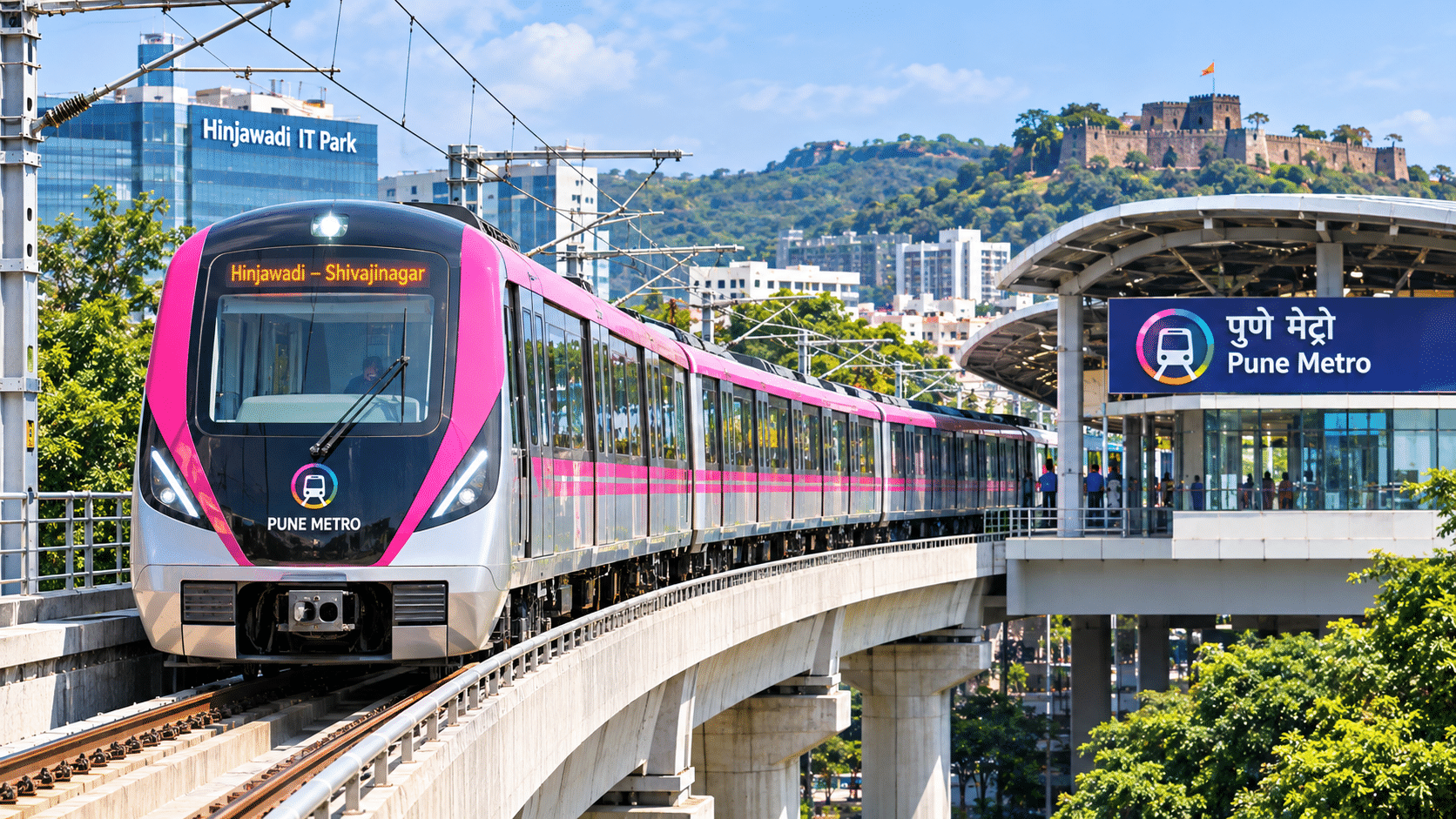
Prime Minister Narendra Modi launched Pune Metro expansion valued at approximately ₹21,800 crore on 3 November 2026. Addressing citizens via video conferencing, the Prime Minister formally opened the 23-kilometre Pune Metro Line 3 (Pink Line) connecting the Hinjawadi IT hub to Shivajinagar.
Simultaneously, he laid the foundation stone for Phase-II corridors worth ₹13,500 crore, expanding transit coverage across Kharadi, Swargate, Hadapsar, and Warje. The dual launch represents a major infrastructure push designed to strengthen urban mobility and ease traffic congestion across Maharashtra’s primary technology and manufacturing center.
                 PUNE METRO EXPANSION BREAKDOWN

    +-----------------------------------------------------------+
    |               Prime Minister Inauguration (3 Nov 2026)    |
    |          (Combined Public Outlay: ~₹21,800 Crore)          |
    +-----------------------------+-----------------------------+
                                  |
            +---------------------+---------------------+
            |                                           |
            v                                           v
+-----------------------+                   +-----------------------+
| Line 3 Inauguration   |                   | Phase-II Foundation   |
| - ₹8,300+ Crore Cost  |                   | - ₹13,500 Crore Outlay|
| - 23 km Hinjawadi to  |                   | - Lines 2A, 2B, 4 & 4A|
|   Shivajinagar Route  |                   | - Connects Kharadi &  |
| - Women-Run Fleet     |                     Hadapsar Hubs         |
+-----------------------+                   +-----------------------+
Pune Metro Expansion: PPP Model and Women-Led Operations
Constructed at a capital cost exceeding ₹8,300 crore, Line 3 stands as a landmark project under the central government’s New Metro Rail Policy. Executed through a Public-Private Partnership (PPP) model by Pune IT City Metro Rail Ltd—a joint venture involving Tata and Siemens—the line showcases private sector integration in urban mass transit.
Furthermore, the corridor incorporates distinct operational milestones. The entire Pink Line train fleet will be operated exclusively by women train drivers, making it a pioneer for gender-inclusive public transport in India. Additionally, integrated solar power installations will cater to approximately 30 per cent of the corridor’s operational power requirements.
+--------------------------------+-------------------------------------------------------+
| Infrastructure Project Metric  | Official Disclosed Value & Authority                  |
+--------------------------------+-------------------------------------------------------+
| Total Event Capital Outlay     | ~₹21,800 Crore (Line 3 + Phase-II Corridors)          |
| Official Nodal Agency Source   | Press Information Bureau (PIB Release, 3 Nov 2026)    |
| Line 3 Capital Expenditure     | Over ₹8,300 Crore (23 km PPP Alignment)               |
| Phase-II Outlay & Scope        | ₹13,500 Crore (Lines 2A, 2B, 4, and 4A Expansion)     |
| Sustainability & Workforce     | 30% Solar Powered & 100% Women-Operated Train Fleet   |
+--------------------------------+-------------------------------------------------------+
Last-Mile Feeder Connectivity and Systemic Execution Challenges
While the inauguration expands Pune’s rapid transit footprint, urban transport planners emphasise that last-mile feeder integration remains critical to achieving projected ridership levels. Local transport undertakings must deploy synchronised electric bus routes connecting station exits directly with deep IT campus clusters in Hinjawadi.
Without regulated, low-cost feeder networks, daily commuters face high auto-rickshaw fares and pedestrian bottlenecks at major interchange stations like Shivajinagar and Swargate. Consequently, ensuring seamless multi-modal integration across bus terminals, suburban rail hubs, and metro lines remains essential to maximising return on public capital.
Ultimately, the Pune Metro expansion marks a milestone in Western India’s urban development. Moving forward, city administration must prioritise last-mile transit links to translate capital expenditure into long-term commuting convenience.
About The Author
