

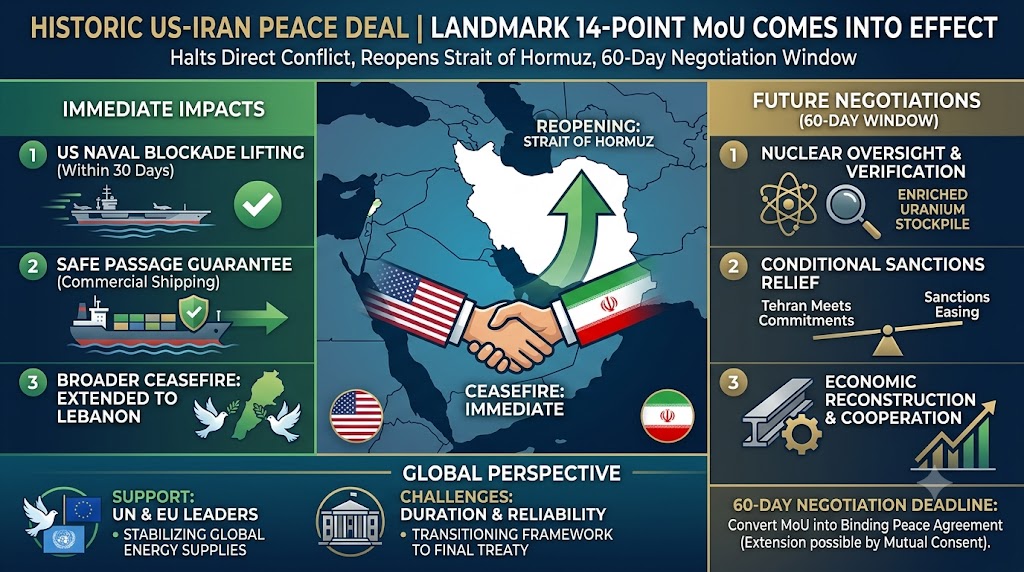
In a historic development for global geopolitics and energy markets, a landmark Memorandum of Understanding (MoU) between the United States and Iran has officially come into effect. The agreement brings an immediate halt to nearly four months of intense, direct conflict. It establishes a crucial 60-day diplomatic window to negotiate a permanent, comprehensive peace settlement.
The 14-point framework was signed electronically ahead of an upcoming high-level summit in Switzerland. It outlines an immediate ceasefire, a mutual commitment to end hostile actions, and a clear roadmap to address long-standing disputes regarding regional security and Iran’s nuclear program.
Key Provisions: De-escalation and the Strait of Hormuz
The immediate priority of the US-Iran peace deal is the stabilization of international trade routes and the cessation of hostilities across multiple fronts.
1. Reopening Global Energy Chokepoints
-
US Action: Washington will begin dismantling its naval blockade around Iran, working to fully restore normal commercial maritime traffic through the vital Strait of Hormuz within 30 days.
-
Iran Action: Tehran has pledged to guarantee and facilitate completely safe passage for international commercial shipping through the corridor.
2. Nuclear Oversight and Commitments
-
Iran has explicitly reaffirmed that it will not pursue or seek nuclear weapons.
-
Future negotiations will bring Iran’s existing enriched uranium stockpile under strict international supervision and verification protocols.
3. Regional Ceasefire Expansion
The scope of the MoU extends beyond the two primary nations to stabilize the broader West Asian landscape:
-
The ceasefire formally extends to Lebanon, committing regional factions to end military operations on multiple fronts.
-
The deal explicitly reaffirms absolute support for Lebanon’s sovereignty, raising hopes that cross-border hostilities involving Israel and Hezbollah will ease.
Sanctions Relief vs. Verification: The 60-Day Countdown
While global markets have reacted with optimism, official sources emphasise that this MoU serves as a structural framework for further talks rather than a final, absolute treaty.
The Sanctions Reality: Despite market speculation regarding an immediate end to economic restrictions, the memorandum clarifies that any sanctions relief will be strictly conditional. Easing embargoes depends entirely on Tehran meeting its immediate verification commitments and showing measurable progress in the upcoming rounds of talks.
Diplomats from both Washington and Tehran now face a demanding 60-day countdown to convert this temporary framework into a legally binding, durable political settlement. This deadline can only be extended via mutual consent from both governments.
Global Reaction: Optimism Tempered with Caution
The breakthrough has triggered a wave of relief from international partners, particularly European leaders, who welcomed the announcement as a golden opportunity to restore maritime security and stabilize roiled global energy supplies. European diplomats reiterated that permanent freedom of navigation through the Strait of Hormuz remains a non-negotiable global necessity.
However, geopolitical analysts warn that the most difficult phase of the US-Iran peace deal is just beginning. Transitioning an active ceasefire into lasting regional stability will require bridging decades-old trust deficits, establishing flawless nuclear verification mechanisms, and finalizing complex economic reconstruction frameworks.
About the Author
