

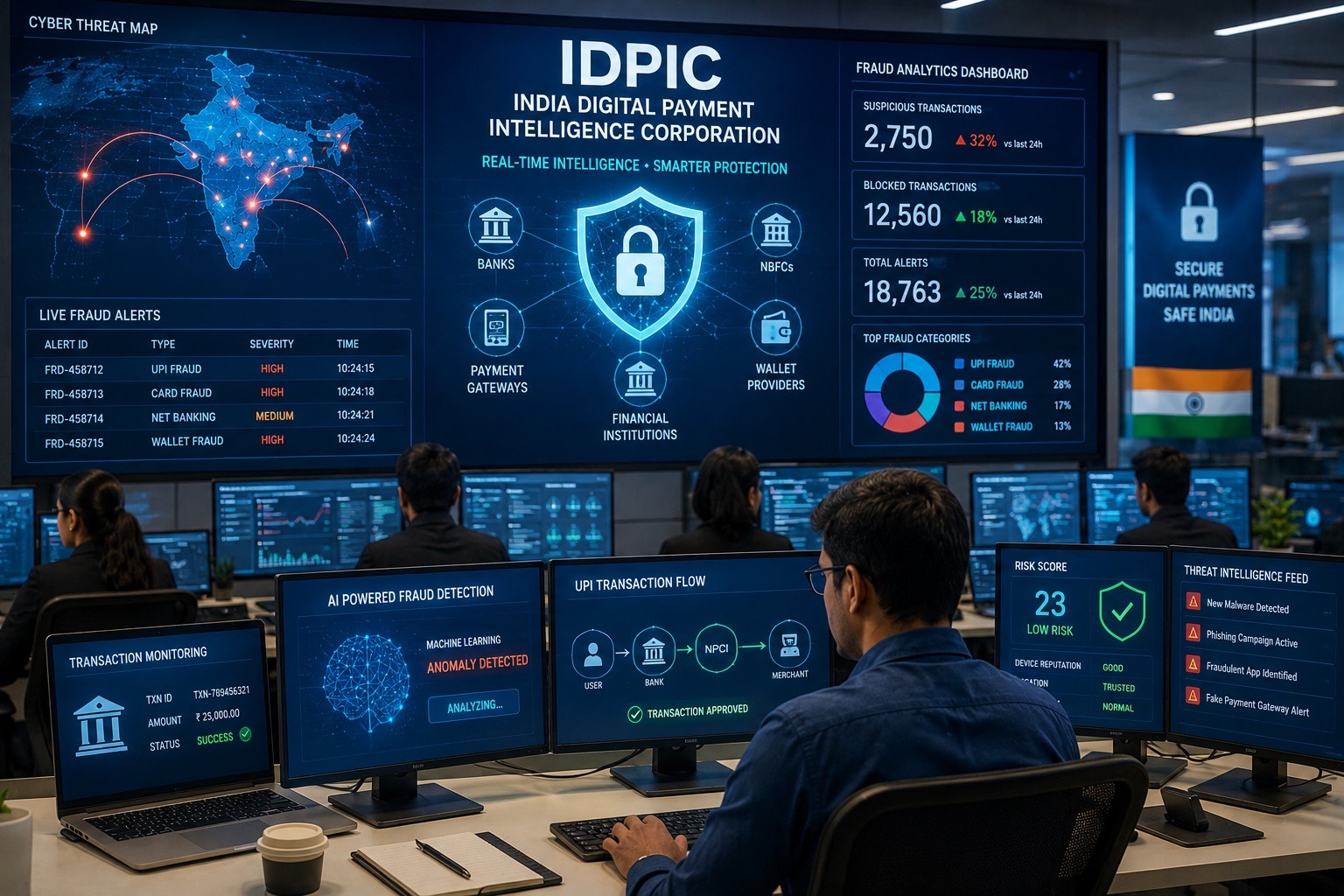
The Government of India has established the India Digital Payment Intelligence Corporation (IDPIC) to strengthen protection against cyber financial frauds. The initiative will improve Digital payment security by enabling banks and financial institutions to exchange real-time fraud intelligence.
Finance Minister Nirmala Sitharaman announced the initiative in the Rajya Sabha. She said the government created the new corporation in consultation with the Reserve Bank of India.The move comes as digital transactions continue to grow rapidly across the country.
Digital payment security gets technology boost
The Digital payment security platform will use Artificial Intelligence, Machine Learning and Big Data Analytics. These technologies will identify suspicious activities and generate real-time fraud alerts.Banks and financial institutions will receive timely intelligence to prevent fraudulent transactions.
The government expects the system to improve coordination among financial institutions.Officials believe faster information sharing will reduce financial losses caused by cyber criminals. The initiative also aims to strengthen public confidence in India’s expanding digital payments ecosystem.
Government strengthens cyber defence framework
The government has introduced several measures to address rising cyber threats.Finance Minister Sitharaman said authorities continue working with financial regulators to improve cybersecurity preparedness. The Indian Computer Emergency Response Team operates the National Cyber Coordination Centre.
The centre monitors cyberspace at the metadata level. It identifies potential cyber threats and shares information with regulators and concerned organisations. The system enables timely preventive and response actions.Officials said coordinated monitoring has become increasingly important as digital financial transactions continue to expand.
Financial sector receives dedicated cyber response support
The government has also established the Computer Security Incident Response Team for the Financial Sector. The specialised unit operates under the supervision of CERT-In. It collects and analyses information related to cyber incidents.
The team issues sector-specific advisories and security alerts. It also coordinates responses to cyber incidents affecting financial institutions. Officials said the unit continuously monitors efforts to strengthen cybersecurity architecture across the financial sector.
The Digital payment security framework will benefit from faster coordination between regulators and industry participants.
Regulators increase coordination against cyber risks
The Financial Stability and Development Council has also created an Inter-Regulatory Technical Group. The group addresses cybersecurity issues requiring coordinated action by multiple regulators.
It works to improve policy coordination across the financial sector. The Indian Banking Association has also formed a dedicated Working Group. The group includes banks, financial regulators and government agencies.
Members study emerging technologies and assess associated cyber risks. They also recommend measures to improve resilience against evolving digital threats.
Digital ecosystem enters a stronger phase
India has witnessed rapid growth in digital payments over the past few years.This growth has also increased the need for stronger cybersecurity safeguards. The government believes technology-driven monitoring will improve fraud detection and strengthen financial stability.
The Digital payment security initiative represents another important step towards building a safer and more resilient digital financial ecosystem. Authorities expect IDPIC to support secure digital transactions while strengthening trust among consumers, banks and businesses.
About the Author
